Thursday, May 29, 2025

Protect Your Neurons from Nimbus!

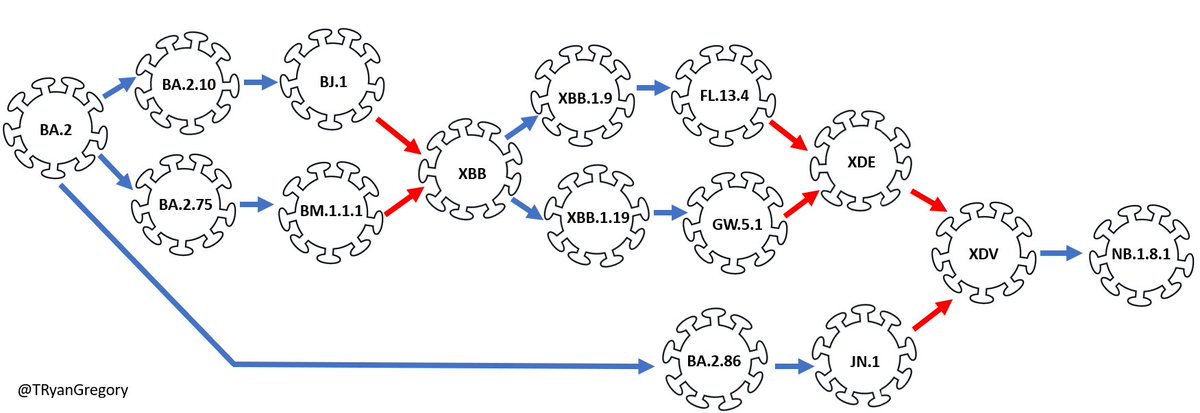
The latest Covid variant has the same name as a big looming rain cloud. The more we let Covid spread, the more it will continue to mutate, and this one is even more easily transmissible. 

It's provoking people to mask up in parts of Asia, and governments are encouraging updated vaccinations in parts of Europe, and it's definitely in the states, but they're not doing much to stop it. Will we?? My kids and I still can't get another Covid shot until it's been a year since our last, and we can't access Paxlovid if we need it. But thankfully there are no mask bans being proposed here.

In the states, the FBI is treating Covid as a crime to be investigated instead of a public health matter to be mitigated:

Wednesday, May 28, 2025

Still Blooming!

Another milestone to reflect on life a bit today: my 60th birthday. It sounds so old, but I biked 60k total on Monday and Tuesday (didn't have time for it in one go), and played pickleball today, and I'm regularly writing 3,000 word essays, so I appear to still be reasonably sound in body and mind.  

I was hoping my crabapple would bloom for my birthday, but everything bloomed early this year. A couple years ago I wrote about some people who randomly walk by, loudly insisting my crabapple is dead. It's still not dead yet! These are the very last of the lilac blooms from my garden. Such a weird year.

Tuesday, May 27, 2025

New Covid Strain Causing Razor Blade Throat

Several news venues have been reporting on Covid in the last few days. An ABC News headline says: "Why are more than 300 people in the US still dying from Covid every week?" 

The article explains,

"Public health experts told ABC News that although the U.S. is in a much better place than it was a few years ago, Covid is still a threat to high-risk groups. 'The fact that we're still seeing deaths just means it's still circulating, and people are still catching it.' ... The experts said there are a few reasons why people might still be dying from the virus, including low vaccination uptake, waning immunity, and not enough people accessing treatments."

That last sentence is infuriating because vaccines wane in effectiveness after a few months, and vaccinations here are restricted to yearly except for people over 65 and anyone moderately to severely immunocompromised, such as organ transplant recipients, anyone HIV+, and anyone taking immunosuppressants. Furthermore Paxlovid, our only treatment option here, is only available to people over 60 or at high risk of complications from Covid. Otherwise, you're on your own.

Sunday, May 25, 2025

On Approaching Death

 CW: As the title suggests, there will be discussion of death and dying and some mention of suicide in this post.

I thought nothing of following up my last post on Irvin Yalom on the meaning of life with Yalom on the meaning of death, until I started writing here. The very reality of being a bit wary of broaching the subject reveals the strength of societal taboos against admitting that we’re all going to die. Until it’s staring us in the face, we delude ourselves into thinking we will get better and better, mentally and physically, despite that our brain starts to shrink in our 30s, and our joints and organs will start to give out not so long after. We work hard to keep death clean and sanitized so the reality doesn’t seep in too much, and we try to do all the right things to keep death at bay: exercise, various special diets, wearing masks to avoid viruses. We can fix some evidence of erosion with meds and surgeries, sometimes miraculously, but some people even hope to keep their brain going long after their body dies.


Wednesday, May 14, 2025

Dancing with Viruses

There are several measles cases in Waterloo Region. As of last week there were currently over 60 cases in nearby Wellington/Guelph, and over 1,300 in Ontario since October.

Measles is like Covid in that there's an incubation period in which people have no symptoms but are contagious. Viruses are stealthy! For measles, it's 7-12 days from exposure to symptoms like fever or cough, so it's really important to track cases and isolate if potentially exposed. For Covid, it can be 5-7 days before it's picked up by a rapid test, and you can have it and spread it without any symptoms at all. Both cause serious complications, including brain infection, and leads to death in about 1 or 2 in 1,000 people. 

Both can be prevented with an N95.

The biggest difference between these viruses is that getting vaccinated is extremely good protection for measles, but not for Covid. If you got your measles shots, you're very likely completely protected. Unfortunately, vaccination rates are plummeting. We need to have at least 94% of the population vaccinated to create herd immunity and keep measles at bay, and Ontario has been hovering in the 70s since Covid started and anti-vaxx nonsense got a platform. Vaccination against Covid does a lot to keep people out of the hospital, but it doesn't prevent getting and spreading the disease because, like the flu, Covid mutates all the flippin' time. Measles is just measles, but Covid could be delta, or alpha, or one of many omicron variants, or whatever's going on now. It changes so much I stopped keeping track. The more it spreads, the more it mutates, and we're doing nothing to stop the spread. 

Sunday, April 27, 2025

Please Vote!!

Let's see if we can avoid our own Timbit Trump tomorrow!! If you're not sure of the best candidate to beat the cons in your riding, check out Smart Voting!  

Prime Minister Carney said of Poilievre yesterday, 

"It's easy to be negative when you've never fixed anything. It's easy to be negative when you've never built anything. It's easy to be negative when you're a career politician who has never accomplished anything." 

Taylor Noakes, agrees that Poilievre has accomplished nothing during his twenty years in Parliament:

"This isn't as much a political party as it is a ChatGPT-based slogan-generating algorithm speaking through the mouth of everyone's least favourite muppet. . . . The Conservatives have essentially made 'Fuck Trudeau' their ideology, and the average Conservative voter has made it their core identity. ... The Conservative Party have placed strict limits on who is allowed to ask him questions, and have further tried to prevent journalists from talking to party supporters and local candidates. ... According to a report by LaPress, Poilievre seems to have the loosest grasp on facts and the truth, as the publication found that he lied, embellished or misled far more than any of the other candidates during last week's debate. ... He has voted against the environment and climate 400 times ... against the Canadian Dental Care Plan, $10 a day daycare, the National School Food Program, the Canada Child Benefit, and raising the federal minimum wage ... against a proposed first-home savings account and a proposal to build four million new homes."

Friday, April 25, 2025

The Rise of Unreason

The Ontario Health Coalition put out a press release a couple weeks ago about the sharp increase in people infected with measles here. There were 816 cases from October 2024 to April, then 155 new cases from April 3-11. Our immunization rates are lower than most of Europe -- only 70% of kids have typical childhood vaccinations. Vaccination rates were reduced dramatically in 2020. "This is a Public Health failure that must be addressed with the utmost urgency." 


David Fisman recently wrote about it: 

Balancing Individual Rights and Community Health Requires Knowledge of History

Ontario is in the midst of a measles outbreak, and our Chief Medical Officer of Health (CMOH) is taking a “you do you” approach. No mandates. No strong guidance. Just a gentle suggestion that people make informed decisions…if they choose to. It’s a startling response given public health’s long history of collective action, and at times, authoritarianism. 

That authoritarianism wasn’t a bug of early public health. It was a feature. Modern public health emphasizes individual rights, but those rights can come into tension with the community’s right to health, especially during outbreaks of communicable diseases. Institutional public health grew out of fear. 

Monday, April 21, 2025

Yalom on Approaching Meaning

About 45 years ago, psychiatrist Irvin Yalom estimated that a good 30-50% of all cases of depression might actually be a crisis of meaninglessness, an existential sickness, and these cases require a different method of treatment. We experience this lack of purpose as boredom, apathy, or emptiness. We are "not told by instinct what one must do, or any longer by tradition what one should do. Nor does one know what one wants to do," so we feel lost and directionless. Instead of addressing meaninglessness as the problem, though, we've been merely addressing the symptoms of it: addictions, compulsions, obsessions, malaise. In today's context, it might suggest that even social media issues could be problems with a lack of meaning. 

The last sentences of his lengthy tome, Existential Psychotherapy, sum up his solution: "The question of meaning in life is, as the Buddha taught, not edifying. One must immerse oneself in the river of life and let the question drift away." How he lands here is an intriguing path through a slew of philosophers and psychiatrists. Even without symptoms of a problem, attention to meaning is necessary as it gives birth to values, which become principles to live by as we place behaviours into our own hierarchy of acceptability. 

"One creates oneself by a series of ongoing decisions. But one cannot make each and every decision de novo throughout one's life; certain superordinate decisions must be made that provide an organizing principle for subsequent decisions." 

Yalom doesn't, however, suggest coming up with a list of values that can become meaningful to us, but that we immerse ourselves in life to become more aware of which values we already have


WHAT'S THE POINT? IT'S FOR US TO DECIDE


According to Yalom, we've hit this crisis point in meaninglessness because we have the leisure to think and because our work is no longer clearly purposeful, both of which are relatively recent experiences for such a large proportion of civilization. It's no longer just the philosophers of the day asking, What's it all for? What's the point of it all? He takes the existential position that it's up to us to figure it out. 


Monday, April 7, 2025

Orange Monday or MAGA Monday?

Time will tell which name will go down in history books. But April 7, 2025 will be up there with Black Monday (October 19, 1987) and Black Thursday (October 18, 1929).

Trump wants everyone to just calm down, already, in his own ever-weirdly worded way. But he said this just before millions of Americans died of Covid, too. 

Thursday, April 3, 2025

So, Tariffs, Amiright?

Round of tariffs for all, except Russia.

I have a friend in the states who isn't worried about any of this stuff. "Big businesses will stop it," she says. She expects 3-6 months of wavering, max, then corporations will push back enough that things will settle down. It's all just posturing. She has a lot of faith in the markets and in this administration's willingness to be pushed. But okay. Maybe.

I suggested the tariff threats have already changed everything, and she was surprised to hear about American products being taken off the shelves or indicated in some way to help us avoid purchasing them, and that travel between our countries is down 70%. We don't want American stuff anymore, and we'll avoid it as much as we can. 

One analogy that rings true: 

"Imagine one of your friends points a loaded handgun at your face, and then immediately goes, 'nah man, just joking lol'. No matter how short a time that was, you're still not gonna ever trust that motherfucker again. It will have permanently altered your relationship. Anyway, tariffs on penguins."

Monday, March 31, 2025

Public Health Needs to be Independent

 David Fisman posted a thread yesterday about problems when big money gets involved in public health.

"During Covid, I experienced firsthand how political pressure twisted science—and nearly destroyed reputations. A short thread on conflict-of-interest theatre, redacted emails, and lessons we still haven’t learned. 

In January 2021, I was publicly accused by Ontario’s Premier of having a conflict of interest due to paid consulting work I did for the Elementary Teachers’ Federation of Ontario (ETFO). The suggestion was that I’d influenced school closure advice. What wasn’t shared? Internal emails—later released via FOI—show this was a manufactured controversy. The allegations didn’t reflect what officials knew privately. And that story deserves to be told. 

On Jan 26, 2021, Heather Watt (Chief of Staff to Health Minister Christine Elliott) drafted messaging about the “conflict.” She sent it to Steini Brown—my dean at the University of Toronto, and chair of the Science Advisory Table—for input. Steini replied carefully. He pushed back, noting: “There’s no direct line between David working for ETFO, us giving you advice to close schools, and you following it.” His reply was initially redacted in FOI responses. Journalist Jack Hauen appealed the redaction—and won. He sent me the full, unredacted email when requesting comment. It showed that the internal view did not support the public claims being made about me. Steini also wrote: “He is merely one of dozens of scientists working on a volunteer basis and does not speak for the group in his work for ETFO.” That’s a very different story than what was spun publicly. 

Sunday, March 30, 2025

Disappearance of the Rule of Law

Charlie Angus talked about Canada-US relations on Meidas Touch: "We're thinking, if we go down the road with this regime, we're talking about the disappearance of the rule of law, and that's deeply offensive to us." 

Rule of law goes at least as far back as the Magna Carta over 800 years ago. It means that everyone is under the law, including the king. Even a president! Even in the US they overtly seek "the government of laws and not of men," and make that clear in the 5th and 14th amendments. John Adams feared the "vulgar rich": To ennoble the new regime, the most talented must be made to serve their country, rather than their selfish desires. Adams thought offering fancy titles would satiate their quest for power, taking a page from Rousseau: "the role of illustrious offices and signs of rank in countering the popular passion for material wealth." But that's not enough for this crew. They have no respect for rule of law. 

Human rights will always be pushed by those who hope to exploit a situation or group of people, and we need to be there to push back. Over and over and over again. I used this 5 minute explanation of the history of human rights in my grade 10 civics classes:


The important bit is at the end, that we have to KEEP fighting for our rights. There will always be people trying to amass power and override the law, and we have to be ready for that, en masse, to stop it. 

Friday, March 28, 2025

Monbiot on Capitalism vs Commerce

 George Monbiot wrote today, 

"One of capitalism's greatest successes is to shut down our imaginations. With the help of its favoured tools - neoliberalism and fascism - it persuades us that 'there is no alternative'. Our first task is to re-ignite our moral imaginations and name our alternatives. I cannot count the number of times I've been told, 'if you're against capitalism, you must be a communist,' or 'you must be a feudalist'. In fact, as in my case, you can be fiercely oopposed to capitalism, to communism, and to feudalism. It helps if you undertstand what capitalism is. This means recognizing that it's true nature is endlessly disguised. It's a distinct economic system which arose around 600 years ago. In The Invisible Doctrine, we give this definition:

Capitalism is not the same as commerce. The Dutch VOC and the British East India Company were not trading with the people whose land, labour and resources they seized. Nor were the slavers in the Caribbean and the Americas. Nor is investor-state dispute settlement (ISDS) commerce: nations are forced to surrender resources to corporations or pay compensations. Nor is conversion of rainforests to cattle ranches or  extraction of deep-sea minerals. No one's freely trading or being properly remunerated in such cases. Yes, colonial looters might then trade the wealth they steal: capitalism can intersect with commerce, and can overrun commerce, but it is not the same. 

Thursday, March 27, 2025

Bearing Witness

 Brandon Friedman wrote an important thread about what we do now. Here it is in full:

"This is a German woman being marched past the bodies of Holocaust victims. After World War II, it was common refrain among German civilians: They just didn't know. For that reason, many were forced by Allied troops to bear witness. Like this. 

I bring this up because fascism is now here, in America. 

If you're thinking, "but it doesn't feel like fascism, nothing in my life seems amiss," then congratulations, you have discovered what fascism is like. 

Wednesday, March 26, 2025

Avoiding the Sausage Machine

click to read
I attended an excellent masterclass on "Trans-Inclusive Philosophy" with Sophie Grace Chappell last week, put on by The Philosopher magazine. She wrote Epiphanies and Transfigured, and this paper will be coming out in a collection soon. She discussed system-building in a way that lit some lightbulbs for me. I was waiting for the video to be posted before writing about it, but, in lieu of that, here's my transcription of it. 

She starts by responding to a call to build a theory of what gender, transgender, and gender identity are, and she clarifies the problems with gate-keeping off the bat. People will demand that before anyone's allowed to claim they're trans, they first have to define male and female, and she likens this to saying before you can sit on a chair and drink some tea, you first need to establish the necessary and sufficient conditions for chair and for tea, which is just ridiculous and very dangerous.

More interesting to me is her second argument, that defining what counts as transgender butts up against bigger problems with any system building. She prioritizing experience over theory because any attempt at an overarching trans theory will inevitably leave someone out. She has her own idea of what fits her, but it won't fit everyone, and other people might have great definitions for themselves, but they don't entirely fit her, either. 

Monday, March 24, 2025

Things May Appear Bleak, And Yet...

Byung-Chul Han's The Spirit of Hope is a beautiful book, the kind you want to treat with care and won't dare dog-ear a page. Anselm Kiefer's illustrations throughout provide a place for contemplative moments between ideas. It's more immediately accessible than The Burnout Society, which took me weeks to wrap my head around, yet no less profound. 

A REVOLUTIONARY POLITICS OF HOPE

We like a secure illusion of control over the world, yet that hasn't gotten us much further along. We recognize something's missing. Han writes, "Amid problem-solving and crisis management, life withers. It becomes survival. … It is hope that opens up a meaningful horizon" (2). 

Han explains how a lack of hope furthers the current neoliberal capitalist trajectory: 

"Fear and resentment drive people into the arms of the right-wing populists. They breed hate. Solidarity, friendliness and empathy are eroded. … Democracy flourishes only in an atmosphere of reconciliation and dialogue. … Hope provides meaning and orientation. Fear, by contrast, stops us in our tracks. … Hope is eloquent. It narrates. Fear, by contrast, is incapable of speech, incapable of narration" (2-3). 

Monday, March 17, 2025

The Flies Have Conquered the Flypaper

Steinbeck's The Moon is Down was first published in 1942, before he was sent off to fight. As a journalist, he enlisted in order to be in the thick of thing to write with authenticity. This may be a book for our times, unfortunately. It's about a town invaded by enemy forces.


It's a short read, but also captured fairly well in the movie, made just the following year, with Henry Travers (Clarence in It's a Wonderful Life). Of course it's a hopeful read as the town fights back, but it's also terrifying for what they endure. 


And then I watched Shame, which might be a more realistic depiction of what it is to live with the beginnings of invasion as sides get confusing and people betray one another.  

Possibly I'm looking for instruction of how to be when another country threatens invasion, what it looks like to be courageous in the face of real danger, but I may well be just torturing myself! I'm also reading Byung-Chul Han's The Spirit of Hope as a healthy antidote to the gloom.

Thursday, March 13, 2025

Still Not at the Finish Line

Jon Douglas, who wrote In It for the Long Haul, shared a series of papers that were discussed at the Conference on Retroviruses and Opportunistic Infections (CROI) that just wrapped up this week. A few caught my eye, but Douglas summarized tons at that link:

French researchers analyzed blood samples from 100 Long Covid patients, 60 recovered Covid cases, and 60 uninfected controls to identify immune and metabolic biolmarkers that diagnosed Long Covid with 99% accuracy. 

Researchers in the Netherlands treated 16 severely immunocompromised patients with persistent Covid-19 using off-label nirmatrelvir/ritonavir, and 75% had viral clearance within 28 days. 

Barcelona researchers studied 130 children and young people three months after Covid-19 and found that those with Long Covid had more autoantibodies and inflammatory markers, suggesting immune system involvement. 

Researchers in another study used brain MRI to compare 23 people with cognitive Long Covid to 19 without symptoms, and they found less gray matter in regions tied to memory, speech, and executive function, plus white matter changes in key memory pathways.

Beyond the conference, Pfizer is testing a new Covid-19 antiviral, Ibuzatrelvir, and is currently in Phase 3 trials. It doesn't taste as bad as Paxlovid, has fewer drug interactions, and is designed to be more stable, so easier to prescribe. Hopefully that means more than just those over 65 can access it in Ontario.
Wednesday, March 12, 2025

Never Again?

All this tariff talk is provoking a recession, which seems to be a feature, not a bug. As the economy falls, companies go bankrupt and are cheap to take over by the wealthy. The very rich will be able to take advantage of desperate times to buy businesses and property, and then are even further ahead when (or if) the economy rebounds. More power. More control. More stuff. The suffering of the citizens is not a concern. At all. 

This entire scheme was kick-started back in 1971 by the Powell Memorandum. Chomsky and Chris Hedges have been talking about this forever. And, of course, Ralph Nader. It's the precursor to disaster capitalism. Supreme Court Justice Lewis Powell wrote a memo attacking "extremists" like Nader who was doing things like trying to get cars to add seatbelts to improve traffic safety. The Memorandum is a push to allow unfettered capitalism without any regulations because, as far as Powell was concerned, businessmen really own the country. They pushed for more business involvement in colleges and universities way back then.  

A couple days ago, Senator Chris Murphy clearly outlined the corruption in the White House. It's all out in the open BECAUSE THEY CAN. Like in Russia, few in positions of power dare call them on it. 

"Trump and Elon Muck and their billionaire friends have engaged in a stunning rampage of open public corruption. It's not fundamentally different than what happened in Russia. These are efforts to steal from the American people to enrich themselves, and their strategy is to do it all out in the open. ...  

Thursday, March 6, 2025

Over Five Years of Covid

David Wallace-Wells has a piece in the New York Times about hitting the five-year mark with Covid (although it started in 2019, and the first case in the US was reported on January 21st). 

He seems to blame Covid for making America more divisive, but that didn't happen everywhere. Curious. He says Covid turned Americans into hyper-individualists: 

"Isolated, we saw one another first as threats and then as something less than real. Covid unfolded on screens for most Americans, and although the experience was in many ways collective, everyone's screens were different: Some showed overflowing morgues, others revealing a sham. Soon, we began to worry less about how our actions affected others and more about how their affected us--a sense of interdependence giving way to anomie, atomization and entitlement."