"When we remember that we are all mad, the mysteries disappear and life stands explained." Twain / "I write to keep from going mad from the contradictions I find among mankind - and to work some of these contradictions out for myself." Montaigne / "I write because I have found no other means of getting rid of my thoughts." Nietzsche / "Writing is an integral part of the process of understanding." Arendt / "Writing, to me, is simply thinking through my fingers." Asimov.
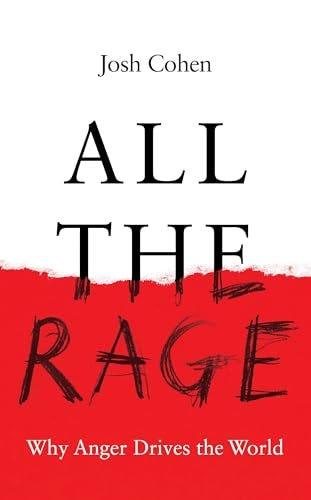
How can we possibly approach the world today without being in a constant stage of rage? Philosopher and psychoanalyst Josh Cohen’s All the Rage suggests how to make this feeling more useful to us.
He writes from a range of perspectives, everything from political uprisings to the patients in his office, and from how rage plays out in the world to how it manifests in our own minds, all with a thread of climate change activism throughout. Ideas are illustrated with examples from fictional characters, historical figures, and his own family. It hardly seems possible to do all that in just 195 pages, yet the book is a thought-provoking and entertaining read, comfortably shifting from micro to macro issues to explore four kinds of rage.
DEFINITIONS
In day-to-day conversations, we use “rage,” “anger,” and “aggression” almost interchangeably. We do the same for “emotion” and “feeling” and for “drive” and “instinct.” The book uses these terms more precisely, so a bit of a glossary might be useful. The order of events that occurs when we’re outraged becomes important. Cohen explains that aggression is often the way we respond directly to a stimulus, and anger is what happens after that first spark of action, when we choose to hold it back. He explains it succinctly in an interview with The Philosopher:
“Aggression is a kind of stimulus response. It’s what we do with a provocation, which might be an injury; it might be a humiliation, an insult of some kind, something that arouses us to retaliation. Aggression is the way that we get rid of that load of stimulus in action. … Anger is a way of holding on. Feelings are ways of holding on to stuff. When we can’t bear to feel something we instead discharge it in action. … Anger is something that you’re left with when action is unavailable to you or perhaps when you try to take the experience to a higher level, i.e. to maintain it in the consciousness as something to experience and process psychically rather than discharge in an action. That’s why psychoanalysis tends to think of anger as a human achievement.”
It’s not the case that we’re insulted, then feel anger, and then rationally decide to act or not act, even if it sometimes feels like that. Instead, the impetus to act is immediate following an enraging stimulus, and the restraint is what leads to the feeling of anger. I think that’s the idea. It’s counterintuitive to me, so it’s useful that it was repeated a few times in the book.
"As the world falls around us, how must we brave its cruelties?" -- Furiosa
Imprisoned climate activist, Roger Hallam, recently wrote about the necessity of expanding emotional well-being as we face bleak events happening around the world. While climate scientists try to "help people through the horrific information that they are being given," they also need a way to manage their emotional reactions. We can no longer afford to merely distract ourselves from the inner turmoil. Beyond climate, we could very well be entering into a period of much greater conflict at a time of even more viruses, some destructive to our food system. When the watering hole gets smaller, the animals look at one another differently.
To move forward with compassion, at a time when divide and conquer strategies have created polarization and infighting, seems to require an effort from each one of us.
Hallam writes,
"We might want to think about why saint-like people are enormously influential, even powerful. . . . They see the world as dependent upon the mind. . . . They are not enslaved by the world; their minds are intent, driven even, to change it. They do not see this as an end in itself."
I started reading about burnout when I walked away from teaching earlier than expected. Suddenly, I couldn't bring myself to open that door after over thirty years of bounding to work. A series of events wiped away any sense of agency, fairness, or shared values. Their wellness lunch-and-learns didn't help me, and I soon discovered I'm not alone.
An article published in JAMA last June looked at rising rates of burnout in healthcare, where 40% of physicians surveyed intended to leave their practice. They suggest, "To prevent a health care worker exodus, experts argue that the emphasis needs to shift from individual resilience to broader system-level improvements." They are looking for standardized methods to affect organizational management with "evidence-based interventions."
Over 25 years ago, Michael Leiter and Christina Maslach came to the same conclusion. They identified six areas of worklife affecting burnout and created a specific assessment for educators. They determined the cause to be a "mismatch" between employee expectations and employer behaviours leading workers to be closer to the bleak end of a continuum from burned out to engaged. They suggest that "the task for organizations and individuals is to achieve a resolution." This is not just a matter of throwing wellness initiatives or resilience-speak into the mix, but addressing any reasonable expectations of employees with appropriate employer interventions in all six interrelating areas.
I recently listened to a podcast of Dr. Louis Cozolino, a neuroscientist and psychoanalyst, discussing what he would teach if he were training psychotherapists. The first year would be phenomenology: the power of Carl Rogers' perspective to train how to develop an alliance through reflective listening while keeping countertransference out of the session. The second year would be physiology: developmental neuroscience and the evolutionary history of brains and bodies. The third year might be called intersectionality: the interpenetration of the spectrum of options that affect clients - brain, mind, family, culture - and a reaction against therapy as a mere opiate to calm the oppressed and exploited. The final year would be on narratives and stories that we live by and on that half second that it takes our brain to construct our experience of the present and feed it back to us.
Cozolino insists that it's not enough to just sit and listen to people vent. After developing a non-judgmental alliance with the client, therapists need to be "amygdala whisperers," to be able to down modulate amygdala activation to stop any inhibitory effect on the parietal system that enables problem solving. In other words, they need to soothe anxieties while arousing enough interest for clients to be able to learn new information. Then it's time to challenge the client's old system of thinking, slowly and delicately, a little at a time, to help them expand previous conceptualizations of themselves and the world. There's a necessary plan and a strategy to the sessions.
By contrast, in my MA psychotherapy program, we're currently learning Piaget and Erikson's stages of development that many of us first encountered in high school classes. There's little to no encouragement to look at these older theories with a critical eye, and we're required to identify stages without a clear idea of how that knowledge might practically help clients. I'm doing well in the class despite the reality that I don't understand how acknowledging that a client is in the "identity vs role confusion" stage can provoke a useful change in the client's perceptions.
I recently binge-watched all of Group, a show inspired by a novel by Irvin Yalom, The Schopenhauer Cure. So I revisited Yalom's non-fiction to see how closely the series aligns to his actual practices.
The Gift of Therapy is a fascinating read from 2017 in which Yalom dives openly into his existential psychotherapy practice, explaining the four givens that affect how we think, feel and act that need to be explored at depth: death, isolation, meaning of life, and freedom (xvii). In the introduction, he jumps right into death denial revealed through a belief in personal specialness (xiii). Our current culture of selfies is likely rife with this! An existential perspective is best for clients who despair from "a confrontation with harsh facts of the human condition" (xvi). We didn't see much of this type of discussion in the show. In fact, the therapist didn't talk much at all beyond reminding the group to be honest and forthcoming.
On Group Therapy
Yalom clarifies the distinction between group therapy and individual therapy in that group is more useful when "patients fall into despair because of their inability to develop and sustain gratifying interpersonal relationships." He offers two instructive points: a just-right structure to alleviate anxiety yet not miss potential revelations if turn-taking is too regulated, and the importance of individual summaries at the end of session recognizing that each person has a different experience of what happened. Yalom also writes and shares his own summaries of each session to group members to maintain continuity from one session to the next.
Match statements from friends, family, colleagues, bosses, and/or random strangers with "opinions," to defence mechanism!
Dr. Mike Hoerger, a clinical health psychologist in the US, noted several psychological defence mechanisms being used to downplay the risk of Covid. This is his entire thread, well worth saving here for future reference. Each definition is followed by slew of examples to help the matching process and then a bits of textbook explanation for further clarification.
1. Denial - Pretending a problem does not exist to provide artificial relief from anxiety.
Examples: "During Covid" or "During the pandemic" (past tense); "The pandemic is over"; "Covid is mild"; "It's gotten milder"; "Covid is not like a cold or the flu"; "Masks don't work anyway"; "Covid is NOT airborne"; "Pandemic of the unvaccinated"; "Schools are safe"; "Children don't transmit Covid"; "Covid is mild in young people"; "Summer flu"; "I'm sick, but it's not Covid"; Taking a rapid test only once; Using self-reported case estimates (25x underestimate) rather than wastewater-derived case estimation; Using hospitalization capacity estimates to enact public health precautions (lagging indicator); Citing mortality estimates rather than excess mortality estimates or citing excess mortality without adjusting for survivorship bias.
I recently watched a few things, back to back, to distract me from the news.
One was openly apocalyptical, as so much is these days. Is it a trend, or is the output the same, but I just never gravitated to it so much?? I've also noticed a rise in interest in mushrooms, mosses, bones, and decay and all things dank and symbolically death-related. The trajectory feels like we moved from flower power in the 60s to a neon wave in the 80s, then all things plastic and shiny in 2000, and now we're into dark, wet rot.
The end times movie was Leave the World Behind. Some people on twitter thought it amazing and watched it a few times over, but I wasn't as impressed. I wasn't invested in whether or not any of the characters lived or died, but it was okay fare for a cold rainy afternoon.
The second half of Frankl's Man's Search for Meaning was added in 1962 to provide greater detail of Logotherapy, in which patients must hear difficult things in contrast to psychoanalysts provoking telling difficult things (see the first part here). It's less introspective and more focused on our place in the world:
"Logotherapy defocuses all the vicious-circle formations and feedback mechanisms which play such a great role in the development of neuroses. Thus the typical self-centeredness of the neurotic is broken up instead of being continually fostered and reinforced . . . the patient is actually confronted with and reoriented toward the meaning of his life. . . . Striving to find a meaning in one's life is the primary motivational force in man. That is why I speak of a will to meaning in contrast to the pleasure principle on which Freudian psychoanalysis is centered, as well as in contrast to the will to power on which Adlerian psychology, using the term 'striving for superiority,' is focused" (98).
My lovely friend and former colleague recently passed away unexpectedly. The kindest people go far too soon. We also went to teacher's college together over 30 years ago, and his quips and just the calm and jovial way about him helped make the ridiculous assignments there far more tolerable. Sitting next to me as a trustee, he and I often chatted about the benefits of meditation; he and his wife actually saw Thich Nhat Hanh in person!
He was a wealth of knowledge, and one of his recommended reads for me was Viktor Frankl's Man's Search for Meaning, which I gobbled up in no time, but it was too late to talk to him about it. That's destroying me a bit these days, so I'll write it all here instead.
Frankl survived several concentration camps, the near starvation and typhus that took many others, and explains how he coped and designed a form of psychotherapy in the process. The book is Nietzsche's "He who has a Why to live for can bear almost any How," which he quotes a few times throughout. He kept his mind on the future, imagining better days after the war, back with his wife again and lecturing about his experiences. I've read it trying to use his words to better tolerate the less acute, more chronic threat of Covid. It might seem trite or contrived to make such a comparison, but consider that more people have succumbed to Covid than Jewish prisoners in the camps and it continues because we are living blindly to it, unthinking. Some estimates suggests Covid has cost us over 30 million lives in just three years.
The book is in two parts. In the first, originally published in 1946, he describes his experiences living in a death camp and the three phases of survival in camp life. He wrote it after being released and returning to Vienna to learn that his pregnant wife, parents, and brother had all died in the camps. In the second half he explains how to cope with it all, but I'll save that for another day. Page numbers throughout are from the 2006 edition.
Freud got some things right, and this isn't a post to slam him. But he understood the whole concept of the unconscious mind upside-down. It's a lot like Aristotle's science, with the cause and effect going in the wrong direction. It's still pretty impressive how far they got as they laid the foundations for entirely new fields of study. I assimilated most of what's below from neuropsychologist Mark Solms's 2019 Wallerstein Lecture. It's fascinating, but over three hours long, and he talks really fast! I'm just a novice in this field of affective neuroscience, and I don't know enough to be sure his confidence in this theory is warranted, but it's a really interesting way to understand ourselves.
Here's the gist of it.
Freud figured that the conscious part of our mind, the part that's aware of our world and ourselves, was something that could be located in the brain, but he placed it in the cerebral cortex, the outermost area that does all the thinking. That makes sense because it's how we connect to the outside world. However, according to Solms, the conscious part is actually way in the innermost region of our brain at the upper part of the brain stem. This has been backed up with studies on people with encephalitis that have found that it's not essential to have a cortex in order to have emotional responses and an awareness of the world and self. When neuroscientist Jaak Panksepp had his students guess which rats didn't have a cortex, they guessed incorrectly because the rats missing this intellectual part of their brain were friendlier, more lively and interactive; they didn't have a cerebral cortex inhibiting their movement toward total strangers much like happens with the subdued inhibitions of friendly drunkenness.
The John Snow Project has the singular goal of cleaning the air in public buildings the way its namesake demonstrated the link between cholera and contaminated drinking water, and eventually was able to convince the government to clean water for public consumption. Cholera was one of the deadliest diseases in 19th century Britain, so this was a big deal.
Covid is currently one of the deadliest diseases right now, but we're still in the place where some people think it spreads by magic or happenstance or that people are getting sick from the vaccines, not the virus, or they throw up their hands at the lunacy of suggesting we can actually prevent transmission. We're right where John Snow was when he just turned off the contaminated tap himself to prove that there's a link. Our situation isn't hard to prove, but it's hard to be believed. In Future of an Illusion Freud talked about the difficulty of convincing people that God isn't real -- people will kill you if you take away a belief they need to manage their lives. So it is with Covid. People get angry if you try to tell them it's not over.
"Once blasphemy against God was the greatest blasphemy; but God died, and therewith also those blasphemers. To blaspheme the earth is now the dreadfulest sin, and to rate the heart of the unknowable higher than the meaning of the earth! . . . The earth hath then become small, and on it there hoppeth the last man who maketh everything small. His species is ineradicable like that of the ground-flea; the last man liveth longest. 'We have discovered happiness'—say the last men, and blink thereby. . . . With the creators, the reapers, and the rejoicers will I associate: the rainbow will I show them, and all the stairs to the Superman. . . . What is great in man is that he is a bridge and not a goal."
Nietzsche's last men are contemptible because they aren't really alive. They have their basic needs met, but there's no spark in them, no spirit. They're merely content to exist with conveniences they had no part in creating. They need to be awakened from this sleepwalking!
That's a nutshell version of what I heard from Jenny Odell's lovely and compelling read, How to Do Nothing (but with a lot less Nietzsche in it).
"There's violence to knowing the world isn't what you thought. . . . Sometimes the world doesn't make a lot of sense, but how we get through it is, we stick together, okay?" - Gloria Burgle, Fargo
I watched Joe Rogan's interview with (interrogation of) Johann Hari about his new book, Lost Connections. Rogan wasn't quite buying what Hari is selling, which is unfortunate because his premise is intriguing. He told a few stories through the podcast, but his book, while still a casual read, is heavily footnoted, and his view thoroughly supported with the most up-to-date peer-reviewed research. He even encourages us to "Kick the evidence. See if it breaks. The stakes are too high for us to get this wrong" (14). It's just this: Anxiety and depression are not primarily caused by a chemical imbalance in the brain, and drugs only work a little bit for very few people.
He needs all the footnotes because his claims are extraordinary, and the worst thing would be if this were seen as a mere conspiracy theory against Big Pharma. This is just a brief summary without all the data and examples. He interviewed many contemporary researchers and compiled the evidence necessary to convince the masses of our wrong turn on this one. And it's not about the cellphones!
Lately people have been talking more of the rise and fall of Freud's psychotherapy and his philosophies. Some write him off completely because many of his psychoanalytical claims have been discounted through a more rigorous scientific method than Freud employed, but it's not good philosophy to discount an entire person for some incorrect claims. If we did that, we'd lose many of the old guys to misogyny or worse. We have to consider the merits of each idea. It doesn't matter if Freud is a genius or a hack; it matters if there's a seed of an interesting concept in anything he wrote. Others claim that he shouldn't be considered because he wasn't the first to write about many of the ideas he discusses, but if that's our criterion for our reading list, shouldn't we toss all those "footnotes to Plato"?
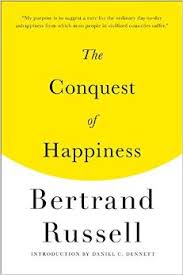
Some Russell quotations have been floating around lately, so I read The Conquest of Happiness, first published in 1930, and, boy, did I need this right now! The main ideas and some bits I liked are below by chapter. The book is really just a mix of Stoicism and Epicureanism, so you could just read that instead, but they're not nearly as palatable. This summary is really long, but not nearly as long as the book!
Part I: Causes of Unhappiness 1: What Makes People Unhappy?
This chapter has some racist bit, but I imagine he was still more progressive than most at the time. We won't throw the baby out with the bathwater at any rate. He raises his thesis here: we can only be happy by being prudent with desires and by focusing outward.
This is a difficult thing for me to figure out, and I'm not sure I'm quite firm on anything yet, but I've been completely fascinated by the discussions around Jordan Peterson, the University of Toronto prof who refuses to use individually-determined gender pronouns, so I'll try to narrow down what I actually think based on some of his YouTube videos, his interview with Joe Rogan, and various articles. I wrote before about some points I disagree with, but here I'll also look at where his argument has some merit. He's got some solid ideas in the mix.
First of all, the fact that I'm wary of discussing this at all, means that Peterson is on to something. He might not be entirely right about what he's doing and how, but it's always a concern when people don't feel free to counter current views. Before I knew his name, this felt like an issue that wasn't allowed to be debated, and those are always the meatiest places to explore. Why can't we question it? What's going on there? I teach philosophy and social science courses, and I get into all sorts of discussions that push boundaries: is incest necessarily immoral, or why don't we all use performance-enhancing drugs, or what if we sterilize couples right after they have one child to decrease population? Yet people questioning their gender is untouchable as a debatable topic so far. It's to the point that teens who feel strongly that they're in the wrong body are allowed significant surgery even though women in their 30s can't get their tubes tied because they can't possibly know their own minds. That's really interesting to me.
I first saw this at the theatre and, despite the fact that it starts with a whole lot of farting in a wide variety of tones and tempos, the ending had me in tears. I highly recommend it. The surface story is about Hank, trapped on a deserted island - sort of - who finds a dead body, Manny, who slowly comes back to life - sort of, and they try to get back home in a Wizard of Oz kind of way. Here are a few different things I think it could be about; I'll likely read much into it because it had me thinking and questioning at every turn. Authorial intention be damned! There are a ton of spoilers, but they won't really ruin anything. This is a film that can be watched over and over.
I just watched this four-hour doc on propaganda and social change and how we're swimming in Freudian concepts like it or not. It's older (2002), but it's compelling viewing useful to weed out the ideas of Freud from those of his followers. My notes are paraphrased (and editorialized) below:
1917 - the Emotional Root of our Desires
Edward Bernays (1891-1994), the father of public relations, is the nephew of Sigmund Freud, the son of Freud's sister and Freud's wife's brother. At just 26, he was asked to join Woodrow Wilson in creating a "Public Relations Council" to promote the war effort. He used conversations with his uncle Freud, whose ideas were soon after published in General Introduction to Psychoanalysis, to understand how people make decisions. Freud's writing was just about understanding why we act. Bernays used that framework of the psyche to develop a means to influence the collective behaviour of the masses.
As much as we like to think our reasoning abilities make us markedly different from other animals, we can be easily persuaded to act if someone plays on our irrational emotions. Bernays' first experiment to test the idea involved marketing cigarettes to women, which involved breaking a strong social taboo at the time. He convinced some suffragettes to march in the Easter parade, smoking, and called the cigarettes "torches of freedom." He spun the taboo into an oppressive restriction to be overcome, which made smoking immediately a symbol of power and independence. This was a brand new way of marketing products.
There was a growing concern with industrial overproduction, so Bernays helped the US shift from a culture focused on satisfying needs to one obsessed with fulfilling desires. He promoted the idea of regular citizens buying shares in companies, and he got film stars to come to parties at the White House, forever after linking politics with celebrity right up to today when Americans are choosing between Meryl Streep and Scott Baio.
1920s - Consumerism Will Save Us from Ourselves
Bernays arranged for Freud's works to be published in the U.S. and gain a widespread audience. He was his unofficial agent in the U.S. Freud wrote about how easily unconscious aggressive drives can be activated in crowds, concluding that man is a sadistic species. Bernays decided that if people are driven by irrational forces, then they need to be guided. If he could stimulate the inner desires of people and satiate them with things, then they wouldn't act on their aggressive impulses. Consumerism was a means to pacify the people as well as to make profits. He developed a system some called "enlightened despotism," or, as Walter Lippmann called it, "the manufacturing of consent, " a term made popular by Chomsky. Bernays saw how ads could create desire which could be easily satisfied and thus transform people into happiness machines.
Herbert Hoover agreed, and democracy became palliative. Democracy was no longer about challenging the relations of power, but about sustaining them.
1930s - Roosevelt Appealed to our Reason
Freud wrote Civilization and its Discontents and clarified that civilization is a necessary means to restrain our animal forces. Individual freedom is impossible and far too dangerous, so we must be controlled externally (to suppress our violent and sexual urges), and therefore we will always be somewhat discontented. It's necessary to be limited individually in order to survive collectively but that's not to say, as Bernays suggested, that we should be controlled en masse to pacify the masses or otherwise (increase profits). But Bernays was right that we can be.
After the market crashed, the U.S. faced angry mobs out to fight corporations. Government used the power of the state to control the market (Roosevelt's "New Deal"). Roosevelt worked with George Gallop to poll people's ideas. They rejected Bernays' ideas, instead believing that people could be trusted to make wise decisions. They were going to avoid any manipulation and appeal to citizens' rational faculties.
Meanwhile, in Germany, Hitler abolished the huge numbers of parties running, and the National Socialists were elected. They took control of business with a motto of "service not self." He aimed to channel desires towards a better society rather than satisfy the selfishness of individuals. Joseph Goebbels was in charge of promoting ideas to the people, and he admired the way Roosevelt was controlling markets. Goebbels went further to encourage aggressive forces in citizens as he believed officials could control them to serve their final ends. He was right.
In 1936, Roosevelt pressured more control over big business and was re-elected. Businesses fought back with help from Bernays, starting an ideological warfare against the New Deal. They created the National Association of Manufacturers, which launched campaigns to create emotional connections between brands and businesses. He filled papers with the messages that business, not government, created America, and he created a vision of a potential utopia for the masses that couldn't happen with government restrictions on the market. The government was worried about the affiliation between the press and corporations and started creating national newsreels to teach people how to check for bias in the news, but it was just a matter of time before controlling the markets in any way, even price controls to benefit the poorest in society, would be linked to fascism.
Bernays' methods were instrumental in persuading the public towards a pro-corporate stance, and he was called to help the CIA to reestablish government control over citizens. He appears to have had few allegiances except money and maybe the thrill of figuring out what persuasive measure would work in a given situation.
1940s - We Can Be Masters of Our Domain
After Freud's death, his daughter, Anna Freud, began writing and speaking more. She started with her dad's premise that people must be controlled for society to work, but she believed people could be taught to control themselves. Freud thought we need to understand our desires and the unfortunate necessity of external controls, but Anna believed we could train our desires internally by changing how children are raised. She started by experimenting on two depressive children, and became close with their mother. When she saw the results of the Nazis unleashing the instincts of their citizenry, she started working intensively with large groups of children in need. Primarily she thought children need to be trained to conform to rules of society as a way to strengthen their ego, which will in turn help them control their own unconscious. (She also established specific defence mechanisms well beyond her father's work, yet they're almost always credited to Sigmund.)
Almost half of the returning soldiers suffered mental breakdowns. Psychoanalyst Martin Bergmann was recruited by the U.S. government to interview returning soldiers, and it was the first time people started exploring and discussing feelings. Bergmann decided that stress and mental breakdown are not caused from conflict, but from soldiers' personal childhood desire for aggression. According to him, they weren't traumatized by the aggression itself, but by their eager participation in it, by their own letting go of their instincts to fight. He further surmised that chaos at the base of human personality can infect society, so people need to internalize democratic values. This led Truman to create the National Mental Health Act to deal with the number of unstable men returning from war.
Psychiatrist brothers, Karl and Will Menninger, wanted to use Anna Freud's ideas on a wide scale to control the unconscious desires of citizens, so they invented Guidance Counselling Centres everywhere and encouraged everyone to go. Their focus was on controlling the "fire of emotions" within.
1950s - Identifying with Brands is Promoted as Therapeutic
Things shifted a bit as Harold Blum came on the scene and thought we could be "appropriately emotional," that we should be allowed to let go within limits since we can master our own passions. And Ernest Dichter, Freud's old neighbour, set up Motivational Research centres. This was the dawn of the focus group and the Mad Men style of marketing. Focus groups would have people free associate about products, encouraged to express their feelings and associations. A famous case is when they asked women why they didn't buy instant cakes, and realized just letting women add an egg to the mixture would increase sales dramatically. The underlying idea driving Dichter was similar to Bernays: that we can use the environment to strengthen and stabilize human personality; it's therapeutic and confidence-boosting for people to identify with specific brands. It was also hugely profitable, which likely didn't hurt. It's hard to say which was more important for the psychiatrists.
Bernays worked with Howard Hunt of the CIA to launch a "terror campaign" and stage a coup in Guatemala by making the conditions in the public and in the press more amenable to such a thing after a more socialist leader insisted on better working conditions (and thus lowered profits) in the American-owned United Fruit Company. The psychological warfare worked enough to provoke the army to stand down. They linked the former leader to communism, made the previous government seen as a threat to democracy, and made business interests seen as democracy incarnate. Bernays openly believed that most people are terribly stupid and can be manipulated to act like automatons.
Government money was given to psych departments in universities to do experiment on brainwashing. Ewing Cameron, of UCLA but working in at McGill in Montreal, used drugs and electroconvulsive therapy in an attempt to wipe and replace people's memories. It didn't work the way he hoped (with some horrific results); and he surmised that people are more affected by external persuasion than internal manipulation.
Anna Freud kept working on children conforming to social norms. She was friends with Ralph Greenson, Marilyn Monroe's therapist, who got Marilyn to move into his home as he decided that his family was the social model to follow.
1960s - Anti-Conformity Rebellions Led to Corporate Losses
After Monroe's suicide, Arthur Miller argued against this psychiatric method that suggests any suffering is a problem. Miller insisted we must let suffering inform our lives, not try to cure any and all tumults we feel. The method advocated by Greenson attempted to control people rather than free them.
Herbert Marcuse also criticized the method. He called it a childish application of psychoanalysis and explained that the planned obsolescence of our time, with a huge variety of things to have and do, leads to a schizoid existence. The destructiveness of the individual is due to "empty prosperity." He called out psychiatry for being used for corrupt purposes, and Anna Freud for increasing repression in her patients through forced conformity. Evil isn't from maladjusted inward conflict, but from society, and it must be challenged, not adapted to. Martin Luther King Jr. agreed with the words, "I am proud to be maladjusted" to a corrupt society. And then the two children that Anna Freud started her method on, both committed suicide. This provoked a new student left to attack this system of social control, sometimes violently.
Wilhelm Reich challenged Freud's premise that people are driven by animal instincts and society is a controlling force that keeps our raging inferno of emotions in check. He countered that our drives are positive and repression by society distorts them. Reich thought violence is a result of denying our libido full expression; neurosis is a result of ineffective orgasm. And then things got really weird with the Human Potential Movement and confrontational experiences and encounter workshops that involved violent and sexual release. Werner Erhard got on board with the EST movement, believing that we can create ourselves individually, only the individual matters, and we can largely ignore society. Students and young adults became less political as they became more self-obsessed.
The downside of all this self-exploration was a corporate loss, particularly to life insurance companies, which are built on the protestant ethic prompting us to sacrifice for the future. Too many people were living for today. The new enlightenment needed products to help people express their individuality, but, at the time, variety wasn't cost-effective for factory production.
1970s - We Can be Reduced to a Lifestyle
The Stanford Research Institute (SRI) was used to measure and test desire satiation. Abraham Maslow, a humanistic psychologist famous for his self-actualization test, also created a tool to measure people's values on a hierarchy of needs that rises as people liberate their feelings. This was the beginning of categorizing society for marketing purposes. He believed we can be defined by the choices we make, and he surveyed people to see how people fit a set of identifiable types he called: lifestyles. The Values and Lifestyles survey (VALS) categorized people into more specific purchasing types than could be determined by age or income: Mainstreamers have a need for security and belonging; aspirers have a need for status; succeeders have a need for control; and reformers have a need for self-esteem. If a product reflects their attitudes, people will buy it. Instead of focus groups discussing products already invented, they used market research to invent new products. This would soon help elect politicians as well.
1980s - We Can Buy our Identity
Self-actualization seminars from the likes of Wayne Dyer and inner self work became more popular (polls showed an increase in interest from 5% in 1970 to 80% in 1980). Reagan ran on the new individualism model with his speech "Let the People Rule" (his We the People speech 8 years later has a similar flavour) knowing that people now embrace whatever gives the illusion of independence. It polled well and many former republicans voted conservative because of the PR spin, which allowed neo-liberalism to thrive. People feel entitled to have the best and to have power over their leaders, and they want their every whim satisfied.
New technology allowed short runs of consumer goods, so people were now able to buy their identities. They felt liberated, yet were more dependent on business than ever. Products were now necessary to their happiness and their very sense of self. Without things, people no longer have any identity. Scary.
Matthew Freud, of Freud Communications (great grandson of Sigmund, and son of an MP accused of pedophilia), helped manufacturers get control over how their corporation appeared in print. And Rupert Murdock's right in there too, of course.
Robert Reich laments that we no longer have a society, just a bunch of individuals focused on themselves. Bernays found a way to get people to see goods as a means to respond to deep emotional yearnings. Politicians used these business methods to find out what voters want and give it to them, and they stopped caring about having a clear and specific mandate. They summoned the greediest aspects of human nature by focusing on individual personal satisfaction. It was a triumph of the perspective that individuals are purely emotional beings easily led off a cliff.
According to Reich, the left used to persuade people we have common interests. Roosevelt persuaded people to join together in labour unions, which drove the democratic party. The worst thing Reagan did was to make denial of compassion a respectable trait.
1990s - Fluctuating Desires Drive the New Democracy
To get re-elected, Clinton bowed to this pressure to satisfy individual voter concerns. (Tony Blair did the same thing in Britain.) It turned politics into a consumer business that can fulfill personal desires. They could learn what voters want and move themself there. Clinton conducted neuro-personality polls to find day-to-day concerns and ran on a platform of V-chips for TVs and mobile phones on busses rather than the typical foreign and domestic policies discussed in previous elections. This was spun as a means to end elitist politics in that the people are now being heard, but the practice suggests that democracy is nothing more than pandering to primitive desires. It's a politics of the self. It's a problem because people are contradictory: they want lower taxes and better public services. We're trapped in short-term, conflicting policies.
This isn't a better form of democracy, a "continuous democracy," it's just propaganda for corporations. Remember that Bernays didn't believe democracy could work and that the masses had to be led, that it's too dangerous to let people have control over their own lives. Consumerism is a way to give the illusion of control while allowing the responsible elite to continue managing society. This is the end result of that premise. We just feel like we have more say now. People's desires are in charge instead of their will. Democracy has been reduced from something that assumes an active citizenry to something which now is increasingly predicated on the idea of the public as passive consumers.
We have to appeal to the public to care for others more. We forgot that we can be more than our immediate desires. Reich summed up the two views of human nature: essentially emotional or rational. The Freudian view suggests we're just bundles of emotions, and businesses have honed their skills at responding to that. But politics must be more than that. Politics and leadership are about engaging the public in a rational discussion and deliberation about what is best for society. People need to be respected for their rational abilities to debate what is best.
***
2000s - Do We Know Enough to Change?
Now we know, or think we know, about neural pathways. The more we restrain ourselves, the easier it gets to avoid certain stimuli. If we have chocolate around, but stop ourselves from eating it, it will get easier to avoid it, and eventually we'll stop being so drawn to it. I practice this myself by actively avoiding social media at certain times of day, and it's something I don't have to actively work at quite so much anymore. The corollary is also true, that the more we do something, the easier it is to do and the more likely we are to do it. The more we allow ourselves to have public outbursts, the more likely we are to have them. We have to practice self-restraint.
This leans towards Anna Freud's work, but she went too far dictating what all needs to be controlled, and not far enough with other tactics to help alleviate profound depression. I think it's less a training that we need, but more of a constant reminder about our goals for ourselves as people so we're not led astray.
Today we also know about neuromarketing. They don't need market research or focus groups when they can look at our brains directly to find out which ads cause a dopamine spike. The masses can clearly be led towards consumerism or acts of genocide, so we need to be ever vigilantly thinking about why we feel like we need new clothes or why we feel a hatred for one group or another.
The fact that Bernays and others are able to manipulate society is testament to Freud's original theory hitting a nail on the head in determining how our drives affect us. But what some people do with that understanding is frightening. This clarifies a pivotal role for schools (complete with lessons on Freudian theory) to ensure we wake people up to their own decision-making as well as to their internal drives. We need to demand a democracy based on collective will for the benefit of society, not individual desires for the benefit of the self.
"The drama has taken on an air of inevitability, of a tragedy at the outset of its final scene — the tension so unbearable, and the weight of looming catastrophe so soul-crushing, that some people seek the release of final defeat rather than endless struggle in the face of hopeless odds. Working for change, or even hoping for it, has felt like a sucker’s game."
That "seek the release of final defeat" bit makes me think of Freud's theory of a death drive:
"Our recognition that the ruling tendency of psychic life… is the struggle for reduction, keeping at a constant level, or removal of the inner stimulus tension – a struggle which comes to expression in the pleasure-principle – is indeed one of our strongest motives for believing in the existence of death-instincts."
We long for finality, for completion, not just in our daily accomplishments, but in all things, in order to release ourselves of the tension of getting near the end. This is clearest, I think, when we feel great making a questionable decision because having finally decided feels so good, so final, even if it's a bad choice. This explains why so many stay on a wrong path and won't budge from it even when shown the error of their decision; it feels so good to have decided that we don't want to have to go back to that moment of choosing.
It's curious how much we say we want more freedom, hence more choices in life, and yet choices can be such a burden.
Anyway, we're clearly on the wrong path now. Are we really going to just watch it play itself out to the final end of humanity? Not according to this article,
"The technological and political underpinnings are at last in place to actually consummate the first global pact to limit greenhouse-gas emissions. The world is suddenly responding to the climate emergency with — by the standards of its previous behavior — astonishing speed. The game is not over. And the good guys are starting to win....The task before the world is best envisioned not as a singular event but as two distinct but interrelated revolutions, one in political willpower and the other in technological innovation."
Why will it all come together now, suddenly? He points to signs like "the price of solar is fallen" - in some place it costs less to use solar or wind than coal or natural gas.
But I'm afraid that what Chait misses with this line of reasoning, is that it's not just the cost that drives the use, it's also the number of powerful people who stand to gain if we continue using fossil fuels. As Jeff Rubin points out in The End Of Growth, Canada's economy depends on money from gas-powered cars and from tar sands. Rubin thinks things will get better only when we can no longer afford to drive:
"...the simple unspoken truth is that a recession is the best possible way to tame runaway carbon emissions."
Chait then suggests we're already using less energy because we have better technology for better lightbulbs: "everything from buildings to refrigerators is being designed anew to account for scientific reality." And these innovations happened because,
"governments disrupted [the energy market]; progress came not in spite of our government but because of it. The private sector developed LED bulbs because Washington required higher-efficiency lighting....The overall direction of American carbon use is no longer in doubt. American carbon emissions peaked in 2007 and have fallen since, with the main question now being how far and fast they will plummet."
Good for Obama, but it's hard to be hopeful with Harper in power. Chait points to countries getting on board, but my concern are the many countries still not interested in this discussion. It's better than it was, but is this really the tipping point of a major transformation? He thinks that American policy will affect the rest of the world, and I hope he's right. He looks to China for proof of hope:
"It is hardly selfish for developing countries to refuse to force their impoverished people to shoulder the burden of averting climate change. (Even now, China burns less than half as much carbon per person than does the U.S.) The developing world has thus been presented with a brutal moral logic: The rich countries have burned through the world’s carbon budget, and there is almost nothing left.
But in the past year, something amazing has taken place. In 2014, China’s coal production and its consumption both fell, and the drop appears to be continuing, or even accelerating, this year....The possibility has come into view that, just as the developing world is skipping landlines and moving straight into cellular communication, it will forgo the dirty-energy path and follow a clean one."
He thinks people are losing hope because they're American, and "the new global consensus on climate change is least evident" in the U.S and Saudi Arabia. "The U.S. is the only democracy in which such a consensus [on climate change denial] can be found." Maybe he hasn't noticed us to the north as our government fights to run more pipelines, sell more oil, take away protection over waterways, remove scientific funding, etc. About a year and a half ago, Huffington Post reported,
Gerry Ritz, Canada's Minister for Agriculture, told the House of Commons last week that "this cold weather can't last forever. This global warming has to stop some time".....fellow Conservative Member of Parliament Gordon O'Connor spoke out..."I don't know what those words mean because they're a buzz phrase. Climate change. If we're talking about what is our preparedness for natural disasters, that's one thing, but climate change, if you want to talk about the climate, the climate always changes. It goes hot. It goes cold, etc....Last year, newly minted Environment Minister Leona Aglukkaq stated that "there's always a debate around science and what's changing" and claimed that climate change was still "debatable.""
I don't think you have to be American to be losing hope over this.
Chait recognizes the immensity of the problem we face, but thinks we are at least starting down a better path:
"Even if the world could eliminate all fossil-fuel use tomorrow, the amount of carbon already in the atmosphere will create, and is already creating, disruption, havoc, and death. Even if the world halted all greenhouse-gas emissions today, it would be, by the standard of perfection, too late.
Besides, the target the world has set for measuring success — holding increased global temperature to no more than two degrees Celsius — is merely a guess at salvation.....Even if all the Paris talks do is simply eliminate the risk of the all-too-thinkable worst-case scenario, it would constitute a monumental achievement in the history of human civilization, like the development of modern medicine."
But he ends equating denial of climate change with despair over the condition of the world as if they both blind us from this revolution taking place. I think we can see how bad things are and likely will be, as he does, yet also recognize there are some small gains happening here and there. It's not the same as railing against these gains because climate change doesn't exist. Not by a long shot. But it's still despair-worthy to consider how little the gains can be at this stage - as he points out:
"The limits agreed to at Paris will not be enough to spare the world mass devastation. But they are the beginning of a framework upon which progressively stronger requirements can be built over time. The willpower and innovation that have begun to work in tandem can continue to churn. Eventually the world will wean itself almost completely off carbon-based energy. There is, suddenly, hope."
So, I'm also not entirely convinced that "the long-awaited green revolution has finally arrived." Some politicians are on board, but not nearly enough. And nothing is happening fast enough. The word "eventually" above doesn't help me believe it's getting so much better.
But most problematic, Chait misses an entire piece of the puzzle: the necessary involvement of big business (or significantly increased regulations). Until corporations stop draining aquifers, stop outsourcing to countries with lax pollution restrictions (exacerbated by trade deals supported by Obama), stop running business on a policy of planned obsolescence (so products have to be re-bought over and over), stop flying products around for pieces to be built and assembled in a selection of countries, and do more than superficial greenwashing, we're not going to be truly off this path of destruction. And it'll be quite the effort to convince people to stop practices that increase profits.
“Our ethos is all that we currently hold to be true. It is what we act upon. It governs our manners, our business and our politics.” - Howard Zinn
Directed by Pete McGrain, and hosted by Woody Harrelson, this 68 minute film explores how we got here and what to do about it as we "fight for a new democracy." It's nothing new, but it's succinct and watchable, and divided into sections which is handy in a classroom. My notes are below, after the film in its entirety.
Like in Go Further, which is a much lighter film with weird musical interludes, Harrelson is espousing a simplistic solution: "Dare to feel responsible for every dollar you put down." Since our purchases can make or break corporations, we have the power to change the world by carefully choosing which products to buy. But, how do we deal with the reality that most people are blind followers too complacent to act, or, as Chomsky calls it, "the stupidity of the average man"?
But Diamond makes the same suggestion in Collapse. I'm not confident it'll work, but it might be all we've got.
POLITICS:
"We don’t have a democratic society. The U.S. is a polyarchy and always has been. Nobody in power wants democracy because it challenges their power structures." - Noam Chomsky
We think politicians pander to the public, which creates the impression that the political system has problems but it’s still accountable to the public, but the reality is that politicians largely ignore public opinion. The corporate-owned media sets the agenda, which makes it seem like we have a choice, but we don’t. Politicians are more similar than different because they answer to the same master – corporations. We don’t have elections anymore, we have auctions. Government is for sale. Money in politics gives the power to those with money, and it’s unlikely for politicians to change the system that gives them power.
CORPORATIONS:
"Corporations only have the bottom line." - Michael Moore
Governments have to balance the needs of the whole society including big business based on ethics and social and moral responsibility. But if corporations have more power than governments, we have to understand the effects that will have on the whole system. Corporations are required by law to work only for the stakeholders, so they externalize costs, and they must expand, so use up more resources. The damage is terrifying and morally bankrupt. Typical corporations are extractive, wasteful, abusive, linear, and global, i.e. not under the power of any one government. They've replaced governments. We need corporations to bring us new technologies, but the system encourages a thirst for short-term profit.
NOT ALL CONSPIRACY THEORIES ARE JUST THEORIES
The Federal Reserve Bank of the US is owned by a private cartel, not by the government.
“The world is governed by different personages from what is imagined by those who are not behind the scenes.” - Benjamin Disraeli
“The one aim of these financiers is world control by the creation of inextinguishable debt.” - Henry Ford
“Since I have entered politics, I have chiefly had men’s views confided to me privately. Some of the biggest men in the US are afraid of something. They know there is a power somewhere. A power so subtle, so organized, so complete and pervasive that they better not speak above their breath when they speak in condemnation of it.” - Woodrow Wilson
BANKS
“Our great industrial nation is controlled by its system of credit. Therefore all of our activities are in the hands of a small group of men who chill and check true economic freedom. We have come to be one of the worst ruled, completely controlled and dominated governments in the world. No longer a government of the majority but a government of the opinion and duress of a small group of dominant men.” - Woodrow Wilson - 1921
The value of money is determined by how much is in circulation. This should be controlled by the government, but it’s controlled by the Federal Reserve. If the government needs money, the Federal Reserve loans it money and the government has to pay it back with interest. The reserve was set up by some of the richest men in U.S. (e.g. J.P. Morgan). They caused a panic in order to convince Wilson to sign and get elected in 1929.
THE MEDIA
"Because of the stupidity of the average man, he follows not reason but faith. In a military state, it doesn’t matter what people think because they can be controlled by force. When the state loses that control, and people can speak up, then we have to control what people think. That’s what media is for." - Noam Chomsky
We tend to base our opinions on biased news. The media presents two sides of an issue, but as if it’s a narrow issue rather than offer a broad and complex discussion.
Edward Bernays, Freud’s nephew, took the new science of psychiatry and used it to manipulate the masses. He invented Public Relations and worked for major corporations and advised political figures. He held big parties and all politicians, businessmen, and artists showed up. He recognized that the way to sell products isn’t to appeal to the intellect, but to feelings: “You’ll feel better if you have it.” Companies can tap into people's deepest desires and deepest fears and use that for their own benefit. Democracy is about maintaining the power imbalance even if it means stimulating the psychological needs of the masses. Democracy changed from the idea of active citizenry to public consumers driven by instinctual or unconscious desires. If you can trigger those needs and desires, you can get what you want. People need to be trained to want new things before the old are consumed. Make people want things they don’t need by linking the product to their unconscious desires. It's all old hat now.
NIGHTMARE: WAR
"The so called independent media is so lazy and controlled by interests that are commercial and political that there is no investigating reporting – it’s just repeating the lines of the people with the most influence." - Edward Said
If we’re going to make decisions about the future of our society, the single most important thing we need is the truth. The nightmare scenario refers to the implications when a powerful group of businessmen with access to the White House make obscene amounts of money whenever there’s a war. Contractors went in to Afghanistan and Iraq to look for business deals. All of them had ties to the White House (e.g. The Carlyle Group). There's been an Iron Triangle created between military, big business, and politics. Military contractors can affect governmental policy and are rewarded financially for doing so (i.e. starting wars). Military organization can work behind the scenes without accountability and ruin careers of people who are too inquisitive or too honest. It develops the means for unprecedented global control. It’s an immensely powerful company without public scrutiny. Congress fails us because they’re paid off by the corporations. When war becomes that profitable, you’re going to see more of it even though going to war should only happen when the honest reasons for the war are laid out and allowed to be scrutinized by the public.
In the popular media, Muslims are terrorists. In 2003, most people thought, wrongly, that Saddam Hussein was linked to 9/11. The US took over strategic positions in Iraq for easier invasions of other countries and to have the oil. War is about getting American control over the areas, not about freeing people. Freedom means allowing dissent and debate. Politics of fear dictates that the media perpetuate myths that we have lots of enemies - evil-doers - so we can never be weak. We have to be ready to fight. Government programs our level of fear without any justification. The rigged American economy can’t go on forever. The system is set up to find wars. Spectatorship is an invitation to fear. Citizenship is how we fight the politics of fear – taking responsibility, taking action, being engaged citizens. We, as individuals, drive the demand for these resources. As long as we are all aware of the fact that there’s blood in this oil, and that is the decision we make, then so be it.
THE FUTURE?
“We shall have a world government whether we like it or not. The only question is whether it will be by conquest or consent.” Paul Warburg, Council on Foreign Relations
Denial is understandable. The rights to freedom of speech, free assembly, and fair trial are no longer protected by law. Acts against the government can be seen as terrorism (e.g. Patriot Act and Harper’s attack on scientists and environmentalists). There's a political movement towards making citizens carry ID in the U.S. which could lead towards chips implanted in us. Will our sense of fear lead us to accept and even welcome totalitarian control by the government? Historically governments use fear to control the masses. In the War on Terror, there are no real enemies. They've convince people it’s real in order to take away our freedoms. That which the system holds most deal is its greatest weakness.
(SOLUTION)
This system cannot continue. The idea of allowing wealthy elites to make decisions is terrifying. The great heroes of our times couldn’t create change on their own. Only the will of the people can do that. Together we can accomplish anything. The way to win back democracy has just one cure, and it’s simple: We live in a capitalist system. It’s turned us into obedient consumers. This creates demands on resources so that we invade to get more. Then using wealth and power, corporations undermine democracy and justice. The ironic outcome of consumerism is it makes you, the consumer, all powerful. The way we choose to spend our money can change everything.