Showing posts with label violence. Show all posts

Tuesday, March 10, 2026

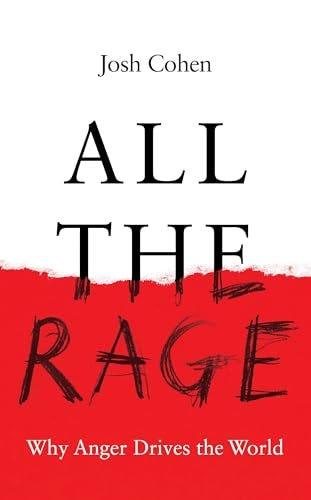
On Useful Anger: Cohen's All the Rage

How can we possibly approach the world today without being in a constant stage of rage? Philosopher and psychoanalyst Josh Cohen’s All the Rage suggests how to make this feeling more useful to us. 

He writes from a range of perspectives, everything from political uprisings to the patients in his office, and from how rage plays out in the world to how it manifests in our own minds, all with a thread of climate change activism throughout. Ideas are illustrated with examples from fictional characters, historical figures, and his own family. It hardly seems possible to do all that in just 195 pages, yet the book is a thought-provoking and entertaining read, comfortably shifting from micro to macro issues to explore four kinds of rage.

DEFINITIONS

In day-to-day conversations, we use “rage,” “anger,” and “aggression” almost interchangeably. We do the same for “emotion” and “feeling” and for “drive” and “instinct.” The book uses these terms more precisely, so a bit of a glossary might be useful. The order of events that occurs when we’re outraged becomes important. Cohen explains that aggression is often the way we respond directly to a stimulus, and anger is what happens after that first spark of action, when we choose to hold it back. He explains it succinctly in an interview with The Philosopher:

“Aggression is a kind of stimulus response. It’s what we do with a provocation, which might be an injury; it might be a humiliation, an insult of some kind, something that arouses us to retaliation. Aggression is the way that we get rid of that load of stimulus in action. … Anger is a way of holding on. Feelings are ways of holding on to stuff. When we can’t bear to feel something we instead discharge it in action. … Anger is something that you’re left with when action is unavailable to you or perhaps when you try to take the experience to a higher level, i.e. to maintain it in the consciousness as something to experience and process psychically rather than discharge in an action. That’s why psychoanalysis tends to think of anger as a human achievement.”

It’s not the case that we’re insulted, then feel anger, and then rationally decide to act or not act, even if it sometimes feels like that. Instead, the impetus to act is immediate following an enraging stimulus, and the restraint is what leads to the feeling of anger. I think that’s the idea. It’s counterintuitive to me, so it’s useful that it was repeated a few times in the book.

Thursday, January 29, 2026

Honouring Our Capacity

I've had several conversations this week about how to be in a time like this when the U.S. government is so overtly corrupted. I'm just the upstairs neighbour in Canada, but we're high on the list of countries to be overthrown. Even without being in that position, it's hard to be aware of the world today and not be in a constant state of rage. I mean even more than before. I want to fast forward to the end when all the bad guys go to prison, but that will only happen with ongoing action from as many people as possible. However, that type of action doesn't necessarily have to be heroic or extraordinary. This is just my two cents from a distance that's looming closer.

INACTION AS COMPLICITY: What's Enough? 

Viewing newly accepted levels of violence in the U.S. is overwhelming and frightening. A few people have posted lists of things we can do to help, but I wonder if, for many people, it's asking too much. This might be a controversial view at a time when it feels like we all need to get on board to shift the world back to a less selfish and violent place, but the perspective that we all are complicit if we don't act might do more harm than good.

Friday, October 6, 2023

Breathe, Grieve, Love, Repeat

We have very little direct influence over one another but we do affect one another in myriad ways that we often don't even notice.

I had a student once, about 15 years ago who I thought was a delight, as I did almost all my students. He was bright and funny and curious about history. He was also known to have significant gang involvement and may have killed someone by now or have been killed. Who knows. I can't barely remember anybody's name of the over 5,000 students I taught, so there's no looking him up. I likely had little impact on the general trajectory of his life, but I taught him a bit about the last century and solidified some writing skills. And maybe the fact that I warmly welcomed him into class on the rare times he showed up had a bit of an effect on him. I hope he's doing okay. 

About seven years ago I got into a big online argument about the meaning of a film, and it's was beautiful. We each had points and tried to persuade the other, and neither of us budged, and it got absolutely nowhere, but it was a delight to debate what we each saw in a work of art. Neither of us even considered name calling or threatening one another's life or getting all our buddies to destroy the other online. 

Remember those days?? It wasn't that long ago.

Because we can't always see how our actions will affect others in future, we have to take care with what we say and how we say it and watch for the direct effect on others. We have to be more careful online where we can't see one another's facial expression to check if they got that we were just joking or to notice the first sign that we're upsetting them. That concern with caring is waning -- I think largely because we don't get immediate facial feedback. But it's vital we get it back for the coming years. 

Thursday, April 6, 2023

Age of Absurdity

We're skipping gleefully into the most absurd period in history. 

The philosophical notion of the absurd came from Camus. It grew legs with existentialists after WWII when the youngest and fittest men were sent to be slaughtered in war. The streets of Paris were full of widows and grieving mothers and broken men. The question of the day was, How can we make sense of our lives and our place here and our idea of justice with all this going on?  

I wrote more about it at length as I struggled with decisions foisted on me during my cancer years that left me with chronic issues. The answer from Camus is to stop trying to make sense of it all. Embrace the absurdity of our lives. We always have the option of leaving it behind, so if we choose to stay - famously if we choose coffee over suicide, then we have to acknowledge the world despite the weight of our knowledge pushing us to escape it through self-deception and cultural deception. All our choices are always a crap shoot, and at the same time, they're always our responsibility even though we can't possibly know how things will turn out, which, at the same time, takes the weight of that decision being the best choice off our shoulders. Outcomes are all out of our control, but we must try to do right anyway. We're taking a test without every having taken the course.

Monday, December 12, 2022

On the Social Disease of Anger

The anger that escalated at a recent Ottawa-Carlton school board meeting when a trustee proposed and lost a motion to mandate masks, in a setting of generally polite discussion, makes it seem like this type of anger is new. But this video of the history of masks, and what we saw when we imposed smoking bans and seatbelts years ago, makes it clear that people have always been fired up by any new restriction. Masks may be even more enraging because they symbolize a danger and harm we'd all like to forget. 

But more than that, this type of anger that targeted the specific trustee with emails and phone calls that included vile sexist and racist comments and threats, is more reminiscent of GamerGate, when a few women dared to criticize some games and were brutally harassed online and doxed, provoking at least one to move. This Vox article explains what needs to be done to prevent these occurrences,  

It's crucial to understand how, when, and why an online mob is expressing outrage before you decide how to respond to it. Gamergate should have taught businesses that online mobs can and do look for excuses to be outraged, as a pretext to harass and abuse their targets. There's a difference between organic outrage that arises because an employee actually does something outrageous, and invented outrage that's an excuse to harass someone. . . . 2014 should have been the year the cultural conversation began to acknowledge how serious aggression toward women really is. It wasn't.

This understanding of the situation suggests that an outlet for anger is the point and that gaming was just a catalyst or merely the easiest avenue for the anger to seem remotely reasonable. It's like when a hungry or tired toddler is upset with a random toy until that inner irritation is resolved. The grade school version finds a scapegoat to unload on and then they discover the glee of having power over another. We need to resolve these inner irritations and the joy of domination before people become adults with a greater capacity to cause lasting harm.

Tuesday, May 17, 2022

The Harrowing Road for Candidates - and the Rest of Us

I've recently read two articles on the problem and solution to the current nastiness in elections after hearing first hand about serious issues candidates have had at the door. You never know who you're going to get when you knock on someone's door, and most people don't want to buy what you're selling. I've been door-knocking as a volunteer in the past and was fortunate not to run into any conflicts, but people are becoming less civil in their expression of discontent recently. 

In "Why is Politics Getting Nastier," Stephen Maher writes about candidates giving up running because of the reactions at the door, on social media, and extending into their lives.

"[Former MP Scott Simms] remembers a big fellow coming out of one house while he was walking up the driveway. The man began shouting at him about prime minister Justin Trudeau. . . . The man was upset. No problem, Simms said, he would leave, but the man kept coming, furious, getting closer. 'I'm going to grab you,' he said, 'and I'm going to throw you in a ditch.' . . . 'So that's one of those times when you realize, I think my time in this business is done.'" 

Physical assaults and death threats have been reported by candidates from all levels of government and all parties, and in other countries, including police charging a woman "for pinning a Liberal incumbent against a wall with a table,"  an office being lit on fire, candidates receiving packages of chemicals and violent images, and the fatal stabbing of MP David Amess

Sunday, May 17, 2020

On Gun Control

I've been observing many gun control arguments online and in the classroom (also online) recently. I've written about this before, once after Sandy Hook and then after a Stoneman Douglas shooting surviver put the onus on school staff to keep kids safe. This one's closer to home, so I finally got around to sorting out my views on a whole assortment of gun-supporters' typical claims (presented largely in my own words and entirely without indications of where they're from in case people don't want their views known here). I'll follow my own classroom rules for arguing: take the most charitable read of a person's point, indicate points of agreement, and only then indicate points of disagreement. It got ridiculously long, so here's the general trajectory of my position with links to each section, and there are bolded bits throughout for faster skimming:

     A Very Brief History of Gun Control in Canada
     It's Undemocratic!
     The Regulations are Nonsense
     Semi-Automatics Aren't Necessary
     Semi-Automatic Weapons are Unnecessary and Upsetting
     Semi-Automatics Can Get in the Wrong Hands
     The Buyback is One More Way to Decrease Gun Deaths
     Violence is a Bad Thing
     Random Assertions and Refutations

But first, full disclosure: I admit that I don't know all the ins and out of the types of guns being discussed, but I hope dear readers can keep to the larger issues being debated here. My one dig at gun supporters is that some, definitely not all, but it often seems that it's a significant number of them, love to dive into the minutiae of models and parts and origins until my eyes glaze over. And when that happens (but of course it doesn't always happen), when that happens, it always reminds me of Roger Ebert's dismissal of certain (but not all) Star Wars fans:
"A lot of fans are basically fans of fandom itself. It's all about them. They have mastered the "Star Wars" or "Star Trek" universes or whatever, but their objects of veneration are useful mainly as a backdrop to their own devotion. . . . Extreme fandom may serve as a security blanket for the socially inept, who use its extreme structure as a substitute for social skills. . . . If you know absolutely all the trivia about your cubbyhole of pop culture, it saves you from having to know anything about anything else. That's why it's excruciatingly boring to talk to such people: They're always asking you questions they know the answer to."

Friday, August 23, 2019

Hannah Arendt's On Violence

Unfortunately, this is really timely.

Arendt wrote this short book in 1970, but there's nothing in it that needs to be updated today. Absolutely nothing significant has changed; it's just more. She was responding to the violence of WWII, Vietnam, the student riots in Paris, and, most specifically, the People's Park protests in Berkeley, where she was teaching at the time as students attempted "transforming an empty university-owned lot into a 'People's Park'." Sheldon Wolin and John Schaar wrote about how the event unleashed an unnecessarily strong police backlash:
"A rock was thrown from a roof-top and, without warning, police fired into a group on the roof of an adjacent building. Two persons were struck in the face by the police fire, another was blinded, probably permanently, and a fourth, twenty-five-year-old James Rector, later died. Before the day was over, at least thirty others were wounded by police gunfire, and many more by clubs. . . . Tear gas enfolded the main part of the campus and drifted into many of its buildings, as well as into the surrounding city. Nearby streets were littered with broken glass and rubble. At least six buckshot slugs entered the main library and three 38 calibre bullets lodged in the wall of a reference room in the same building. Before the day ended, more than ninety people had been injured by police guns and clubs."
That was on May 15, 1969, known as "Bloody Thursday." The Kent State shootings in Ohio were almost exactly one year later. Arendt tries to make sense of it all through a look at the changing view of violence in society.

Saturday, February 16, 2019

Amber Alert Red Herring

People were upset to be woken up by the Amber Alert Thursday night. And now, on social media, people are REALLY upset that people were upset to be woken up by the Amber Alert.

This is trending:


But, instead, we need a #believethem movement to trend for whenever a parent or grandparent or neighbour has good reason to believe that someone is about to do something dangerous or lethal involving a child.


Monday, July 30, 2018

On Manne's "Down Girl"

With thorough argumentation and heavily footnoted facts brought to the table, Down Girl, by Kate Manne delineates misogyny from sexism and hopes "to offer a useful toolkit for asking, answering, and debating" (13) issues centred around misogyny.

Contents:
     Misogyny vs Sexism
     Ideological Nuances
     Abortion
     Domestic Violence
     Family Annihilators
     Testimonial Injustice
     Keeping Them Down

Right off the bat, let's clarify that it's not remotely a man-hating thesis. It's about looking at how we all are affected by the beliefs floating around us.
"One need not be a man to be a misogynist either: women can fit the description too, as can non-binary people. . . . many if not most of us at the current historical juncture are likely to be capable of channeling misogynistic social forces on occasion . . . unwittingly policing and enforcing distinctively gendered norms and expectations but also, on my analysis, over-policing and over-enforcing gender-neutral and potentially valid norms, e.g., genuine moral obligations" (77).
A primary issue discussed is that women who compete for typically male-dominated roles: "will tend to be perceived as morally suspect in at least three main ways: insufficiently caring and attentive with respect to those in her orbit deemed vulnerable; illicitly trying to gain power that she is not entitled to; and morally untrustworthy, given the other two kinds of role violations" (xiv). Women have an extra layer of barriers to wade through to get to positions of powers because everyone (men and women) has been socialized to believe women are the caretakers of the world. It's similar to what Neil deGrasse Tyson describes in the world's reactions to his efforts to excel in science - the path of most resistance:


Wednesday, April 25, 2018

On Entitlement and Unfettered Rage

One of the benefits or downfalls of the internet is that it allows fringe groups to find each other online. When it comes to feeling like nobody in the world knows about climate change or the Myanmar genocide (or philosophy), because nobody in my immediate vicinity is too concerned or interested, then it's invaluable to find clusters of intelligent people writing about them regularly online. Finding people with the same concerns about the world can be a game-changer when you've all but given up on working towards a solution for a grave social injustice.

But it's a tragic downfall of cyberspace when the "social injustice" is that you can't get laid. People in some fringe groups who, as individuals, would all be seen as rare deviants in need of help, are able to find each other now, and cluster together to reinforce and normalize their warped version of reality.

Such is the case with the van killer in Toronto. I won't use his name because I hope it's forgotten and he's forgotten rather than becoming infamous. But we can't forget that he was part of a movement of "involuntary celibates" (incels) who are outraged at their misfortune with women. Instead of blaming their own approach or attitude or maybe something they said along the way, they put all the blame on women for not flocking to them they way they expected would happen.