Showing posts with label Munk Debates. Show all posts

Sunday, November 4, 2018

Munk Debates: Is Populism the Way of the Future?

I watched the recent, heavily protested, Munk Debate between good buddies on the right, Steve Bannon and David Frum. The issue they were debating was, "Be it resolved, the future of western politics is populist, not liberal."

Spoiler alert, the results were a draw, in that the audience in general didn't change their opinion on the issue. At the end of the debate, the moderators revealed incorrect results indicating a sweeping win for Bannon, but here's their retraction:


72% of the audience still disagrees with populism regardless Bannon's arguments. Nobody defined populism throughout the evening, but I take it to mean politics that focuses or appeals to the ordinary person as if society is all the same. It's an ideology that pits the common folk against the elites. It's being juxtaposed with liberalism, which generally means politics that focuses on individual liberty and equality. I'm not sure they're as different as is being suggested, but I'll get to that at the end.

from Cas Mudde 


The Toronto Star reported on the protest on Friday. Twelve were arrested (mainly for trespassing and public mischief) and two officers were injured. Protesters interrupted the debate when Bannon first began speaking, but they were given a choice to either be quiet or leave, and things calmed down after that. Protesters took what's now labelled as a "no-platform" position that fights to deny a platform for profoundly bigoted views. There's an excellent thread by Bashir Mohamed on Twitter that explains the rationale, arguing that the belief that preventing the speech of hate groups will in any way harm the marginalized goes against all we've seen in history. The gist of it is here:
"Do you really think slaveowners, Nazis, and the Klan were defeated by a bunch of fucking 'free thinkers' in a debate hall? . . . Canadians allowed the Klan to operate in Canada until 2003 due to complacency. . . . Canadians allowed apartheid supporters a podium because of 'free speech.' Do you think this defeated apartheid? . . . Alberta allowed the Klan to be formally incorporated from the 1930s - 2003. . . . A more local example is from the 80s when U of T students protested the Klan's presence on their campus. They were lead by Gary Yee. How did the Government of Ontario respond? By saying the Klan had a right to 'free speech.' . . . It wasn't the 'free speech' advocates who defeated the Klan. But instead, it was activists like Gary Yee who reduced the power of the Klan through their advocacy. . . . After today, there will be even more columns from our predominately white pundit class. They will argue that the protesters were the ones who gave Bannon power. Instead, history shows us that those very pundits and those who stand in line are the ones who give him power."

We are clearly seeing a rise in supremacy groups, and Janet Reitman reports in today's New York Times Magazine that law enforcement officers don't know how to respond effectively to white nationalism.


She writes,
“The F.B.I. knows how many bank robberies there were last year,” says Michael German, an author of the Brennan Center report and a former F.B.I. agent, “but it doesn’t know how many white supremacists attacked people, how many they injured or killed.” More concerning to German, though, is that law enforcement seems uninterested in policing the violent far right. . . . In at least one instance, the police have in fact coordinated with far-right groups. In 2017, a law-enforcement official stationed at a rally in downtown Portland, Ore., turned to a member of a far-right militia group and asked for his assistance in cuffing a left-wing counterprotester, who had been tackled by a Proud Boy. “This is what public demonstration looks like in an era when white nationalism isn’t on the fringes, but on the inside of the political mainstream,” says Brian Levin, a former New York City police officer who now leads the Center for the Study of Hate and Extremism at California State University-San Bernardino.

So, why would the Munk Debates invite two similarly minded men to debate on such a non-issue right before an election? Here's one answer:
Why would any Canadian organize a local debate between two factions of the American corporatist right and try to pass it off as a serious policy dialogue between a conservative and a relative liberal, a notion that is preposterous on its face yet seems to be the predominating media narrative. Actually, this is easier to understand if we consider the apparent agenda of the organization behind last night’s event. Press Progress reminded us earlier yesterday that the Munk Debates are bankrolled by the Aurea Foundation, established in 2006 by the late Peter Munk, the Canadian gold-mining billionaire. The Aurea Foundation says on its website it “gives special attention to the investigation of issues related to the political and economic foundations of freedom, the strengthening of the free market system, the protection and enhancement of democratic values, human rights and human dignity, and the role of responsible citizenship.” Whatever that means in practice, former Munk Debate participants include Henry Kissinger and Tony Blair, so obviously the foundation isn’t allergic to war criminals.

So, there's that. I've written from the no-platform perspective before, and I agree that it's important to prevent the spreading of hate speech. It seems clear that allowing it to continue provokes acceptance of shooting unarmed migrants and killing protesters, and it's not unreasonable to fear even worse. But, once it's out there, it's important to listen to in order to call out the slippery debating tactics. This is loosely, but accurately, paraphrased or quoted from the debate, largely abridged because it was very repetitious.


BANNON'S POSITION
It's not a question of populism, but of whether we'll have populist nationalism or socialism. We have to go back to the inciting incident, [the bank bailout], on December 18th, 2008, in Washington, when Hank Paulson told Bush that we need $1 trillion by 5pm or the U.S. financial system will implode, and we'll have global anarchy. Nobody has brought the U.S. to its knees like that day, and it was the financial and corporate elites. . . . It wasn't a free bail out as pension funds were affected. The little guy bore the burden. 60% of jobs were gone.
Then he insisted that Trump had turned that around - to much audience laughter. This happened a few time. He'd say something that's an outright lie, and the audience would respond as if it's all a joke, and he'd comment, with a flirty grin, "It's a very tough crowd." He's a schmoozy kind of guy.
The party of Davos left a financial wasteland. It's why we have Brexit and Bolsonaro. Trump's economic nationalism doesn't care about your race. [laughter] Economic nationalism cares if you're a citizen. Populist nationalism is working and it's spreading. We're at the beginning of a new political revolution. The only question is if is national or the socialism of Corbyn and Sanders. The party of Davos and the elites have blown to many calls: the rise of China, $7 trillion spent on wars, deregulation that caused financial crises, and we're headed to another one. But the question here is what form of populism will win. . . . 
Why is the nation state so demonized and scorned? The alternative is socialism for the elites and brutal poverty for the poor. 
Bannon's rebuttals to Frum's points were all about soothing the fears of the little guy. We're going to take care of everyone and overthrow the elites. And then he added in lots of bald-faced lies about how much Trump has or is about to improve the economy, get back jobs, fix NAFTA, bring back manufacturing jobs, stop China gains through Mexico, make NATO work, support Muslims, work for the Black working class, etc. Bannon's playing the long game with Trump. "We're just in the top of the first inning. I believe we'll hold the Senate, and it's a dogfight over the House. It's a process. . . . Trump's getting his sea legs. . . . I haven't seen a bad decision from Trump yet." And he insists there's no correlation with Trump and the growing violence in the country: "The violence raised by the left is far worse. . . . Trump is an imperfect instrument, and the deplorables are the finest people."


FRUM'S POSITION
We hope to accomplish three things here: 1. to speak to those who are undecided. It's important. Bannon's politics offers you nothing. It doesn't care about you. It does not respect you. It is anger and fear that drives people to the polls. 2. to speak to those who see Trump for what it is and resist it. I know the fear many feel, and I stand to reignite your faith and speak to your courage. This is not the first time democrats faced thugs and dictators. They were wrong then, and they're wrong now. We're here to show that we are what our grandparents were, and we can face the challenges. And 3. for those who see Trump and support him anyway because they enjoy destruction. Bannon is burning everything down. We are nearing the 80th anniversary of Kristallnacht. We understand burning non-metaphorically. You have been winning, but you will lose. And when you lose, your children will be ashamed of you. And the future will not belong to you.  And it starts tonight.   
I'm a conservative who seeks to conserve a liberal heritage. I want a state that doesn't steal, media that doesn't lie, courts that don't lie, and voting that counts every vote. Populism claims to speak for the people, but they begin by dividing people by religion, gender, race. Some of the people are not the people; they are those people. We see Trump doing this again and again. Populism will lose because it's a scam. . . . Liberal democracy is stronger than it looks.  
The failures of a good system are not the reason to turn to an evil one. We have to renew and repair. Bannon and I have one thing in common: we see the stress on middle class incomes. The populist response is to see this as opportunities to exploit and overthrow instead of flaws that need reform and constructive repair and renewal. Our choices are destruction or renewal, freedom or servitude with politics that excludes and oppresses part of the nation. . . . The idea of America first gets progressively less attractive when it leaves behind communities. We're stronger when we work cooperatively. This has been argued for 200 years: domination or potential fruitful cooperation. That's the key question. . . .  The cruel always think the kind are weak. . . . 
Populism is not interested in results. It's an attempt to exploit emotions to gain power. . . . The people can feel when they're respected and will demonstrate on Tuesday who they feel is not protecting them. The future belongs to those who care about it, not who will  immolate it for temporary gain. Populists don't know what to do; they only know who to hate. . . . These parties all have sinister connection to Russia power.
Frum's rebuttals to Bannon were largely a reiteration that we're going to fix the system from within, and a correction on all the Trump "facts," largely connecting corporate elites to the Trump administration, sometimes getting snarky: "If Trump thought blacks would vote for him, they would allow them to vote." When asked why Trump was able to win, he said it's all due to false promises around protecting health insurance. Trump offers no details, but presents a strong commitment to the people, and then nothing happens. "The best defense of Trump, is that the job's just too hard for him."


SO IT GOES... 

At this point, it just becomes clear they're both saying the same thing about how broken the system is. Can it be overthrown by elites that are so clearly part of it, or can it be fixed from within by elites that are so clearly part of it? Those were the options on offer. The people voted with Frum and against racism and laughable lies, which is good to see.

BUT, if you have 90 minutes to spare to watch a video, maybe watch this one instead:


Thomas Frank takes down both sides of this debate. He starts with Bannon's inciting incident: the bank bailout. "This was the turning point, but we missed the turn."

In a nutshell, he says,

The system needs to be fixed, but it won't happen on its own. The bailout happened under Bush, but Obama followed along, continuing Bush's policies unchanged. [The best illustration of this is the last ten minutes of Inside Job.] The Tea Party was a fake protest movement, and Paul Ryan was "down with big business," but then made it worse once in office. Trump's a "blue-collar billionaire." We're stuck in a vicious cycle of raging against elites by electing elites who make it all worse.

The Democrats used to stand for protecting the lower and middle class. But then they started saying there's nothing we can do about technology and globalization. They're more honest about their refusal to change the system. But it's not because they lacked the power to change things; they did it because they wanted to do it that way.

Back in the 70s, Democrats argued over who they were, but agreed on turning away from the New Deal fixation of the working class and embrace the post-industrial economy. They identified with the winners of the new order: the professional class. These were people who used to vote Republican. American liberalism started out as populist, but now it's all about winners, the "wired workers who will inherit the future." They're the creative class, the innovators, and we're encouraged to build zones in cities to lure them to come as if creativity and innovation are the property of a class. They protected the banks because these are their classmates.

This is only possible when the party on the left is not interested in its history of helping the working class. Meritocracy is faith that professionals deserve their rewards. They're all defined by how they did in school. Their solution for inequity is education. Instead of actually actively reducing inequity, they rationalize it. Frank's solutions are identical to Robert Reich's in Inequality for All: change the policies that allow the rich to get richer. It seems so easy, but it's not when the rich are your friends and peers.

According to Frank, who is very pessimistic about it all, this will end only when citizens take back the Democratic party. The most popular position is for them to hold big business accountable, but political consultants tell them not to, and they listen. And everyone in Washington hates Bernie Sanders.

He's concerned that, "The gravity of discontent pulls to the right." When people are upset or afraid, they vote conservatively, and the current Republican party is incompetent. Only two more sleeps.

ETA: Here's another good video of Frank where he explains how right-wing populism is a "freakish historical anomaly" that's only a few decades old. It's full of contradictions in that it "worships the working man while steadily worsening his conditions." The political divide was one the few against the many, but now it's the few against the few: the enlightened technocrats against the resentful billionaires. His solution this time: get the majority together and it will be unstoppable.

ETA: A Guardian series on populism.

Saturday, May 26, 2018

Defining the Left

This is a continuation of my previous post on the political correctness issue raised in last week's Munk Debates with Jordan Peterson, Michelle Goldberg, Michael Eric Dyson, and Stephen Fry (who stayed on task, so won't be discussed here). The rest of the debate skirted around the issue of political correctness but focused more on the extreme versions of left and right. Again, this is what I heard in the most charitable reading I can give it. That being said, I find Peterson difficult to follow at times. He has a tendency to mix clear and obvious truisms with a suggestion of something more controversial. Then when that controversial point is questioned, he can easily insist it's not what he said at all, without then clarifying what it is he actually meant by the suggestion. It's all a little slippery.


COLLECTIVISM VS INDIVIDUALISM in IDENTITY POLITICS

Peterson indicated his concern with the collectivist nature of the Left, in which you're not an individual, but a member of a group categorized along lines of ethnicity, sex, and race. The problems with this perspective, he says, are that it leads to tribalism, it doesn't allow free speech because "when you speak, you're just playing a power game on behalf of your group," and we can't have group rights because we can't have group responsibilities.

Goldberg and Dyson both referred to Peterson's view of the left as a caricature that, if the case at all, is an insignificantly small minority.

About group identity in general, Dyson said, "Identity is foisted on people of colour. Who wants to be part of a group attacked at Starbucks? We're treated as a group and denied the ability to act as individuals. . . . Nobody is a bigger snowflake than white men who complain 'they won't let us play with the old regime where we hated other races.'" And Goldberg said,
"Wanting more minorities in power is not because we're looking for crude equity, but because many individuals are not able to reach their potential on their own. It's classical liberalism. . . . A huge part of politics is groups struggling for rights for individual members: women seeking the right to control over their own body and minorities seeking redress from police brutality. We can't contend with those social problems if you see society as just atomized as individuals. There's nothing pernicious about people banding together to redress injustices." 
Goldberg also took him to task for the false analogy between individual and group responsibilities. We can have group rights and then take individual responsibility within that group.

Their main argument is that being a member of a group is the only way for the disenfranchised to get freedom for the individuals within the group, especially now that we're at a point where technology and outsourcing are taking even more jobs. Nora Loreto has a similar concern with Peterson's slant:
"Researchers at McMaster University in Hamilton, Ontario, have demonstrated that there is a link between precarious work and increased anxiety, depression and emotional difficulty. These trends can change only when people work together and demand improvements, whether it’s locally through community activism, or on a larger scale. But that kind of thinking would put Peterson out of work. Peterson’s logic preys on people already in despair and puts them into a cycle that they cannot improve on their own. He’s creating a cadre of dependent disciples.
That being said, however, there is a legitimate concern that political correctness is a surreptitious way for people to get power. It can be seen as a type of vigilante justice in which small groups try to define the rules for the rest. I saw this first hand as I had to gently remind a parent that the province sets the curriculum for my course, so, no, I can't remove an entire unit in order to accommodate her daughter's comfort in my class. That's new and weird, but it feels like it just takes a little push back to remind people that what makes them personally uncomfortable can't be solely what determines what's available to the rest. As I said yesterday, we need limits to political correctness, but let's not thrown the baby out with the bathwater. And, when we use these terms, it's imperative we discuss specifics so we can have real arguments about the true consequences of ideas rather than nebulous theoretical debates. If people feel persecuted, it can help to scrutinize the barriers to freedom they're addressing in order to assess whether or not our pity is warranted. We have to start talking about this issue with real examples on the table to be able to get at the nitty gritty of the border between demanding respect for others and abusing power from the bottom up.

ETA a little de Beauvoir (America Day by Day, p. 94):


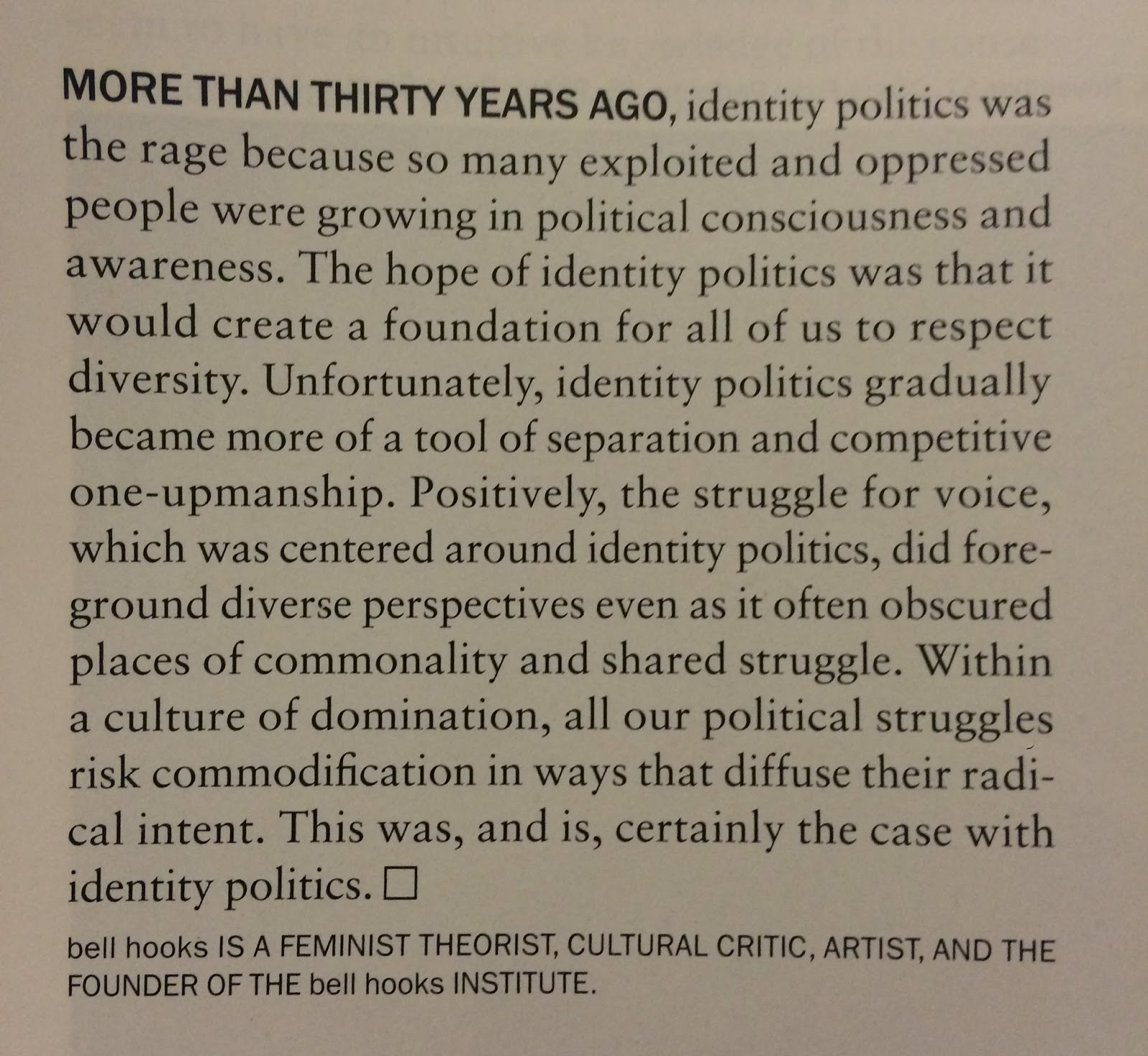
ETA: a little bell hooks:


HIERARCHICAL ORDER and AFFIRMATIVE ACTION

According to Peterson, we live within a hierarchy, and they tend towards tyranny when they're corrupted, but we have mechanisms to stop corruption. Our current hierarchy is one of merit. He said, "Foucault* believed the only basis for hierarchy is power, which is part of the PC doctrine. In our imperfect hierarchy we have constructed, it tilts at least somewhat to competence and ability as evidenced by staggering achievements." If we aim for equality of outcome, we'll regress to a state of tribalism.

The moderator asked, "How does Peterson get an equal voice back if it's implied that white privilege doesn't allow it?"

Dyson was incredulous considering Peterson's bid for equal access to the masses despite his popularity on YouTube: "How can Peterson get his equality back?? Why the rage? You're doing well!"

It brought to mind a similar exchange with my own children. When my children were little, about ages three and one, a wall in our kitchen was dedicated to their artwork. At the time, it was entirely my oldest's creations, but one day I added some artwork from her little brother. She balked at the intrusion, complaining that, "You're covering all my work with his!" So, together, we counted the twenty or so pieces she had up, and then that one piece from him. It really felt to her that her space was being taken over. As the oldest, she hadn't had to compete with anyone like this before. For two- thirds of her life she had my undivided attention. She learned to get a better feel for equity later on. She was just little. As for the others: "When you're accustomed to privilege, equality feels like oppression." It's time to give others a chance to speak.

Dyson and Goldberg addressed the idea that if we don't make any accommodations for people previously left behind, then those people never have a chance to reach their individual potential. It reminded me of a Chris Rock joke about white men having a 400-year head start. And there have been a few studies (herehere, and here) that sent out identical resumes with different names at the top to show that people with names that sound white and male get significantly more calls for an interview than their identical counterparts. Equality of opportunity is only logically fair if we really believe that racism and sexism are over. But they're so clearly not.

Dyson added, "If you free a person after oppression, with no skills or means of status, then you've liberated him into oppression. Peterson is not suffering from anything but that his privilege is invisible to him." And then he reminded him of some of the horrors being faced by minority groups, currently and historically. This takes me back to what Matthew Stewart said in a recent Atlantic article about the wealthiest 10%.
"We have figured out how to launder our money through higher virtues. . . . Our new multiracial, gender-neutral meritocracy has figured out a way to make itself hereditary. . . . If the system can be gamed, well then, our ability to game the system has become the new test of merit."

EXTREMES OF EACH SIDE: 

Peterson suggests that the left goes too far in its bid for diversity, inclusivity, and equality of outcome.  His view is that equality of outcome is abhorrent. And if that's not the worst case of the radical left, then, he challenged his opponents to answer, what is? At what point should we be concerned that the left has gone too far? He's trying to differentiate the reasonable left from the pathological left that has dominated the universities according to irrefutable studies from Johnathan Hiadt (duly refuted here and here).

Goldberg responded with "violence and censorship," but Peterson didn't accept the answer. "Saying the radical left goes too far when it's violent is not sufficient. It's a set of ideas that led to catastrophes in this century."

However, at the extremes, equality of outcome in which everyone ends up with the same stuff isn't what anybody's hoping to achieve. Even Marx didn't hope for that result. In the Communist Manifesto, Marx explains,
"The average price of wage-labour is the minimum wage, i.e., that quantum of the means of subsistence, which is absolutely requisite to keep the labourer in bare existence as a labourer. What, therefore, the wage-labourer appropriates by means of his labour, merely suffices to prolong and reproduce a bare existence. We by no means intend to abolish this personal appropriation of the products of labour, an appropriation that is made for the maintenance and reproduction of human life, and that leaves no surplus wherewith to command the labour of others. All that we want to do away with, is the miserable character of this appropriation, under which the labourer lives merely to increase capital, and is allowed to live only in so far as the interest of the ruling class requires it." 
Nobody wants everybody to get the same pay regardless their effort or ability or marketable skills. Guaranteed Basic Income only works if most people continue to work, as they will, to improve their lot beyond the basics. But the left hopes that the basics are covered. We don't want anyone to be scrambling to survive while others have more than they can use. It's not a matter of destroying the hierarchy entirely, but of flattening it enough that the bottom are able to thrive, not at the expense of the top, but merely without exploitation at their hands.

And nobody wants the extreme view at the other end either: equality of opportunity. That, I imagine, would look a little like Vonnegut's short story, "Harrison Bergeron," in which characters have to accept disabilities imposed on them in order to create a true level playing field. That side wants complete freedom as if it's entirely merit based. Peterson mentions that our imperfect hierarchy has mechanisms in place to prevent corruption. Isn't the Employment Equity Act just one such mechanism?

If we can keep from the extremes of the political dichotomy, and get specific about what the world should look like, then I think we're all uncomfortable with needless suffering, aren't we?

-------

*This is besides the point, but Peterson claims that Foucault said the only basis for hierarchy is power, and because of that, it's implied that Foucault wanted to dismantle or had a problem with, or saw something wrong with hierarchies, and then Peterson objects to this. But that doesn't jibe with what I've read on Foucault. For instance, this is Foucault on power: "We must cease once and for all to describe the effects of power in negative terms: it ‘excludes’, it ‘represses’, it ‘censors’, it ‘abstracts’, it ‘masks’, it ‘conceals’. In fact power produces; it produces reality; it produces domains of objects and rituals of truth. The individual and the knowledge that may be gained of him belong to this production" (194). If it IS the case that somewhere Foucault said hierarchies are only based on power, then surely they can also be based on productive power. It would appear that Peterson and Foucault are more in agreement than the former would prefer to admit.

Also besides the point, several pieces have been written about Peterson since Nellie Bowles wrote that New York Times article about his solution to the incels just over a week ago. Tabatha Southey compiled his most sexist views in Macleans, and McSweeney's satirized it in verse. And then, just yesterday, a former colleague of his, Bernard Schiff, called him 'dangerous' in The Star.
"Jordan has studied and understands authoritarian demagogic leaders. They know how to attract a following. . . . Douglas Murray described the atmosphere at one of Jordan’s talks as “ecstatic.” I have no way of knowing whether Jordan is aware that he is playing out of the same authoritarian demagogue handbook that he himself has described. If he is unaware, then his ironic failure, unwillingness, or inability to see in himself what he attributes to them is very disconcerting. . . . 
Jordan has a complex relationship to freedom of speech. He wants to effectively silence those left-wing professors by keeping students away from their courses because the students may one day become “anarchical social revolutionaries” who may bring upon us disruption and violence. At the same time he was advocating cutting funds to universities that did not protect free speech on their campuses. He defended the rights of “alt right” voices to speak at universities even though their presence has given rise to disruption and violence. For Jordan, it appears, not all speech is equal, and not all disruption and violence are equal, either. . . . If Jordan is not a true free speech warrior, then what is he? . . . He is a social order warrior. . . . He is a biological and Darwinian determinist. Gender, gender roles, dominance hierarchies, parenthood, all firmly entrenched in our biological heritage and not to be toyed with. . . . 
I have been asked by some if I regret my role in bringing Jordan to the University of Toronto. I did not for many years, but I do now. He has done disservice to the professoriate. He cheapens the intellectual life with self-serving misrepresentations of important ideas and scientific findings. He has also done disservice to the institutions which have supported him. He plays to “victimhood” but also plays the victim. . . . Jordan may have, however, welcomed being fired, which would have made him a martyr in the battle for free speech. He certainly presented himself as prepared to do that. A true warrior, of whatever. . . . Jordan is seen here to be emotionally explosive when faced with legitimate criticism, in contrast to his being so self-possessed at other times. He is erratic. . . . 
“Bernie. Tammy had a dream, and sometimes her dreams are prophetic. She dreamed that it was five minutes to midnight.” That was our last conversation. He was playing out the ideas that appeared in his first book. The social order is coming apart. We are on the edge of chaos. He is the prophet, and he would be the martyr. Jordan would be our saviour. I think he believes that."
I wonder if the debate was his swan song, unbeknownst to him, or will his followers relish the attempted sacrifice and grow in numbers? Time will tell. Until then, here's some Charles Taylor to bring us back to political correctness:
"Misrecognition shows not just a lack of due respect. It can inflict a grievous wound, saddling its victims with a crippling self-hatred. Due recognition is not just a courtesy we owe people. It is a vital human need."

Friday, May 25, 2018

Munk Debate On Political Correctness

Immersed, as I have been, in the political correctness / free speech dichotomy, I looked forward to the recent Munk Debate with Michelle Goldberg and Michael Eric Dyson on one side, and Jordan Peterson and Stephen Fry on the other. The debate was supposed to be about whether or not political correctness is a form of progress, which I take to mean, Does socially ostracizing or legislating certain language and behaviours benefit society in the future? Unfortunately, it went largely off the rails. Munk Debates aren't always as illuminating as they could be, despite the excellent moderator. I've written about a few of them: on the environment, on men, and on religion. They tend to fail in two ways: if any one person diverts from the central question or if all of them are too kind and not nearly critical enough of their opponent's arguments. One of the best questions a moderator ever asked, that I've copied in my classroom, was "Which of your opponent's arguments is most convincing?". I think in this recent debate, it would be impossible to answer because so few points were clearly argued.


ON POLITICAL CORRECTNESS:

I'll try to frame the ideas presented as charitably as possible, but this is merely what I heard being said. Here's the upshot of the response to the actual question in a flowchart:


On the con side, Fry lamented throughout that nobody was actually debating the original claim. He was left alone with his defence of the opposing side, and he so wanted a playmate in the game! His position was that there's no evidence that monitoring and limiting language has any benefit. His evidence to the contrary wasn't clearly explained, however, but it was implied ("look around") that he's using the fact that we still have sexism and racism everywhere as an indication of political correctness's failings.

I would counter that there is evidence of a benefit. That the fact that, back in the early 80s,  I had teachers that used racial slurs openly in class and that now that's an offence that could lead to termination, does in fact affect our culture in a positive way. Going to school with teachers who were openly sexist and racist has a marked affect on students, and it's a very positive thing that HR Departments have taken these issues seriously. And then, in the mid-80s, working at a corporation where we all just rolled our eyes at ongoing sexual harassment, I once came to work at 21 in a tailored dress, and my boss demanded that I stand up and do a spin so everyone in the department could see how "there's not an ounce of fat on this one!" It wasn't until 1991, when Anita Hill decoded her experiences that we began to learn how to speak out and demand that some behaviours be legislated. Absolutely the political correctness movement has been progressive. Yes, of course, if we look around racism and sexism still exist. But in many small and large ways, it's better than it was. And that progress was, at least in part, due to the stifling of some language and behaviours.

Fry suggests that it's an old rationalist idea that limiting languages changes thinking, and it lacks any empirical evidence. But now we know about neural pathways and cue exposure with response prevention (CERP). When we stop ourselves from a behaviour repeatedly, our desire to act in that manner decreases. If we continue a behaviour, it increases. That seems like plain common sense, but studies are discussing neural pathways in the brain. I picture it like trudging through deep snow in the winter. The more you do it, the more the path is formed and easy to travel, so you can do it without any effort. If we allow ourselves to make derogatory statements, the more we do it, the easier it gets, and the more acceptable it begins to feel. The corollary of course, is the more we actively stop ourselves from the behaviour, the more the pathways close up and we stop desiring to behave in bigoted ways. Changing how we talk and act consistently does change the way we think.

Fry thinks we should take to the streets to really make a change. I love a good march, but I rarely feel like anything's being accomplished from them. But Fry also argues that advances in culture were primarily a result of basic human decency. I agree that one thing that has had a marked affect is just being shown that non-dominant groups are pretty normal and maybe should be treated as well as dominant groups. I often credit that one episode of Ellen, when a much-loved character, we by default considered heterosexual, suddenly came out as gay, as being the turning point in the movement. Suddenly somebody everyone liked was in a group that made many people uncomfortable at best. That changed things for sure. Decades earlier, Mr. Rogers was a trendsetter in a similar vein:


Pop culture can help to teach us decency, but it can also work against those teachings. If human decency is the fulcrum that determines if we progress socially, then wouldn't it be advisable to put some barriers on the views that are most detrimental to decency? Will we improve our prospects of greater kindness with children (and the rest of us) immersed in "free speech" or surrounded by people curbing their more colourful vitriol?

The moderator asked a good question to Fry: "Why won't we look back at the PC movement in the same way as the civil rights movement?" He didn't answer it directly, but I think the movements are markedly different because the issues are different. What we're dealing with today, in many ways, is slipperier. Instead of refusing to tolerate segregation and staying seated on the bus, it's a matter of refusing to tolerate a word or tone and calling it out. It might seem petty, but it's all part and parcel of the fight, yes fight, to diminish the hold that racism and sexism still have in our culture. Fry suggests fighting instead of limiting words and behaviours, but can't it be both? Isn't is always?

We have to shut down the pejorative use of "fag" and "gay" in the classroom, AND we have to march and petition for LGBTQ+ rights and freedoms and ensure adequate inclusion in the charter and human rights codes. We have to complain about sexual harassing acts in the workplace, AND we have to fight for policy changes to ensure equal pay for work of equal value.

On the pro side, Goldberg argued that complaining about PC culture is a means to dismiss concerns that might affect the dominant group's comfort. She said, as I've argued before, "The dominant group is still really free to speak their mind." They've all been publicly chastised by Twitter mobs, yet they're all able to continue to speak. It's really a question of freedom or security (aka freedom from): "One group thinks their feelings should be accommodated. They feel uniquely that their feelings of being censored need to take primacy over groups feeling threatened." We tend to lean towards freedom in our culture, but there are times a little security can go a long way.

Dyson asked, "Of the things in the past that were once acceptable and now are not, what would you want to bring back?" We're so used to never saying the N-word that we don't even say it when talking about not saying it! Once upon a time, the offensiveness of the term was explained, and restraint requested, and it stuck because it does help society progress when citizens aren't chipped away moment by moment by people insisting that their right to use derogatory language is more important the that right to be free from verbal barbs thrown in your direction. Goldberg reminds us we've been here before. People react when their power is being challenged. We can't call Indigenous Peoples "Indians" anymore, and we've had to add people of colour to our curriculum. It's hard because it's new, and some of the ways we've tried to change have stuck, and some haven't. "We might look back at gender neutral pronouns and wonder that it was ever an issue."

It's really a matter of scale. We know from Gordon Allport that antilocution is the first step towards hate crimes and genocide, and we've seen that play out in real life, and it still happens within some groups and communities in the U.S. and Canada. The more we think is acceptable to say, the more we think is acceptable to do. I'm reminded of a story in one of Chris Hedges books: A man was in a crowd shortly before WWII, and a couple Nazi youth started harassing an elderly Jewish man with a long beard. They sat him on a barrel and cut his beard with hedge clippers in an exaggerated way, and the audience in the marketplace laughed, and the man watching it all knew this was the beginning of the end for them.

But what's the net harm caused by refraining to say bigoted words? How far can it go?


ABOUT THAT FEAR: 

Fry says, "There's a general feeling that we can't speak our minds. . . . There is a real fear to speak honestly about statements publicly. . . . I've never experienced that before. . . . The mistake of the left is to underestimate the right. I fear that PC is a weapon they value. The more we tell the world what words and attitudes are acceptable, all of this opens the door to ban bad actors."

Addressing the last claim first, it's a slippery slope to suggest that getting HR to stop a coworker from referring to a female boss as "babe" will lead to a full-on 1984, Big Brother level of censorship. We do, however, have to be awake enough and always thinking and questioning to make sure our rights aren't stripped away beyond a call for basic decency. I think we're up to the task. But what makes that claim a slippery slope, and the opposing one not? It's all in how the steps from one stage to the next are clearly linked to one another. Can we just use the words we associate with hatred without ever acting on them? Most of us can, but some people are testing the waters when they say things, preparing to take it further. It's the hateful citizens we have to worry about in this direction. Can we ask people to stop using them without adding to the list of words and phrases until we can no longer openly criticize Trump? It's a controlling government we are wary of down this path, and I'm banking on that we have enough people paying attention that we'd revolt at the inclusion of useful criticisms. (ETA - I believe this is the weak link in my argument, and I might address it another day.)

Goldberg addressed a different part of Fry's fear: "Men with a history of predatory behaviour were losing jobs. It created a cultural earthquake, an anxiety that it will go too far. Due process is important. When you look at who's actually lost their jobs, it's not people in general, but people who took their dicks out at work. . . . It's not the case that men everywhere can't talk anymore. . . . Who is silencing you? You're scared, but it's a feeling that is an intangible result."

BUT, I also think there is something to the fear that political correctness is currently going too far. My vision in my head of what it means had the brakes on a while back. This is a timely and important debate not to figure out if it's useful as a concept, but to determine where it should end. So, for me, it is the case that political correctness definitely can be progressive, but the more pressing issues for us today, then, are around who gets to determine what's acceptable or unacceptable, a tolerable level of scrutiny of behaviours, the consequences, and what that 'due process' looks like?

We run the risk of shutting down everything from a warm touch to playful flirting. Can we hug a colleague without it being legislated how close we stand? Can a teacher physically console a weeping student without threat of losing their livelihood? We're cautioned not to, but sometimes it's a sign of character to throw caution to the wind. And can I make a joke without getting arrested? Peterson, with typical hyperbole, formerly shared his concern that "all manifestations of male sexuality are going to be brought under legal control" (here), and he claimed it an injustice to have to use gender neutral pronouns at a student's request, much like I might ask to be referred to as Ms. instead of Miss and actually expect people to comply. But we don't have to raise potential extremes to be concerned. Teachers worry about losing their careers for one unthinking, unintended glance or comment. There definitely has to be a transparent process that allows people to feel secure in their positions knowing that they'll be exonerated once their intentions come to light, yet also catch the rare few with malevolent intent, the ones that have many complaints against them, for instance. One mistake is a mistake, but four or five might be an intended misuse of their power.

One of Fry's concerns is that the "ability to play gracefully with ideas is disappearing from our culture. . . . I don't think we should underestimate the feeling in the culture that the liberals are . . . undiverse in their call for diversity. You can be diverse but not diverse in your opinions, in your language, in your behaviour." I completely agree that we need to be able to continue to raise difficult issues in open discussions. I think that can still happen, and we have to be very watchful that touchy debates and discussions aren't shut down, but, as always, it must be done with care and respect for all those present.


THE FAILURE OF THE LEFT:

Fry says, "The reason for Trump's success isn't the triumph of the right but the catastrophic failure of left. Fuck PC, resist and fight. Fight through democracy, not through universities and language."

Dyson argues, "The reality is that people don't have access to a means to affect democracy. . . . We need to engage in tough criticism in a way that speaks to the needs and interests of those whose voices are not amplified." There is little possibility for the least powerful to have any effect on democracy any more. Chomsky and Reich agree with the assessment that the left is in a mess. Both major parties are neo-liberal in nature. The left should be the party that addresses the basic nature of inequities, but we can see how well that works here with Justin at the helm.

A Harvard professor, Dani Rodrik, agrees:
"Had political parties, particularly of the center left, pursued a bolder agenda, perhaps the rise of right-wing, nativist political movements might have been averted. In principle, greater inequality produces a demand for more redistribution. Democratic politicians should respond by imposing higher taxes on the wealthy and spending the proceeds on the less well off. This intuition is formalized in a well-known paper in political economy by Allan Meltzer and Scott Richard: the wider the income gap between the median and average voter, the higher the taxes and the greater the redistribution. Yet in practice, democracies have moved in the opposite direction. . . . Part of the reason for this, at least in the US, is that the Democratic Party’s embrace of identity politics (highlighting inclusiveness along lines of gender, race, and sexual orientation) and other socially liberal causes came at the expense of the bread-and-butter issues of incomes and jobs."
I think they didn't necessarily come at the expense of, but, perhaps as a distraction to: I'll give you gender neutral bathrooms, but I'm keeping the Koch cash and pushing my pipeline through your wilderness. Rodrik continues,
"The French economist Thomas Piketty has recently documented an interesting transformation in the social base of left-wing parties. Until the late 1960s, the poor generally voted for parties of the left, while the wealthy voted for the right. Since then, left-wing parties have been increasingly captured by the well-educated elite, whom Piketty calls the “Brahmin Left,” to distinguish them from the “Merchant” class whose members still vote for right-wing parties. Piketty argues that this bifurcation of the elite has insulated the political system from redistributive demands. The Brahmin Left is not friendly to redistribution, because it believes in meritocracy – a world in which effort gets rewarded and low incomes are more likely to be the result of insufficient effort than poor luck."
I think, for the states, the biggest problem wasn't that Clinton lost to Trump, but that Sanders lost to Clinton. Sanders's policies were actually of the left, and that's so very rare. Now we'll see what happens in Ontario.


Possibly the brightest point in the debate came with Fry's closing:
"Angels can fly because they take themselves lightly. It's very important for us, who are privileged . . . to take ourselves a little more lightly, not to be too earnest, too pompous, too serious, and not to be too certain. It's a time for really engaging in emotionally fulfilling, passionate, and positive doubt." 
Some of the participants, more than one, had difficulty really hearing one another and addressing their very real fears in order to come to find the common ground. I'll get to the wayward path of the rest of the debate tomorrow.