Showing posts with label Marx. Show all posts

Thursday, December 26, 2024

Basic Christian Morals

I was scrolling mindlessly yesterday morning, on Christmas Day, and came across some outrage around unhoused people being put up in a hotel at taxpayer's expense. The naysayers clearly have never seen Dicken's A Christmas Carol or even Bill Murray's Scrooged. Remember when that line, "Are there no prisons? Are there no workhouses??" came back to bite him in the ass?

Matthew 25:35-40

First of all, what the heck are taxes for but to ensure the basic needs of all?? If we decide that each person has to manage on their own without help from anyone, then we're back to law of the jungle, and we don't need much in the way of government or leadership at all or any social organization. If we're back to might makes right, with "might" referring to the power of wealth, then we're no longer in a civilization. For thousands of years we've known that a healthy, well-functioning society requires a way to care for the less fortunate. From the most base analysis, if we don't help others, they'll be more inclined to steal from us. This stance might claim to want social organization for education and hospitals, but it seems like they just want to ensure they have it for their own families, not for everyone in general. The things that they can afford to pay for somehow don't count as basic needs to provide for all. 

Curious.

Sunday, October 6, 2024

On Burnout: "Can" is the New "Should"

I started reading about burnout when I walked away from teaching earlier than expected. Suddenly, I couldn't bring myself to open that door after over thirty years of bounding to work. A series of events wiped away any sense of agency, fairness, or shared values. Their wellness lunch-and-learns didn't help me, and I soon discovered I'm not alone.

An article published in JAMA last June looked at rising rates of burnout in healthcare, where 40% of physicians surveyed intended to leave their practice. They suggest, "To prevent a health care worker exodus, experts argue that the emphasis needs to shift from individual resilience to broader system-level improvements." They are looking for standardized methods to affect organizational management with "evidence-based interventions."  


Over 25 years ago, Michael Leiter and Christina Maslach came to the same conclusion. They identified six areas of worklife affecting burnout and created a specific assessment for educators. They determined the cause to be a "mismatch" between employee expectations and employer behaviours leading workers to be closer to the bleak end of a continuum from burned out to engaged. They suggest that "the task for organizations and individuals is to achieve a resolution." This is not just a matter of throwing wellness initiatives or resilience-speak into the mix, but addressing any reasonable expectations of employees with appropriate employer interventions in all six interrelating areas. 


click for clarity

Feels vindicating, right?!

Wednesday, September 6, 2023

On Marxism

It's such a go-to now to call the enemy some version of a communist in a weird throwback to 1950s America and McCarthyism. And now the leader of the opposition accused Canada's Prime Minister of being a Marxist, and he said it like it's a bad thing!

Lisa B0923 explains why Trudeau is decidedly not Marxist: 

"This is what Marxists believe: 'Marxism analyses the impact of the ruling class on the laborers, leading to uneven distribution of wealth and privileges in the society. It stimulates the workers to protest the injustice.' Now I guess compared to the current CPC the liberals may look Marxist because the current CPC is so far right, like, you can't even see them in the distance." 

@lisab0923 #greenscreenvideo #greenscreen #pierrepoilievre #jamiljivani #michelleferreri #cpc #durham #doorknocking #staged #justintrudeau #liberal #marxist #buzzwords #ragefarming #politicalspectrum #conservativesarewack #howembarrassing #canada #canpolitt #sorightyourewrong #neverpoilievre #everydamnday ♬ original sound - Lisa

But let's dive a little deeper into what Marx said to see that philosophically, communists and capitalists aren't that far apart, but both are nowhere near the neolibertarian capitalists. Kinda like Lisa said above, neoliberals are just so far to the right that everyone looks like a commie from their vantage point.

Commies, Capitalists and Neoliberal Capitalists

What I think is interesting is that one of the fathers of capitalism, John Locke, and one of the fathers of communism, Karl Marx, were reacting to their different situations in very similar ways. 

Friday, August 23, 2019

Hannah Arendt's On Violence

Unfortunately, this is really timely.

Arendt wrote this short book in 1970, but there's nothing in it that needs to be updated today. Absolutely nothing significant has changed; it's just more. She was responding to the violence of WWII, Vietnam, the student riots in Paris, and, most specifically, the People's Park protests in Berkeley, where she was teaching at the time as students attempted "transforming an empty university-owned lot into a 'People's Park'." Sheldon Wolin and John Schaar wrote about how the event unleashed an unnecessarily strong police backlash:
"A rock was thrown from a roof-top and, without warning, police fired into a group on the roof of an adjacent building. Two persons were struck in the face by the police fire, another was blinded, probably permanently, and a fourth, twenty-five-year-old James Rector, later died. Before the day was over, at least thirty others were wounded by police gunfire, and many more by clubs. . . . Tear gas enfolded the main part of the campus and drifted into many of its buildings, as well as into the surrounding city. Nearby streets were littered with broken glass and rubble. At least six buckshot slugs entered the main library and three 38 calibre bullets lodged in the wall of a reference room in the same building. Before the day ended, more than ninety people had been injured by police guns and clubs."
That was on May 15, 1969, known as "Bloody Thursday." The Kent State shootings in Ohio were almost exactly one year later. Arendt tries to make sense of it all through a look at the changing view of violence in society.

Thursday, January 3, 2019

On Capitalism's Limitations

Every year, when we get to the part of my philosophy course where we read some Marx & Engels, and I ask for criticisms of the reading, like I do with every other political philosopher we read, instead of thinking and devising astute observations, there's always a few who are adamant: "Communism is fine in theory but doesn't work in real life." This is a truism chanted without much thought needed to repeat it. But then I ask, "Can't the same be said for capitalism?" And, "What do you mean by work? What does it look like when a political theory works?"

Saturday, May 26, 2018

Defining the Left

This is a continuation of my previous post on the political correctness issue raised in last week's Munk Debates with Jordan Peterson, Michelle Goldberg, Michael Eric Dyson, and Stephen Fry (who stayed on task, so won't be discussed here). The rest of the debate skirted around the issue of political correctness but focused more on the extreme versions of left and right. Again, this is what I heard in the most charitable reading I can give it. That being said, I find Peterson difficult to follow at times. He has a tendency to mix clear and obvious truisms with a suggestion of something more controversial. Then when that controversial point is questioned, he can easily insist it's not what he said at all, without then clarifying what it is he actually meant by the suggestion. It's all a little slippery.


COLLECTIVISM VS INDIVIDUALISM in IDENTITY POLITICS

Peterson indicated his concern with the collectivist nature of the Left, in which you're not an individual, but a member of a group categorized along lines of ethnicity, sex, and race. The problems with this perspective, he says, are that it leads to tribalism, it doesn't allow free speech because "when you speak, you're just playing a power game on behalf of your group," and we can't have group rights because we can't have group responsibilities.

Goldberg and Dyson both referred to Peterson's view of the left as a caricature that, if the case at all, is an insignificantly small minority.

About group identity in general, Dyson said, "Identity is foisted on people of colour. Who wants to be part of a group attacked at Starbucks? We're treated as a group and denied the ability to act as individuals. . . . Nobody is a bigger snowflake than white men who complain 'they won't let us play with the old regime where we hated other races.'" And Goldberg said,
"Wanting more minorities in power is not because we're looking for crude equity, but because many individuals are not able to reach their potential on their own. It's classical liberalism. . . . A huge part of politics is groups struggling for rights for individual members: women seeking the right to control over their own body and minorities seeking redress from police brutality. We can't contend with those social problems if you see society as just atomized as individuals. There's nothing pernicious about people banding together to redress injustices." 
Goldberg also took him to task for the false analogy between individual and group responsibilities. We can have group rights and then take individual responsibility within that group.

Their main argument is that being a member of a group is the only way for the disenfranchised to get freedom for the individuals within the group, especially now that we're at a point where technology and outsourcing are taking even more jobs. Nora Loreto has a similar concern with Peterson's slant:
"Researchers at McMaster University in Hamilton, Ontario, have demonstrated that there is a link between precarious work and increased anxiety, depression and emotional difficulty. These trends can change only when people work together and demand improvements, whether it’s locally through community activism, or on a larger scale. But that kind of thinking would put Peterson out of work. Peterson’s logic preys on people already in despair and puts them into a cycle that they cannot improve on their own. He’s creating a cadre of dependent disciples.
That being said, however, there is a legitimate concern that political correctness is a surreptitious way for people to get power. It can be seen as a type of vigilante justice in which small groups try to define the rules for the rest. I saw this first hand as I had to gently remind a parent that the province sets the curriculum for my course, so, no, I can't remove an entire unit in order to accommodate her daughter's comfort in my class. That's new and weird, but it feels like it just takes a little push back to remind people that what makes them personally uncomfortable can't be solely what determines what's available to the rest. As I said yesterday, we need limits to political correctness, but let's not thrown the baby out with the bathwater. And, when we use these terms, it's imperative we discuss specifics so we can have real arguments about the true consequences of ideas rather than nebulous theoretical debates. If people feel persecuted, it can help to scrutinize the barriers to freedom they're addressing in order to assess whether or not our pity is warranted. We have to start talking about this issue with real examples on the table to be able to get at the nitty gritty of the border between demanding respect for others and abusing power from the bottom up.

ETA a little de Beauvoir (America Day by Day, p. 94):


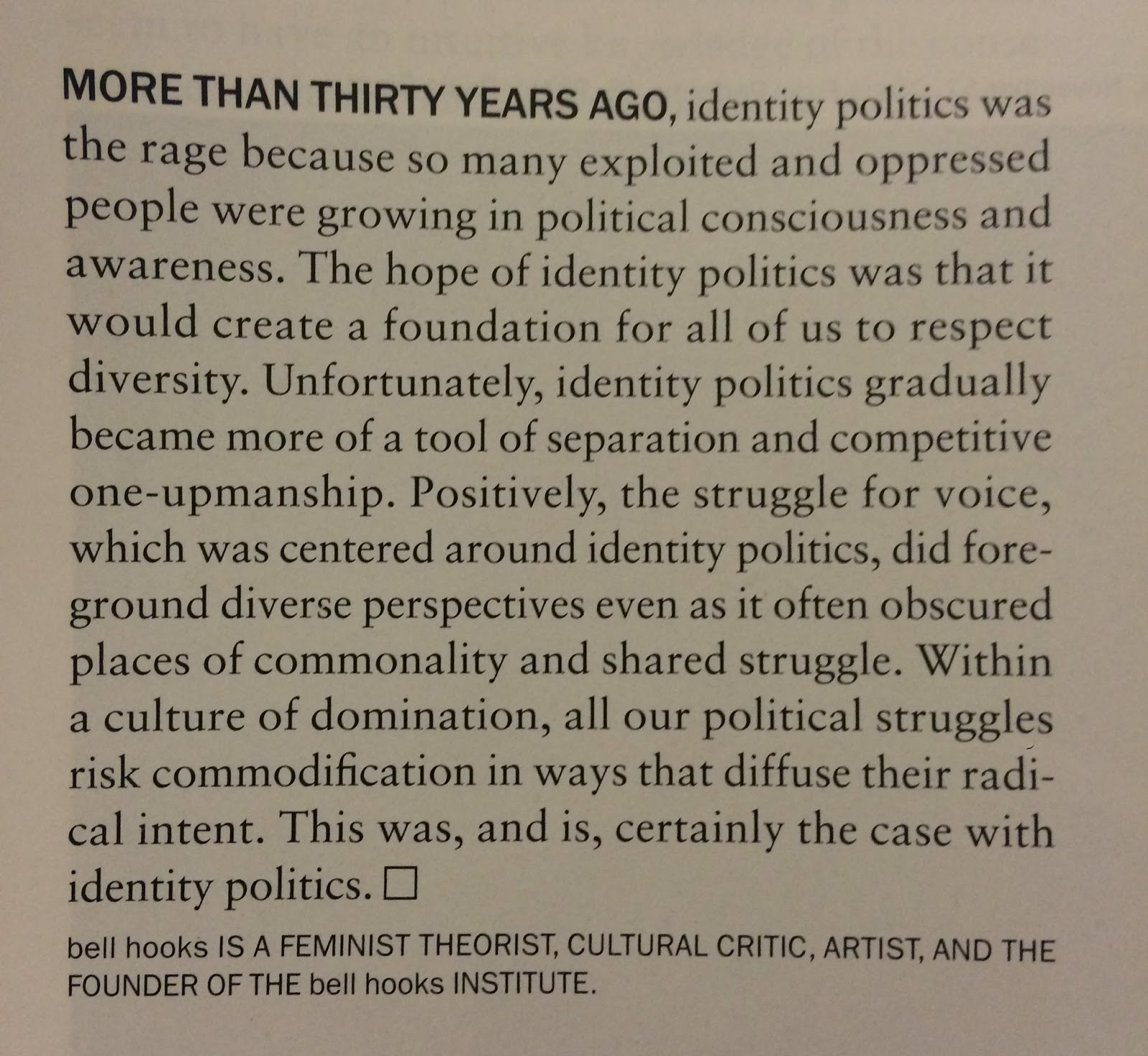
ETA: a little bell hooks:


HIERARCHICAL ORDER and AFFIRMATIVE ACTION

According to Peterson, we live within a hierarchy, and they tend towards tyranny when they're corrupted, but we have mechanisms to stop corruption. Our current hierarchy is one of merit. He said, "Foucault* believed the only basis for hierarchy is power, which is part of the PC doctrine. In our imperfect hierarchy we have constructed, it tilts at least somewhat to competence and ability as evidenced by staggering achievements." If we aim for equality of outcome, we'll regress to a state of tribalism.

The moderator asked, "How does Peterson get an equal voice back if it's implied that white privilege doesn't allow it?"

Dyson was incredulous considering Peterson's bid for equal access to the masses despite his popularity on YouTube: "How can Peterson get his equality back?? Why the rage? You're doing well!"

It brought to mind a similar exchange with my own children. When my children were little, about ages three and one, a wall in our kitchen was dedicated to their artwork. At the time, it was entirely my oldest's creations, but one day I added some artwork from her little brother. She balked at the intrusion, complaining that, "You're covering all my work with his!" So, together, we counted the twenty or so pieces she had up, and then that one piece from him. It really felt to her that her space was being taken over. As the oldest, she hadn't had to compete with anyone like this before. For two- thirds of her life she had my undivided attention. She learned to get a better feel for equity later on. She was just little. As for the others: "When you're accustomed to privilege, equality feels like oppression." It's time to give others a chance to speak.

Dyson and Goldberg addressed the idea that if we don't make any accommodations for people previously left behind, then those people never have a chance to reach their individual potential. It reminded me of a Chris Rock joke about white men having a 400-year head start. And there have been a few studies (herehere, and here) that sent out identical resumes with different names at the top to show that people with names that sound white and male get significantly more calls for an interview than their identical counterparts. Equality of opportunity is only logically fair if we really believe that racism and sexism are over. But they're so clearly not.

Dyson added, "If you free a person after oppression, with no skills or means of status, then you've liberated him into oppression. Peterson is not suffering from anything but that his privilege is invisible to him." And then he reminded him of some of the horrors being faced by minority groups, currently and historically. This takes me back to what Matthew Stewart said in a recent Atlantic article about the wealthiest 10%.
"We have figured out how to launder our money through higher virtues. . . . Our new multiracial, gender-neutral meritocracy has figured out a way to make itself hereditary. . . . If the system can be gamed, well then, our ability to game the system has become the new test of merit."

EXTREMES OF EACH SIDE: 

Peterson suggests that the left goes too far in its bid for diversity, inclusivity, and equality of outcome.  His view is that equality of outcome is abhorrent. And if that's not the worst case of the radical left, then, he challenged his opponents to answer, what is? At what point should we be concerned that the left has gone too far? He's trying to differentiate the reasonable left from the pathological left that has dominated the universities according to irrefutable studies from Johnathan Hiadt (duly refuted here and here).

Goldberg responded with "violence and censorship," but Peterson didn't accept the answer. "Saying the radical left goes too far when it's violent is not sufficient. It's a set of ideas that led to catastrophes in this century."

However, at the extremes, equality of outcome in which everyone ends up with the same stuff isn't what anybody's hoping to achieve. Even Marx didn't hope for that result. In the Communist Manifesto, Marx explains,
"The average price of wage-labour is the minimum wage, i.e., that quantum of the means of subsistence, which is absolutely requisite to keep the labourer in bare existence as a labourer. What, therefore, the wage-labourer appropriates by means of his labour, merely suffices to prolong and reproduce a bare existence. We by no means intend to abolish this personal appropriation of the products of labour, an appropriation that is made for the maintenance and reproduction of human life, and that leaves no surplus wherewith to command the labour of others. All that we want to do away with, is the miserable character of this appropriation, under which the labourer lives merely to increase capital, and is allowed to live only in so far as the interest of the ruling class requires it." 
Nobody wants everybody to get the same pay regardless their effort or ability or marketable skills. Guaranteed Basic Income only works if most people continue to work, as they will, to improve their lot beyond the basics. But the left hopes that the basics are covered. We don't want anyone to be scrambling to survive while others have more than they can use. It's not a matter of destroying the hierarchy entirely, but of flattening it enough that the bottom are able to thrive, not at the expense of the top, but merely without exploitation at their hands.

And nobody wants the extreme view at the other end either: equality of opportunity. That, I imagine, would look a little like Vonnegut's short story, "Harrison Bergeron," in which characters have to accept disabilities imposed on them in order to create a true level playing field. That side wants complete freedom as if it's entirely merit based. Peterson mentions that our imperfect hierarchy has mechanisms in place to prevent corruption. Isn't the Employment Equity Act just one such mechanism?

If we can keep from the extremes of the political dichotomy, and get specific about what the world should look like, then I think we're all uncomfortable with needless suffering, aren't we?

-------

*This is besides the point, but Peterson claims that Foucault said the only basis for hierarchy is power, and because of that, it's implied that Foucault wanted to dismantle or had a problem with, or saw something wrong with hierarchies, and then Peterson objects to this. But that doesn't jibe with what I've read on Foucault. For instance, this is Foucault on power: "We must cease once and for all to describe the effects of power in negative terms: it ‘excludes’, it ‘represses’, it ‘censors’, it ‘abstracts’, it ‘masks’, it ‘conceals’. In fact power produces; it produces reality; it produces domains of objects and rituals of truth. The individual and the knowledge that may be gained of him belong to this production" (194). If it IS the case that somewhere Foucault said hierarchies are only based on power, then surely they can also be based on productive power. It would appear that Peterson and Foucault are more in agreement than the former would prefer to admit.

Also besides the point, several pieces have been written about Peterson since Nellie Bowles wrote that New York Times article about his solution to the incels just over a week ago. Tabatha Southey compiled his most sexist views in Macleans, and McSweeney's satirized it in verse. And then, just yesterday, a former colleague of his, Bernard Schiff, called him 'dangerous' in The Star.
"Jordan has studied and understands authoritarian demagogic leaders. They know how to attract a following. . . . Douglas Murray described the atmosphere at one of Jordan’s talks as “ecstatic.” I have no way of knowing whether Jordan is aware that he is playing out of the same authoritarian demagogue handbook that he himself has described. If he is unaware, then his ironic failure, unwillingness, or inability to see in himself what he attributes to them is very disconcerting. . . . 
Jordan has a complex relationship to freedom of speech. He wants to effectively silence those left-wing professors by keeping students away from their courses because the students may one day become “anarchical social revolutionaries” who may bring upon us disruption and violence. At the same time he was advocating cutting funds to universities that did not protect free speech on their campuses. He defended the rights of “alt right” voices to speak at universities even though their presence has given rise to disruption and violence. For Jordan, it appears, not all speech is equal, and not all disruption and violence are equal, either. . . . If Jordan is not a true free speech warrior, then what is he? . . . He is a social order warrior. . . . He is a biological and Darwinian determinist. Gender, gender roles, dominance hierarchies, parenthood, all firmly entrenched in our biological heritage and not to be toyed with. . . . 
I have been asked by some if I regret my role in bringing Jordan to the University of Toronto. I did not for many years, but I do now. He has done disservice to the professoriate. He cheapens the intellectual life with self-serving misrepresentations of important ideas and scientific findings. He has also done disservice to the institutions which have supported him. He plays to “victimhood” but also plays the victim. . . . Jordan may have, however, welcomed being fired, which would have made him a martyr in the battle for free speech. He certainly presented himself as prepared to do that. A true warrior, of whatever. . . . Jordan is seen here to be emotionally explosive when faced with legitimate criticism, in contrast to his being so self-possessed at other times. He is erratic. . . . 
“Bernie. Tammy had a dream, and sometimes her dreams are prophetic. She dreamed that it was five minutes to midnight.” That was our last conversation. He was playing out the ideas that appeared in his first book. The social order is coming apart. We are on the edge of chaos. He is the prophet, and he would be the martyr. Jordan would be our saviour. I think he believes that."
I wonder if the debate was his swan song, unbeknownst to him, or will his followers relish the attempted sacrifice and grow in numbers? Time will tell. Until then, here's some Charles Taylor to bring us back to political correctness:
"Misrecognition shows not just a lack of due respect. It can inflict a grievous wound, saddling its victims with a crippling self-hatred. Due recognition is not just a courtesy we owe people. It is a vital human need."

Sunday, June 5, 2016

Avoiding the Lesser of Two Evils

It's not my country, but what happens in America affect the world. And we're right next door. The Left Forum had a panel discussion a couple weeks ago with Glen FordChris Hedges, and Jill Stein, chaired by Linda Thompson, that's worth a listen. It's two hours long, and a feat of tolerance for all the chattering and cell phones in the audience, so I summarized some highlights below.


In a nutshell, Clinton is just as scary as Trump, so everyone who hoped to vote for Sanders, should vote for the Green Party or any independent party if Sanders doesn't win in the primaries. The Greens are unlikely to win, but it will send a clear message that there are enough Americans who care about reform, that they won't fall for the ideology that there are only two parties running. Here are their arguments heavily condensed and slightly paraphrased:


Hedges on the Façade of a Two-Party System:
"Once the neo-liberal ideology is no longer able to hold the loyalty of a population, those regimes will collapse. Mechanisms that defend power are no longer willing to work on its behalf. That process of revolutionary change is slow and often invisible. The facade of the superstructure remains in place. That is precisely where we are in American history. It’s incumbent upon those who care for the socialist society, that we step outside these structures, even if we remain a minority, so that we provide an alternative to this power.  
Nationalism is a disease which has infected both parties. It deifies the military. It sucks people into its orbit; it has at its disposal powerful forms of indoctrination that stokes the kind of proto-fascism we see at Trump rallies. Democrats are as culpable as Republicans at creating this toxic environment. Clintons are built on loyalty to corporate power and white supremacy. They passed the three-strikes law, massively expanded sentences, expanded the prison industrial complex, pushed through the first trade agreement. John Ralston Saul called Bill Clinton's administration a corporate coup d'état.  
Sanders was okay with Israelis bombing Palestinian communities. He's an AIPAC wind-up doll. He's been in the pockets of the Clintons for a long time; he campaigned for Bill Clinton in 2004. He's got a faustian bargain with the Democrats, and he's naive to think he could compete fairly in the primaries.  
We owe it to our children to step outside this system and begin to fight back. We'll never achieve power through political parties. All of our energy has to be invested in movement. We have to knit groups together (anti-fracking, black lives matter, fight for the minimum wage...) and carry out sustained acts of civil disobedience. The ability to reform from within the structures of power has been taken from us.

Stein on the Lesser Evil Agenda:
"I'm most horrified by a political system that gives two lethal choices and says pick between them. This is a reflection of inherent dysfunctions in this system. Both are minority parties, so it's important that we seize this moment. A report from NOAA last week discussed an Oh my God report confirming that we could expect nine feet of sea level rise by 2050 if we don’t take profoundly different action by then. Instead we get drill baby drill on steroids not only increasing, but accelerating.

While agreement in Paris was being forged, and Obama was celebrating, they were behind close doors, signing on to the end of the oil export ban which massively increases oil exploration. We have a choice of a corporate vision with a smile or without a smile. Both parties are funded by same predatory banks, fossil fuel giants, and war profiteers. It’s clear we can’t keep going in this direction. Climate meltdown has a deadline. By 2050 all of the coastal US cities will be under water and 600 million people will be refugees. The greater evil is the economic meltdown we’re looking at. Banks are bigger than ever.

But we actually have the power. Alice Walker said that the biggest way we give up power is not knowing we have it in the first place. If we don’t fight in the halls of power, then we’re basically raising the white flag of surrender, and we’ll be bulldozed by the stroke of a pen. The great news is that we have the power to stand up. If you take just people locked into predatory student debt, locked into economic servitude, and those people are 43 million strong, that is a winning plurality in a presidential race. There's only one party who will bail them out if that word gets out. It doesn’t take a whole lot of motivation to see it can be erased with a stroke of a pen if they vote Green. We’re in the polls now where Sanders was six months ago. As Bernie’s campaign begins to fold in a path of sabotage, we can’t have a revolutionary campaign in a counter-revolutionary party.

We need coalitions. Change is not going to happen under Clinton. We need to stand up now if we want to decommission nuclear power plants on the coast because they will flood out. We should be telling supreme court what to do. We did it in the 60s. We brought troops home; brought in clean air act and clean water act. Don’t accept that we’re powerless. We are powerful. And we have the numbers it takes to win the battle. We just need the courage of our convictions. There's an attitude of cowardice that is unleashed when we’re told to accept voting for the lesser evil. We need to have courage. It’s time to forget the lesser evil and fight for the greater good like our lives depend on it, because they do. 
The lesser evil paves the way for the greatest evil and makes it inevitable. People can’t mobilize themselves; witness the beating Sanders is getting. That party is being hijacked. Through the policies of the Clintons, we got the makings of Trump. We got the right-wing populism which is a response to the economic desperation of the people caused by Clinton. In terms of the nuclear threat, the Obama administration withdrew from the anti-ballistic missile treaty which was the main tool to move towards nuclear disarmament, and now the Obama administration is leading a trillion dollar movement towards nuclear war. We know what Hillary will do. She wants to take an airborne attack. Trump is risky, but Hillary is certain death.

Thompson on Some Problems with the Left:
Che Guevara said that revolutionaries are motivated by great feelings of love. The left is bad for getting too intellectual and has problems expressing that love. People have to feel safe abandoning the lesser evil and going for the unknown. Unity is the key. There are lots of little tiny groups of activist that have to unite. 
A lot of the problem isn’t Trump, it’s the corporate media and the 1%. The left-wing media is to blame as well. Amy Goodman has blacked out Jill’s campaign as much as the right-wing media does. There’s a section of Democracy Now where you can say what you want to see on their show. Ask them why she’s not covering these parties. We can’t let them get away with this anymore. Call for a revolution.


Hedges on the Prison System and Fascism:
We have to stop talking about people within the system of mass incarceration and focusing on non-violent drug offenders. There are round-ups of everyone in the room in a drug deal. 94% of the people incarcerated never go to trial. They slap all sorts of charges on you that you didn’t commit. They tell you, if you go to trial, you’ll be charged with all of it, and you’ll never win. But if you accept the plea of 11 years, we'll cut this and this. 80% of the people in the prison system shouldn’t be there. The whole system lynched them. My students with the longest sentences went to trial because they didn’t commit the crime, and they punished them with 30-year sentences. 
Fascism rises out of a political vacuum. We have to stop getting conned into the personality. We have to see the system for what it is. In terms of fossil fuels, war machines, etc., there will be no difference between Trump and Clinton. Read Democracy Incorporated by Sheldon Wolin to get an understanding of how inverted totalitarianism works. Neither Clinton nor Trump will set up a reasonable environmental policy. In this system there’s no way to vote against Exxon Mobile. 


Ford on Black Leaders
"Some black leaders are still corporate owned. We can’t just vote for people who look like us. We have to support people with values, people willing to stand up against racism and imperialism. We have to get away from skin-based politics."

Stein added, "The Malcolm X Grassroots Movement put together a plan in the context of an emergency of racial injustice that demands attention."

A commenter added: "Society can’t be dominated by white progressive and white liberals. There are so many overt displays of white supremacy, that black people don’t want to join them. We need to think of a society where you don’t have control of most of the land, because it wasn’t yours to begin with."


Hedges on Fighting for Marginalized Communities: 
Within marginal communities the system of capitalism has created a system of perpetual evictions, which has affected the psychological health of citizens and the cohesive nature of neighbourhoods. In the 30s, people would get up and block sheriffs from bringing foreclosures. Capitalism destroys the cohesiveness that make that resistance possible. Men are in prison and women and children are evicted. Marx called this surplus labour. People are preyed upon. They lock you in a cage to generate $40-50 thousand a year. Whole corporate entities (moving companies, storage companies, insurance...) are built around benefiting from systems of oppression. 
We’re not in those community to see what’s been done to crush those people. None of us could endure that. It gets back to the dark system of corporate capitalism. You have to look now at sacrifice zones - at what we have allowed to be done to the vulnerable in society. We’ve gotten caught up in the boutique activism of personality politics. Feminism should be about empowering oppressed women, but it’s about having a woman president and woman CEOs. The bottom ⅔ of blacks in the country are worse off than when King marched. White liberals are caught in the game of diverting attention from horrific, brutal, cruel forms of injustice. I teach in a prison because I wouldn’t know otherwise. These people are invisible. They vanish. Newspapers don’t even have labour journalists any more. 

Ford added: "It's not just white liberals - it's those who have become collaborators with this corporate system. In every struggle for independence of colonialist power, we have to kill more fellow African-Americans in order to get to the enemy."

Stein: "It's our job, as privileged white people who have enormous benefits from the system, to support the community and struggle in their fights as they define them. They’re already organizing; our job is to help. There have been victories in indigenous land and treaty rights. The support of environmental communities is critical to those victories. This is a model to support."

Hedges: "In the prisons, they are so far ahead of us politically. They don’t think anybody’s going to overcome the lobbyists. They are organizing a mass prison strike. It’s going on right now across the country. It started in Alabama. I will be cross-country on September 9th, the anniversary of Attica. In system of neo-slavery, no prison runs without prison labour. Don’t go to the state house or the capital to protest, go to the prison house to show us you’re there. These people have so much courage. They broke their strike in Alabama by refusing to feed them. They are a highly conscious politically oppressed group who are rising up with integrity to fight back, and we have to stand with them."

Thompson: "We don’t need to reinvent the wheel. We need to re-invigorate the discussion the Panthers started. They already created a 10-point program."

Ford: "We need to decolonize Puerto Rico and forgive the debts."

Stein: "We need to liberate the public airways. The president could instruct federal communication to stop the privatization of airways. When the FCC looked at privatizing internet, there was a social movement that stopped it.

Commenter: "We need to be willing to be under the leadership of The African People's Socialist Party and go to the prisons. It's the only way to be in touch in a vital, emotional way or else it gets too abstract.  A lot of things we debate are moot.  39,000 strikers are protesting a destructive company that gets 1.8 million per month in a template that's the demise of the working class. They shipped call centres to Trinidad.

Hedges: "Workers are reduced to serfs across the board. The problem is multifaceted. It's partly the fault of the unions who made concessions to corporations. But this is what’s going to happen to all of us  It's a reconfiguration of the economy to neo-feudalism with prisons that feed like sharks off them, where a phone call home costs 5 times the actual costs, and prisoners have to pay from their $28/month wages."

Stein: "The media calls Verizon strikers greedy, but it's not just about wages. They're demonized because they're asking for more than living wage. We're moving to a system in which a poverty wage is acceptable; it's important to be vocal to support the strike."

Ford: "It is all about the cost of labour and the race to the bottom driven by the tremendous wage differentials in the world."

Stein: "We need social movements. They are the engine of social change. Political parties are able to unite social coalitions. A real political party is an effort to bring people together under a common agenda. There’s not a conflict between working for electoral parties and social parties."

Hedges: "The next trade agreement will destroy the post office. It says that no government enterprise can exist unless corporations can compete with them. It's the same reason hedge funds run charter schools. Marx explained that in late stages of capitalism, as you disenfranchise the country, you disembowel the state structures in order to make profits."


To sum it up: We have the ability to make this change. It feels like there are a lot of issues to address, but there's really just one: the neo-liberal agenda to profit off the back of the people. And it's being promoted by the Democrats as much as the Republicans. We need to continue to have candidates run that come out of the movement. And we actually have to vote for them.


Sunday, May 31, 2015

The Moral Imperative of Revolt

I prefer Hedges' subtitle to his title, Wages of Rebellion, but this post isn't about him per se.  Morally, we have to revolt against this corrupt system - like when the workers in Rome all walked out in a series of secessions (it doesn't always take the first time), or when the Barons and peasants turned on the King in the middle ages, or when workers in Winnipeg went on strike, and through all the rebellions against tyrannical rule in between and later.

The problem: unbridled power; the common people being subjected to the whims of the state; the masses living in poverty while the elites reap the rewards of their labour.  Right now we need a Clause 61 like they had in 1215:  25 MPs ordered to uphold the Charter in case the PM tries to overrule it:
Any infringement of the charter’s terms by the king or his officials was to be notified to any four of the committee; and, if within forty days no remedy or redress had been offered, then the king was to empower the full committee to ‘distrain and distress us in every way they can, namely by seizing castles, lands and possessions’ until he made amends. In this remarkable clause, then, the charter introduced the novelty of obliging the king to sanction and institute armed action against none other than himself.

Over and over throughout history whenever a small group has found the means and strategy to get total control over a people, the people eventually revolted.  Many died trying before succeeding, and sometimes their efforts made life significantly better, and things improved for a time, until everyone got complacent again.  You'd think that any knowledge of history would make leaders wary of taking so much power for themselves and screwing over the masses.  You'd think.  

But things are frighteningly different today.  Religion is not the opiate of the masses anymore; the internet is.  We're back to bread and circuses.  We have it just good enough to ignore the news.

Here's Marx's full quote (italics are his - he was an emphatic writer):
The abolition of religion as the illusory happiness of the people is the demand for their real happiness. To call on them to give up their illusions about their condition is to call on them to give up a condition that requires illusions. The criticism of religion is, therefore, in embryo, the criticism of that vale of tears of which religion is the halo.  
Getting rid of the distractions in our world is a red herring.  We have to get rid of the conditions that lead us to need so many distractions, the condition that requires illusions to exist.  We need to WAKE UP to the issues and get angry enough to act on them today.

This time, I fear, if we don't sort things out, we won't have another chance.  If we can't stop C-51 and openly protest the destruction of our air, water, and soil, then we are totally fucked.  

I'm a teacher using the "f-word," so you know this is serious!

C-51 could be made law this week if the Senate doesn't vote it down (click on each name to get a phone number and e-mail, or use this form instead/also).  An Ottawa Citizen article on the protests yesterday said,
Some organizers feel the turnout was also hurt by a general feeling of resignation, as polls show that, while more than half of Canadians now disagree with at least part of the proposed bill, they nevertheless believe C-51 will be pushed into law.... First Nations protest organizer Lynda Kitchikaeesic Juden is another strong opponent of the bill. “It troubles me and it worries me that other Canadians don’t realize that this bill, and this sounds horrible, but it means that they can be treated just like Natives,” she said.
MP Randall Garrison's speech is worth a read in full if there's any question that this bill needs to be defeated, as is Senator Grant Mitchell's blogpost.

People who let this go by without comment, without a letter in the mail or a sign in the streets, unless ignorant of the issue (which even my grade 10s understand), they are acting immorally.  As Geddy Lee said, "If you choose not to decide you still have made a choice."  That silent choice is for unfettered authoritarian state control and the freedom to obliterate our natural resources, destroy water sources, oppress the workers, and make a profit for themselves at the expense of others.  Who wouldn't agree that's immoral?  Utilitarians and deontological philosophers alike would be on the side of rejecting the bill.  It doesn't maximize pleasure for the most people, and it can't be applied universally without contradiction.

Okay, Epicurus liked to keep out of these affairs entirely, and I've thought of getting a place in the middle of nowhere, off the grid, miles from a newspaper or internet access.  I admit I might have done it already if I had found a group of friends willing to come with.  But I didn't.  And it's just as well because we have a responsibility to the next generation and to the other species who don't have a voice in this mess.  And if Epicurus' friends were taken into custody for questionable scrolls, and once he acknowledged that his garden would be affected by climate change, he would have acted.  I mean, Lucretius wrote of him,
When 'human life lay groveling ignominously in the dust, crushed beneath the grinding weight of superstition' one supremely brave man arose and became 'the first who ventured to confront it boldly.
And his student, Philodemus, wrote,
Men suffer the worst evils for the sake of the most alien desires, and they neglect the most necessary appetites as if they were the most alien to nature...It is impossible to live pleasurably....without living prudently and honourably and justly, and also without living courageously and temperately and magnanimously, and without making friends, and without being philanthropic.

So I think Epicurus wouldn't just sit in his garden oblivious to this one, chatting with his buddies about how to determine which desires are natural or necessary.  Because at this point, if we ignore politics, it won't just fizzle out, it will kill us all.

Wednesday, January 1, 2014

2013 Ideas in Review

Facebook bombarded me with everyone's highlights of 2013 this morning, and I was struck with the urge people have to track the value of time spent by listing stuff they did.  It's all trips and big events.  When I consider all I had done this year, what came to mind first is a whole lot of sitting around.  I'm really good at that, and it's my favourite thing to do.

I sit around reading a writing and watching movies, but the highlight of my time sitting is always the kitchen table talks I have with whomever's at my table.  It's mainly the kids and I, and we often comment that we should set up a hidden camera and try to forget about it, because we are seriously funny people!  If we could capture our conversations for YouTube, we'd be rich!  But I also have friends that come and sit and drink and play music and tolerate my singing.

Like cutting Samson's hair, if you clean it, it loses its magic!
But in my time sitting, I also did a whole lot of fretting about the world (social justice and environmental erosion mainly), and about my work.  I'm going to consider a different approach to the world crap because what I've been doing is neither particularly useful nor enjoyable. Maybe tomorrow.

As for work, we started the year in strike action, and we ended it with some questionable micro-managing from the province. I'll say no more on that for the same reason I deleted most of my work posts:  apparently being perceived to be publicly complaining about the policies of my board or school can be grounds for termination, but I can complain about the Ministry of Ed documents all I like.  I understand this idea in principle - if I owned a small business and an employee tweeted negatively about it, I'd definitely call them out on it.  But, somehow this feels a little different.  And who's to say when my complains about ministry mandates are a bit too close to being about board mandates?  Nuff said.

Sitting around doesn't look like anything, but it's a lot.  When I was in university, writing essays at the kitchen table all day, my partner at the time, a tinner, would come home from work to find me in the exact same place as he left me.  As he peeled off his dirty work clothes, he'd often question how I could just do nothing all day long.  That I finished a 20-page essay didn't count.  And, 25 years later, that I wrote my thoughts on books and philosophers and political thinkers all year isn't fodder for facebook lists.  Thinking, talking, and writing about things just isn't share-worthy.

Which is a shame.

Is it because it's too commonplace or too uncommon?  Or because the ideas come and go without making it on snapchat?  Instead of listing the trips and events, wouldn't it be cool if people spent New Years Day considering all the new ideas they deduced or considered or solidified over the year?  I think it would make for a far more interesting bunch of facebook statuses to wake-up to at the very least.

Here's what I thought about mostly:

* It's amazing what we can do when we go for it balls-out even though we don't know what we're doing (I built a studio!).  But we all have limits. It's not the case that you can be or do anything you set your mind to do.  But, without trying you'll never know where your limits are.
* Bureaucracies suck the intelligence out of everything.
* Mainstream media is eroding body image and self-esteem, but we don't have to play with them.
* The planet's ability to continue to maintain life is so far gone, and so few care, it's likely unfixable.  As much as I abhor government intrusion in personal choices, I can't imagine what else could possibly turn this all around.
* Maybe we're screwed not because we're too greedy, but because we're also too compassionate.  Or maybe it's just greed as a species that we want every human in the world to live well (well enough that we don't have to see them suffer at least).
* Rape isn't going away nearly fast enough.  In fact, it feels like it's getting so much worse.  We still have a good, long fight on our hands on this one.
* Stoicism and Taoism are two of the best philosophies for coping with tragedies beyond our control.
* I still haven't been swayed from my agreement with Marxist economic strategies.  It's not about paying everyone the same, but ensuring nobody's being exploited.
* Art and music and dance and film (and cats) are phenomenal means of celebrating the world and distracting ourselves from its devastation.  I have unbridled enthusiasm for it all that won't be contained.  Even if someone points and laughs.
* Teaching is the best means to develop ideas (mainly by stealing them from the brilliant kids I teach).
* Cycling has to be safer if we actually want people to ditch the car at home, and working with the city sometimes actually gets us somewhere!
* We need some good role models - and fast.  Chomsky and Hedges and Monbiot and Suzuki are awesome, but they don't have the style or charm or something enough to sway the masses.  We need activists that can affect the people the way Malcolm X and Martin Luther King Jr did, because people will blindly follow someone who can sell them what seems like a good idea.  We have people in droves who do that for the oil industry, etc., but far too few on the other side.

As an exercise, it clarifies how mundane bare-bone ideas are!  And, unfortunately, as a facebook status or a tweet it would likely look something like this:

2013 was AWESOME!  I thought about the world and stuff!!  Going to be a hard one to top!  Happy New Years everybody!  

Sunday, August 4, 2013

On a Four-Hour Workday

Stephen Elliott-Buckley echoes Bertrand Russell's idea of the 4-hour workday.  Russell in brief:
Above all, there will be happiness and joy of life, instead of frayed nerves, weariness, and dyspepsia. The work exacted will be enough to make leisure delightful, but not enough to produce exhaustion. Since men [and women] will not be tired in their spare time, they will not demand only such amusements as are passive and vapid.
And many of us - maybe half - could do it easily but for our unbridled desire for more stuff.  It's an easy fix for many problems if those who need less money simply worked fewer hours and freed up a job for someone else who needs it to survive.  If all the teachers who are living comfortably worked part-time, we'd be able to hire a bunch of new recruits and get some fresh ideas in the system.