Showing posts with label Stoics. Show all posts

Friday, April 24, 2026

The Unknowable and Inevitable Mourning

I’m curious about the intersection of psychology, philosophy, and spirituality, and the more I read, the more closely they all appear to intertwine until they’re sometimes indistinguishable. 

Buddhism overlaps with Stoicism, which influenced Albert Ellis’s REBT (then CBT and all its variations). They dig down to acknowledge and question mistaken core beliefs. Plato inspired some of Freud’s work, which mixed with Sartre and Camus to become the existential psychotherapy of Irvin Yalom and Otto Rank. They have a focus on the acceptance of death, which comes back around to the Buddhist prescription to meditate on our bones turning to dust. Yet, despite a general theme being repeated, it’s striking how hard it is to get out from the minutia of daily life to attend to it.

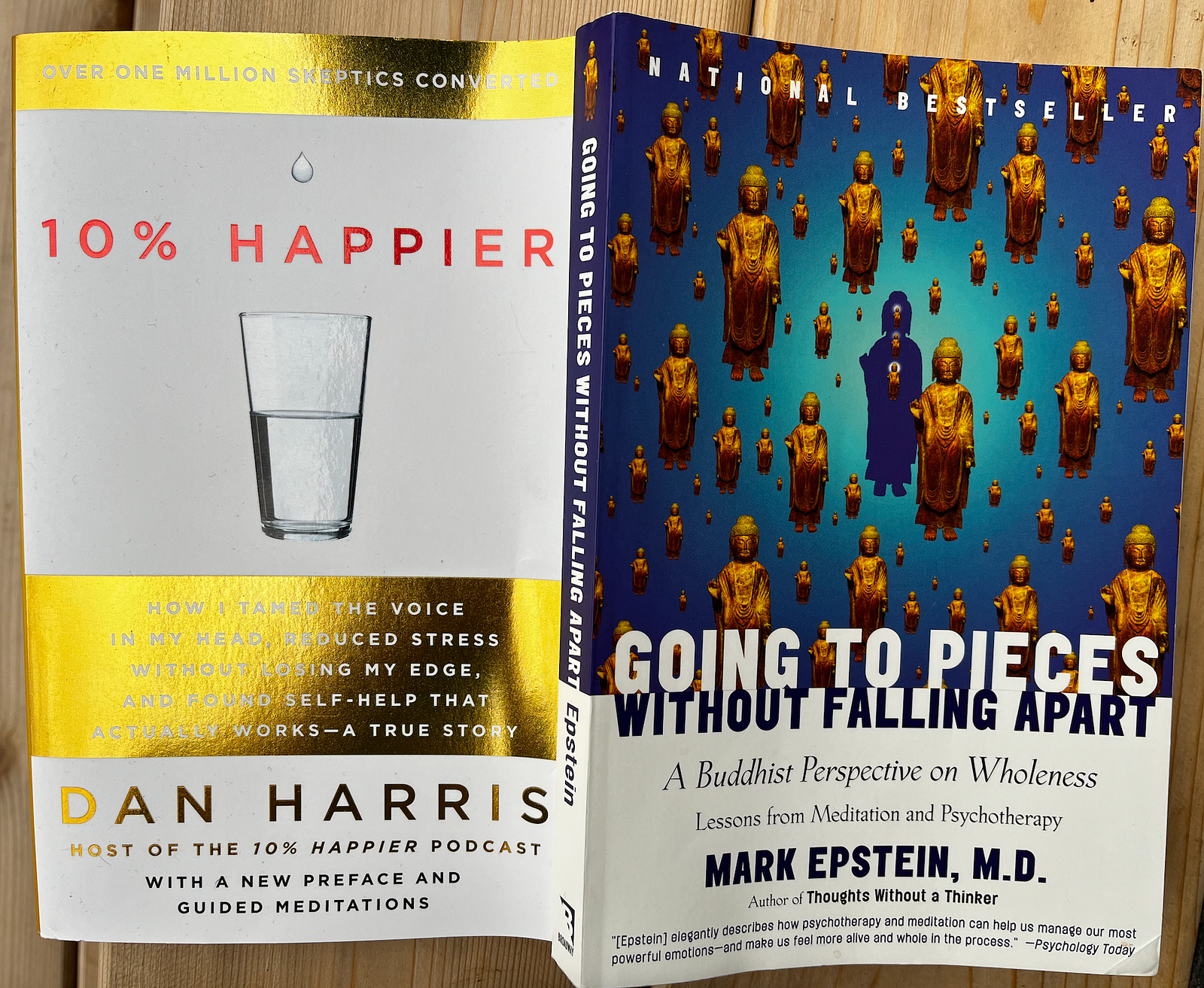
This mix can be found on Dan Harris’ channel, 10% Happier, which I stumbled on when he had comedian Bill Hader as a guest. Harris was a journalist who had a panic attack on air, then turned to meditation for help. I dove into his 2014 book, in which he chronicles his skeptical and very gradual buy-in to the whole idea in a very relatable way. He debunks a few well-known gurus over the course of the book, and then he ends up guided by a few contemporary Jewish Buddhists, including psychiatrist Dr. Mark Epstein (an unfortunate last name in these times). I went back to re-read his 1998 book, Going to Pieces without Falling Apart to flush out some concepts.

ACCEPTING CHANGE

No man ever steps in the same river twice, for it’s not the same river and he’s not the same man.” ~ Heraclitus

These are both books that hope to show us a way to calm our mind enough to be able to think more clearly. Epstein calls the Buddha the original psychoanalyst who teaches us to take a step back from our monkey mind, or the “imperialistic tendency of mind” (prapañca) that can get us spiralling from one tiny error at work towards a vision of living in a cardboard box. We overthink all the time, but it’s possible not to do that. We don’t have to let the spiralling continue. Harris has a metaphor I like of our overwhelming thoughts and feelings bombarding us like a waterfall: we can take a step back to stand safely behind the waterfall to watch it all go by. Harris and Epstein agree that we need to practice this strategy of stepping back through meditation.

Friday, July 5, 2024

Avoiding the Consequences

Our inability to measure long term consequences from short term gains will be the death of us. Covid,  climate change, and conflict are holding a mirror to our collective behaviours.

Henry Madison wrote about the shift back to normal that's essentially pushing us off a cliff towards the default normal we had prior to this century:

"As Max Planck famously observed, social change mostly happens not because of thought and innovation; it happens because one generation dies with its ideas, and the next then gets to run with its own ideas. (The reason institutions are so crucial is that they allow ideas to transcend generations.) So during that great peace and prosperity post-WW2, whole generations forgot what created it: Massive public investment and action. The new elite generation that came to power in the 1970s forgot that and began a process of erasing all of those 19th and 20th century public health and welfare actions: What we now call the birth of 'neoliberalism' and libertarian politics. Just names really; you need to zoom out to see the true social movement it represents. It's societies' most common form throughout all of human history: feudalism topped by some form of monarchial figure. That monarch can be a president too. The US presidency is the most regal figure of power in the world today; populism has transformed that democracy back into the social form the US had desperately tried to escape. The main point is that Covid inaction is just one further part of this same movement that's been going on for over 50 years: The removal of the 'public', an invention of the late-19th and 20th centuries, to restore societies to the form they'd had for centuries previously."

I've recently written more about that we've barely ever managed to creep out of feudalistic systems before we're swept back under again. It seems to be too much of a draw for the powerful to sacrifice the many for their own overwhelming gains, so the people have to continuously work for equity. If we relax for a second, we go under.

Friday, September 1, 2023

Endgame Vision


"Where there is no vision, the people perish." ~ Proverbs 29:18

In many versions of that passage it says with prophetic vision people cast off restraint, but I think vision works as well on its own and is more inclusive, and perish gives a clearer image of the end result. It doesn't mean we'll all be free without a vision guiding us, but that we'll all go haywire. The proverb actually goes on to say that we'll all still be happier if we follow the law - or moral restraint - despite a lack of vision, but I'm dubious about that part of it. It can be better for everyone if we're moral, but I'm not convinced it makes us all happier. All of Proverbs 29 is about turning away from evil motives and doing the right thing, but something that jumps out to me as vital is our need for a sense of where we're headed, especially during times of chaos, even while we pretend everything is normal.

This reddit post is making the rounds. It expresses the experiences many of us are having and asks some good questions about where we go from here:


Practical issue first: I'm not sure how living with minimal Covid risk is dwindling their savings away. Five N95s can last a month (rotate them, one/day of the week) for $10, and there are several organizations that provide them for free for people in need. So I wonder if they're not going in to work or quit their job or if they're taking cabs instead of the subway or something like that. If they lost their job just for wearing a mask, that's a different issue specific to a few states in the US and a few places outside there. 

Sunday, July 23, 2023

A Microcosm of Arguments

This thread of comments of how Covid is affecting younger people encapsulates many of the attitudes affecting the people most affected - and general ableism. I used pseudonyms, and I'm not linking because it might not be the thing they want to be known for. It was Elsie's thread, so responses were to her.


Teen: "Why don't more people talk about what the Covid lockdowns did to young people like me? At 15 years old, I was involuntarily isolated from my friends for SIX MONTHS. I didn't see them, I didn't meet them. The lockdown RUINED young people like me. An entire Generation."

Elsie: "Okay, so I was 19 when the pandemic started. I caught covid in March 2020, before lockdown, and never recovered. Now I can't work, can't leave the house, and I've had no friend for 3 years. So which is worse? A few months of lockdown or a lifetime of isolation?"

Mom: "My daughter spent a year and a half doing virtual school. Lost out on a lot of dreams she'd worked hard for (National competitions etc). I'm immune compromised, and me dying would be worse, but do NOT diminish the impact of isolation on many teenagers." 

Elsie: "I was also a teenager! What about my dreams? Or do they not count. I might never live independently, never have a job, never get married or have children. Why are my dreams worth less?"

Mom: "Why are you hosting the Suffering Olympics? It's quite unnecessary."

Monday, June 26, 2023

Frankl's Logotherapy

The second half of Frankl's Man's Search for Meaning was added in 1962 to provide greater detail of Logotherapy, in which patients must hear difficult things in contrast to psychoanalysts provoking telling difficult things (see the first part here). It's less introspective and more focused on our place in the world:

"Logotherapy defocuses all the vicious-circle formations and feedback mechanisms which play such a great role in the development of neuroses. Thus the typical self-centeredness of the neurotic is broken up instead of being continually fostered and reinforced . . . the patient is actually confronted with and reoriented toward the meaning of his life. . . . Striving to find a meaning in one's life is the primary motivational force in man. That is why I speak of a will to meaning in contrast to the pleasure principle on which Freudian psychoanalysis is centered, as well as in contrast to the will to power on which Adlerian psychology, using the term 'striving for superiority,' is focused" (98). 

Monday, December 26, 2022

SARS #1 and Collective Amnesia


SARS #1 (Severe Acute Respiratory Syndrome) was a deadly coronavirus that hit Canada in February of 2003. It started in China in November 2002 then entered Toronto in a traveller flying in from Hong Kong. 

SARS #1 differs significantly from SARS-CoV-2 because the OG killed people faster, so it was easier to contain! It took 44 lives, but the first cases succumbed fast enough that the city shut down tight, so there were only 438 cases in total in Toronto from March to August 2003. 

Symptoms included a high fever, severe cough, and difficulty breathing. The first patient in the hospital, the son of the traveller who had died just two days earlier, waited in the ER for hours, unknowingly infecting others. He died within a week. Toronto hospitals closed ERs and refused new admissions, then public health jumped into action to contact trace and quarantine suspected cases. Toronto hospitals suspended non-essential services, restricted visitors, and created isolation units for SARS patients. Health care workers were put in "work quarantine" and were not allowed to use public transit or go anywhere besides work and home. 

It was able to die off completely because of drastic public health measures, but also because it was primarily contagious through people who were sick. It didn't spread much from people pre-symptomatic, and didn't have a third of all cases hiding quietly in a carrier, and finding and isolating sick people is easier that isolating anyone who might have had a contact. 

I was untouched by it all, just 90 minutes away, and would likely have no personal memory of it except I had planned a class field trip to Toronto months before that had to be cancelled, and it caused some outrage. Even back then, some parents thought they should be able to override public health concerns. One memorable mom was beside herself because this field trip was going to be part of her daughter's 16th birthday celebration! Sorry, but we have to follow public health rules. 

Compared to SARS #2, only 1 in 1,000 die, not 1 in 10, so it feels like less of a problem in the short term. But that very sentiment makes it more of a problem long term. 

Saturday, March 21, 2020

On Expectation

How we see our lives and how we expect things to go for us is life or death right now, sanity or madness. This has been an emotionally exhausting week! Not knowing is difficult, and there's so much up in the air right now.

It reminds me of when I was first pregnant and past my due date. Every little spasm in my belly set off alarms. Now it's not my belly any more, but higher. A little tickle in the throat, a cough from the dust, a twinge in the chest all have me super hyper-focused on my body: Is it here?? Is it time??

We have to take precautions, absolutely. We're happy introverts in my home, comfortably hunkering down, but then necessary grocery shopping is like running across the trenches to deliver a message. Get in and out as fast as possible! Check down each aisle before turning a corner! Wash all the produce as soon as we get home from the store! Okay, apparently some of these precautions are ones other people have always taken. But miss wiping a corner of a box of cereal with a Lysol wipe, and it could mean the end of us. The cashier (Praise be!) might inadvertently cough as she bags the groceries, spraying us with invisible bullets. I'm not looking forward to the next trip. Hopefully we can make it two weeks with this load.

But once we're home and scrubbed clean yet again, we have to create an ideal little nest as much as possible, with music and baking and creating things and some good conversations. For those of us with the luxury of a job we can do from home, and the tremendous luxury of reasonably good company in the home, we have to imagine the weeks ahead of us as a respite from the noise of the world. Imagine the games and days on the porch or garden and the bike rides and just time to be lost in thought. Pay attention to the people who are sharing and helping like never before. We give our world the colour of our thoughts. If we start to worry about how long and how hard and how small the house is and every little irritation that's bound to arise, then we will have painted our days with jarring contrasts and muddy tones. 

There are other precautions to take that people aren't discussing, like teaching the kids how to access emergency funds in case I succumb so they don't lose the house. What do you want done with your things? With your body? Garbage day is Tuesday. There have been a few of those conversations too.

During that first extended pregnancy, my midwives told me to enjoy the time. Everything's easier with the baby on the inside, they warned. I scoffed then too! How can I enjoy my time with this event looming over everything I do? Their advice holds as well today as it did way back then: eat well, sleep well, go for lots of long walks, and finish that book you've been meaning to read! It happens when it happens, and we all just hope everyone's healthy on the other side.

Before the baby was due, a few well-meaning friends warned me their deliveries took over 36 hours, so I prepared mentally for the long haul. Two weeks later, when the labour pains were finally real, I watched the clock through the breathing and paced myself. It ended after only 12 hours, which felt like nothing compared to what I was expecting. Tonight I told my kids to expect this to end in July, and maybe we'll be pleasantly surprised in May! We just have to get our heads around it all in the right kind of way to make these next few months manageable. This will be a marathon, not a sprint.


Monday, August 26, 2019

On Maintaining Firm Categories: Do Labels Matter?

This link about people on the spectrum came to my FB feed as "Sponsored Content," so I'm wary at the get go, but they present this argument to be addressed: "Autism is a neurological difference in processing, and simply having a collection of traits or quirks without this difference in processing does not make someone autistic." They argue that "there does need to be some clarity, to get away from the ‘We’re all a little bit autistic aren’t we…’ phrase."

My position: But, why?

And, right before that came one of ContraPoint's latest video in which Natalie's characters argue about who counts as trans with a gender dysphoria anti-trender argument countered by a more fluid gender performativity stance.

I'm going to mesh the issues together here because of some similar arguments. I lean towards 'why does it matter?'. Whether someone's got dysphoria or is trending, it takes minimal energy to use whatever pronouns they asked to be used (while, of course, forgiving the forgetful who mean well). What's the harm in letting people try on the other gender or non-gender to see if it fits better? What's the benefit of doing brain scans on people to get some illusion of certainty about how people feel instead of just trusting how they say they feel? Similarly, who is harmed when people acknowledge their struggles with adhering to behavioural norms by latching on to a recognizable diagnosis? With ASD or ADHD or any other checkbox of symptoms that we've rolling into together under a label, why is it important to delineate who is in and who must stay out via an often expensive and sometimes questionable process? When one of my kids was diagnosed (incorrectly, I believe), the very reputable psychometrist badgered me to find that one thing they're obsessed with when one didn't immediately come to mind. Curious.

Thursday, March 14, 2019

Seligman's Hope Circuit

Martin Seligman is famous for a learned helplessness study I wrote about a few years back:
In a famous experiment, dogs were put in a compartment and trained to jump a barrier when given an electric shock. After one or two tries, the dogs jumped the barrier immediately after being put in the compartment even when no shock was given. BUT some dogs were restrained the first time and not able to jump the barrier. They had to tolerate the shock without being able to escape. When they were unharnessed, they still didn't jump the barrier, but just stayed there, tolerating the pain.


Sunday, March 18, 2018

On UW's Mental Health Recommendations

After another suicide on the campus of the University of Waterloo, the university compiled 36 recommendations to try to alleviate the mental health crisis and held (and taped) a forum as well. It really says something about our lives that one of the recommendations is about the process of communicating suicides to students. At my school board, when I was a union rep, we had long conversations on this same topic. Suicide is now common enough to elicit developing a standard operating procedure for WHEN it happens.

We are clearly in the midst of a profound mental health crisis everywhere, not just in the universities. But because we're still on shaky ground trying to determine the cause of the problem, it's so hard to find the best solution. I had a good discussion with my class about Johann Hari's Lost Connections, and they were quite defensive at the suggestion that anxiety and depression are anything but biological conditions. People with these conditions are "actually sick," they insisted. Of course they are. But we can be sick without the cause of the illness being an inborn chemical imbalance. Clearly we can get lung cancer from living in a city where we swim though polluted air on our daily commute. So, like particulates physically affect our lungs, loneliness, trauma, ongoing stress, a lack of control over our environment, losing hope for the future, and perfectionism physically affect our brains. The effects can be seen in an MRI. It's no less real and no less an externally imposed condition in our brains than pollution is in our bodies.

Monday, February 19, 2018

On Hari's Lost Connections

"There's violence to knowing the world isn't what you thought. . . . Sometimes the world doesn't make a lot of sense, but how we get through it is, we stick together, okay?" - Gloria Burgle, Fargo


I watched Joe Rogan's interview with (interrogation of) Johann Hari about his new book, Lost Connections. Rogan wasn't quite buying what Hari is selling, which is unfortunate because his premise is intriguing. He told a few stories through the podcast, but his book, while still a casual read, is heavily footnoted, and his view thoroughly supported with the most up-to-date peer-reviewed research. He even encourages us to "Kick the evidence. See if it breaks. The stakes are too high for us to get this wrong" (14). It's just this: Anxiety and depression are not primarily caused by a chemical imbalance in the brain, and drugs only work a little bit for very few people.

He needs all the footnotes because his claims are extraordinary, and the worst thing would be if this were seen as a mere conspiracy theory against Big Pharma. This is just a brief summary without all the data and examples. He interviewed many contemporary researchers and compiled the evidence necessary to convince the masses of our wrong turn on this one. And it's not about the cellphones!

Friday, August 18, 2017

On the Absurdist Victory: All is Well

A while back I wrote about a video comparing Stoicism and Existentialism. The video also touched on different psychology principles developed from each philosophy. Stoicism is easily seen in CBT and REBT, which all start with the premise that when we're upset it's because of our perception of things, not the things in themselves, and we often have an irrational view. Through reality testing and viewing the situation in a detached way we can be less emotionally affected by anxiety around events. It's been very effective in reducing anxiety levels in a good 70-80% of patients.

Existential psychoanalysis took a different path:
"The basic thrust of existential psychoanalysis, if it aspires to be at all existential, must in turn be rooted in the sensibilities of existential philosophy. That sensibility may be characterized by two principal themes: a) all human knowledge is rooted in personal experience; b) the weight of experience is so exasperating that we seek to escape it through self-deception....Every one of us employs deceptions for the same reason. Whenever we're thwarted in our endeavors we feel disappointment and frustration. We may fear that we won't get our way by being honest and resort to guile and manipulation - the principal source of neurotic guilt....On a deeper level it entails the patient's willingness to plumb the depths of experience while accepting responsibility for whatever comes to light, for better or worse."
Instead of our view of externals provoking upset, tumults are from the struggle for people to accept the truth about themselves and recognize their various attempts to escape it. Instead of looking at individual daily triggers, existentialists look at that big one: We search for meaning and purpose in life, but the reality has to be faced - that there simply isn't any. We've been thrown here randomly, and it's up to each of us to make the best of things. The "curative power lay in the patient's capacity for honesty." Upsetting experiences are useful for taking us outside ourselves and possibly provoking a transformation of consciousness that leads to maturation. No pain, no gain. Suppression of experiences is the problem: not an inaccurate assessment, but a refusal to actually see what's there. We need to give voice to our darkest truths, no matter how ugly. From an early age, we devise pleasant fantasies to override potential traumas as slight as disappointment, and then we become anxious that there's something deep within that we don't really want to know. Self-deception and deception by others (as they might help us remain in denial) are part of every issue. We're all inherently devious and deceive one another as a matter of course. The solution is acknowledging our radical freedom, digging past the deceptions to find our authentic selves, and recognizing the absurdity of it all.

Friday, August 4, 2017

On Comparing Existentialism and Stoicism

This summer, I went on one camping trip with a book on Stoicism, then another camping trip with a book on Existentialism, and I was intrigued by the many similarities. Then I came across this video that has some overlap with what I had noticed. As they say in the video, Massimo Pigliucci (MP) on Stoicism and Skye Cleary (SC) on Existentialism, both are philosophies that offer a way to live instead of just a way to think about the world. I'm putting it all together here with quotes (names linked to sources) to sort it out for myself. I'm just thinking out loud here. This is too long for any normal person to want to read.

These are both philosophies that allow surveyors to pick and choose from variations on a theme as neither has one authoritative dude overriding all others, and, it would appear, few of the big guns cared to adopt either label anyway. For the Stoics, defining yourself as one is avoided because it's pretentious. In The Role Ethics of Epictetus, it's clarified that we are simultaneously different things, and how we play each role is more important than what our roles are. The roles are often not our choice, but how we do them are, i.e. whether or not we're a virtuous son, mother, teacher, or waiter (MP). For Existentialists, we can't be defined by the roles we take on because we're more than the mere facts about ourselves (SC), so labels become meaningless.

Friday, July 28, 2017

On Regret

I've taken many questionable risks in my life. I lean toward leading a life that's lived fully over a safe and secure existence. Most I bounced back from easily from typical childhood falling from trees when I've climbed too high to dropping out of high school and somehow ending up with a Masters. Sometimes it's gone extraordinarily well for me. When an elderly woman next door to me died, I went deep into debt to buy and flip her crumbling house only to find it packed with cash. People thought I was crazy for my efforts to save my school from the chopping block until it all worked, and I'm still there. People were adamant that I can't possibly hold my head high as a teacher and unwed mother back a few decades when premarital sex was shameful, but I ignored them all with the most delightful results. And when my third pregnancy was fraught with complications, and doctors strongly advised me to terminate because of a high risk of Edwards syndrome, I, still single, took a chance and have another healthy daughter to show for it. I've been very very lucky over the years.


But then there are the times that didn't go as well. That time I was convinced I was overinsured and cancelled the insurance on a property, then it promptly went up in flames. That time I got scared of my debt load and hastily sold the slightly charred land - 24 acres with 2000' of waterfront, then soon realized there's nothing else like it out there in my price range. And that time I was convinced by a couple doctors, in opposition to others doctors, equally educated, to get an auxiliary lymph node dissection (ALND), and only afterwards found out about, and succumbed to, the risks of lymphedema.

Like most people, I imagine, I have an easy time ignoring my luck and a really hard time coping when my decisions don't pan out as well. Regret is a bugger.

So I wrote to Stoic advice columnist, Massimo Pigliucci, explaining my surgery situation in very general terms so it could be applied to and/or understood by more people, and I made it sound worse than it is to get a response to the worst case scenario. In general I asked "How were the Stoics so able to get on top of these types of thoughts so well?"

On Wasting Time

I had a brief Facebook conversation with Massimo Pigliucci about my decision to fritter away a morning watching the rain and petting my cat. He said, "It's up to you to determine whether your morning was wasted or not. But from a Stoic perspective the good use of time comes when one is doing something virtuous." And I started wondering further about what specifically counts as wasted time. So I turned to a thorough re-reading of Seneca's On the Shortness of Life. Here are the bits that stood out to me with chapters noted after each quotation:

Seneca points out that people complain about the cruelty of nature because life is short, even Aristotle did, but it's not short, it's just that we waste much of it (1). Then he lists many examples of what a waste of time looks like:
"soft and careless living...no worthwhile pursuit....held in the grip of voracious avarice....diligence that busies itself with pointless enterprises....sodden with wine....slack with idleness....tired out by political ambition, which always hangs on the judgment of others....desire for trading...in hope of profit....passion for soldiering....striving after other people's wealth....thrown...by a fickleness that is shifting" (2).

Sunday, May 21, 2017

Taking Comfort in Stoicism

When thing take a turn for the worst, no philosophy helps me like re-reading the writings of Epictetus, Seneca, and Marcus Aurelius.

I had a dream last night that I was at a bike show (about bicycles, not motorcycles), talking to a distance rider, when, after a long conversation, I noticed that his one arm ended just this side of the elbow. He had a prosthetic, but nothing fancy, just something to help him grip the handlebars. And I felt so sheepish for whining about my trivial issues.
What, then, is to be done? To make the best of what is in our power, and take the rest as it naturally happens. (Epictetus Discourses B I, Ch I)
We have to figure out what's in our power to control, then stop griping or trying to fix what's not in our power to change. It is what it is. So, right now, I can't change the fact that I had this surgery and that things went wrong. That's in the past where I exercise no control. But then we have to learn to affect what we can control with courage. I can control my behaviours: how well I do my painful stretches and care for my wonky arm, and I can certainly control my attitude, but most importantly, I can control my perception of things (which will, in turn, affect my attitude and behaviours).

Before I get to controlling perceptions, be aware the tricky part isn't actually changing how we see things, but that earlier bit: knowing what's in our power to control. Does it makes sense to rally against powerful interests in order to shift energy consumption in order to save the planet? Is saving our habitat actually within our control? Likewise, in this situation, does contacting my MPP about the problems with the current health care system, which I've done, actually do a hill of beans to change anything? It's harder than it looks to have the wisdom to know the when to accept our lot and when to have the courage to fight for change. We have to take a chance and fight for what's right, yet not hang on to the outcome, not have any expectations that our actions will see results in our lifetime.

A recent interview with contemporary Stoic author, Massimo Pigliucci, sums it up well:
We should very much try to change things for the better, that’s the whole point of the Stoic discipline of action, and that discipline is connected to the virtue of justice. But we should also be rational about it, and understand that sometimes things go our way, and at other times they don’t. We have varying degrees of influence over external events, but the only things truly under our control are our judgments and actions, for which we are morally responsible.
My disposition leans towards fighting anyway, so I'm more likely to need to be reminded to accept those things so obviously outside my limits. It is what it is.... It is what it is....

To change our perception of things, we just need to be grateful for what we have and remind ourselves of those worse off than us. Regularly imagine the worst thing possible happening, and consider how you could cope with it, and then we'll be ready for anything.
No prospect of hardship comes to me new or unexpected I anticipated it all and have rehearsed it in the privacy of my mind....And so a wise person gets used to future misfortunes, and what other people make bearable by long suffering he makes bearable by prolonged thinking. (Seneca Letters from a Stoic 76)
I'm very good at preparing for the worst when it comes to big things. I had a new will drawn up last September and showed my kids where to find all the important documents, just in case. But it's the minor annoyances of life that we sometimes overlook and allow to build up until we're in a tizzy.

When stretching is painful, and I note an ounce of self-pity because I haven't prepared myself for the unexpected pain, then a quick mental image of Franco playing Ralston in 127 Hours can do the trick to help me get over myself and recognize how minuscule my troubles really are - and how much much worse they could be.

We're also advised to remind ourselves that if this were happening to an acquaintance, we wouldn't be so affected by it, so it's silly to be affected by it when it happens to us.
For example, when our neighbor's boy breaks a cup, or the like, we are presently ready to say, "These things will happen." Be assured, then, that when your own cup likewise is broken, you ought to be affected just as when another's cup was broken. Apply this in like manner to greater things. Is the child or wife of another dead? There is no one who would not say, "This is a human accident." but if anyone's own child happens to die, it is presently, "Alas I how wretched am I!" But it should be remembered how we are affected in hearing the same thing concerning others. (Epictetus The Enchiridion 26)
I know if it happened to another, I'd think, "It's unfortunate and frustrating, but it's not the end of the world, for heaven's sake!" This too shall pass. Just thinking like this, a little each day, affects our attitude towards things, makes us less upset at minor annoyances. And that in turn affects our behaviours, making us far more patient and understanding with one another.

If we can affect our perception of things, then we're well on our way to want what we have and not want what we don't, and actually be content for a moment - that is, when we can remember all this!
He who fails to obtain the object of his desire is disappointed, and he who incurs the object of his aversion wretched. If, then, you confine your aversion to those objects only which are contrary to the natural use of your faculties, which you have in your own control, you will never incur anything to which you are averse. But if you are averse to sickness, or death, or poverty, you will be wretched. Remove aversion, then, from all things that are not in our control, and transfer it to things contrary to the nature of what is in our control. (Epictetus The Enchiridion 2)
The sooner we can accept that some pain and suffering is part of life, and that death is coming for all of us, the sooner we can get on with things and enjoy each day.

And then we can use these seemingly unfortunate events to a greater purpose by using them for self-improvement, like bombarding parliament with letters of concern about the state of our ER departments, or, more to the point, by acclimatizing ourselves to greater troubles. Look how much I can tolerate!
With every accident, ask yourself what abilities you have for making a proper use of it. ....If you are in pain, you will find fortitude. If you hear unpleasant language, you will find patience. And thus habituated, the appearances of things will not hurry you away along with them.  (Epictetus The Enchiridion 10)
Aurelius predated Nietzsche's, "What doesn't kill you, makes you stronger" somewhat with this bit:
Everything which happens either happens in such wise as thou art formed by nature to bear it, or as thou art not formed by nature to bear it. If, then, it happens to thee in such way as thou art formed by nature to bear it, do not complain, but bear it as thou art formed by nature to bear it. But if it happens in such wise as thou art not formed by nature to bear it, do not complain, for it will perish after it has consumed thee. (Meditations 10)
This won't consume me. I was formed by nature to bear it!

So, that one day when my daughter changed my dressings and the blood shot out from my side a little like this:


I was a little traumatized that we had to catch it all in the sink - not just woozy, but made quite afraid to take the bandages off again. But I'm still healthy and active, living and breathing and using my arm a little more every day. And, like my dream reminded me, some people don't even have two hands to work with. I'm very much one of the lucky ones!


Then again, I lieu of reading the Stoics, it helps just to keep this song in mind: 


Tuesday, August 16, 2016

On Feelings

I was thinking about the fact discussed here that we only started acknowledging feelings as something to be concerned with or a measure of well-being when soldiers returned from WWII, a good half of them with shell shock. Freud had us actually ask people about what's going on in their heads, and this basic technique is with us today augmented with Aaron Beck's Cognitive Behaviour Therapy that digs for and replaces negative self-talk.  The Humans of New York series is currently focused on soldiers with PTSD. The soldiers who have had some therapy, some ability to talk through their past experiences, have been significantly helped by the process.

But I've been thinking of a side-effect of becoming aware of our feelings and how our experiences affect us: Some of us are becoming hyper-aware of every moment of fear or disappointment or grief or sadness to a debilitating degree.

Years ago I went on a road trip with some friends travelling from concert to concert around Ontario. Just before leaving, the driver of the wreck we were travelling in was cautioned to make sure it didn't overheat. Just that one word of warning from a random bystander sent us to the side of the road every couple of hours to open the hood and stare inside. The temperature gage never got anywhere close to the danger zone, but every time it moved, we had to pull over. Sometimes too much attention can be as bad as not enough.

After thousands of years of stoically forging ahead despite flashes of anxiety, in just 70 years we've shifted to a point in which every fluctuation in mood might be fodder for medical help. Instead of ignoring nervousness or sadness, we fixate on them, allowing them room to blossom, like a scab that won't heal because we can't leave it alone. Sometimes hyperawareness of anxiety can make it much worse until it becomes paralyzing and pleasurable events become mired in painful feelings of stress. Can something actually be enjoyable if we're barrelling through a sea of tumults, trembling with a heartbeat that is curiously inaudible to others in order to just get through it all? Does it really make sense to feel the fear and do it anyway when the dread of doing it might override the pleasure of having it done?

My youngest asked me recently, "When were you most afraid?" And I couldn't really remember ever feeling afraid. It seems to be like pain. During each childbirth, I got to a point when I was quite certain I was going to die. How can we possibly live through such a bodily trauma? But I can't actually remember what it felt like. I remember talking about it at the time; I remember my postures and my words and some of my thoughts, and they all lead me to believe I was in a ton of physical pain, but I don't remember the pain at all. How quickly the human race would diminish if women could physically remember the pain of childbirth.

Then a group of friends were recalling myriad scars and surgeries, and I had none to offer. Later I remembered getting many stitches in my thumb just last fall. You'd think it would be part of our survival instincts to remember trauma more immediately, but it seems a far more important survival instinct to forget. Remembering pain would keep us locked in our homes inert and lifeless.

Similarly, there are many times I remember exhibiting the actions of one who's afraid, of clasping the person next to me during a movie or speed-walking through bear habitat. But I don't remember how the panic felt, certainly not enough to avoid it.  I remember it intellectually, able to describe the events going on in my body and thoughts in my head, but I can't relive the actual feeling. It's different from anger, for instance. If I start to describe an injustice from my childhood, I can easily re-experience the rage first hand. Describing a sad tale can have me in tears, and a hilarious memory can leave me gasping for air. But, I'm guessing for most of us, fear and anxiety seem harder to re-establish emotionally. When I describe a frightening experience, I don't revisit the fear in the same way; it's more of a giddy excitement after the fact. Imagining a scary event about to happen has a much more intense effect than the memory of an event that ended. And pain seems completely impossible to re-live. Just as well. So, if fear is short-lived, and enjoyment has better sticking power, then the pleasure of a fearful event can far outweigh the pain in retrospect. And retrospect lasts a lot longer than the moment.

Often the fear I remember isn't even from the event itself, but from my perception of a potential worst-case scenario that typically never comes to pass. During a scary event, we're too busy to register our fear. But the anxiety anticipating the event can produce in our heads, merely from our perception of an event that we're not actually experiencing at the moment, and that might not even happen in such a dramatic way, isn't tempered by busyness. Before an event, we have all the time in the world to stew. But we mustn't. Not much anyway. If we can remember, like Epicurus would have us do, that it's ridiculous to worry about an event, to feel pain from something that isn't actually happening to us right now, it can help reduce the level of anxiety. We're safe at home but all tied up in knots - how silly!

Somehow it's heartening to know that, even thousands of years ago, people still worried over stupid things, and they were counseled to actively stop themselves from having those thoughts. We've come full circle again to recognizing that dwelling on our feelings just exacerbates them. Talking over trauma, over feelings around events in the past, can be life altering and miraculous, but scrutinizing emotions created from perceptions of potential experiences we haven't actually had, can be debilitating. Epicurus, William James, Aaron Beck... all recognized that a shift in perception and active shutting out of stressful thoughts is necessary to get on with thing. We will be scared and offended and enraged. Sometimes we just have to ride it out.

The trick is to figure out which emotional upheavals are better examined and which are better ignored. We don't quite know what a minor trauma is. Working in a high-school, there's been a clear change in the amount of attention and concern we give to heartbreak, for instance. It's par for the course in adolescence, but now we're understanding to a fault, postponing due date to allow extra time for students to process, which, I believe, makes that trauma larger than life. It hurts; there's no denying that. But is it a pain that will dissipate faster it it's attended to or ignored? And if we attend to lots of everyday traumas, will we be able to cope when something huge hits us? Suggesting as much is painted as heartless, so we get the illusion of the benefits of an immediate salve but no immunity in the longterm.

A bit of worrying can be useful if used to our advantage. That anxious hyperawareness we experience might help us ensure we don't miss a detail. I've written papers that I wasn't stressed at all about, and my over-confidence almost always led to a lower mark because I didn't have that adrenaline boost of stress forcing me to re-check everything a few more times. We need just the right amount of anxiety to help us rise to challenges, yet actually go through with them.

I'm thinking a lot about anxiety today because I'm off to Temagami on a canoe trip in the morning. I'll be in bear territory, and I'll have bear spray at the ready, but that's not the scary part. I rent a car only twice a year or so, and I always avoid driving on major highways. I'm picking up a fellow traveller on the way, so I'll have to manage the 401, and then it only makes sense to continue on the 400. And on the way back, I'll be desperate to be home before sunset so that I'm not driving in the dark. Backroads won't get me there in time. My passenger has no idea what she's getting herself into, how silent and still she'll have to be for me to manage all the lanes and signs and so many cars and trucks all over the place!

I've had one accident, and it was on a side road. It was a clear day, but snow was blowing across a field rendering the road indistinguishable and other vehicles invisible. I followed the line of hydro poles to try to stay in my lane, but I still managed to clip the front bumper of an on-coming car that materialized before my eyes. I partially blame having a passenger who kept leaning between the bucket seats to rifle around the back for another CD. There has never again been rifling around in a car I was driving!

I've driven myself to Parry Sound and back over and over, sometimes three trips in a day, but always on the back roads as far as I could, but I used to drive back and forth to Ottawa on the highway regularly when I had a friend living there. That was 20 years ago, but at least I know it's possible. It's something I was once able to do pretty fearlessly, like a normal human being.

So for the rest of the day, I'll be actively ignoring the waves of panic and shaking off the burgeoning flood of tears. There will be no blowing snow tomorrow, and it might not even rain. In the right-hand lane, doing precisely 3 km over the speed limit, and staying well back from other cars, I'm unlikely to have or cause an accident. I'll have a passenger to help navigate the signs for most of the trip.  If I miss an exit, I'll have plenty of time to take the next one and turn around. And my anxiety has done me the great service of forcing me to write out my planned routes and an alternative route, to mark a map with sticky-notes, and to print off magnified areas of concern from google maps. Handy!

And I'd rather die on my way to a canoe trip than slipping in the bathtub. There's always that.

Just imagine how good it smells there. Like suddenly breathing real air.

Saturday, January 19, 2013

A Stoic Resurgence

In reading a few other blogs lately, Stoicism has come up a few times, and I'm seeing it in a few books I've been reading lately too.  Maybe it'll stick this time.

In Robin Hanson's blog discussing why middle aged people are most pessimistic, I suggested that maybe it's a point in life where we know too much horrible crap happening in the world, and it's making us miserable.  And we're just before a point in which we've found a way to cope with the unending tragedies that are part of being alive.  Maybe my cohort will become happier in a stoic manner - once we get our heads around how little control we have over the world, accept that many of these problems aren't ours to solve, and develop a tranquility around it all.

Then stoicism came up again in arguments about the relationship to Cognitive Behaviour Therapy via Lieter Reports, a N.Y. Times article by Kathryn Schulz about self-help books' suggested dualism of selfhood.