Showing posts with label Buddhism. Show all posts

Friday, April 24, 2026

The Unknowable and Inevitable Mourning

I’m curious about the intersection of psychology, philosophy, and spirituality, and the more I read, the more closely they all appear to intertwine until they’re sometimes indistinguishable. 

Buddhism overlaps with Stoicism, which influenced Albert Ellis’s REBT (then CBT and all its variations). They dig down to acknowledge and question mistaken core beliefs. Plato inspired some of Freud’s work, which mixed with Sartre and Camus to become the existential psychotherapy of Irvin Yalom and Otto Rank. They have a focus on the acceptance of death, which comes back around to the Buddhist prescription to meditate on our bones turning to dust. Yet, despite a general theme being repeated, it’s striking how hard it is to get out from the minutia of daily life to attend to it.

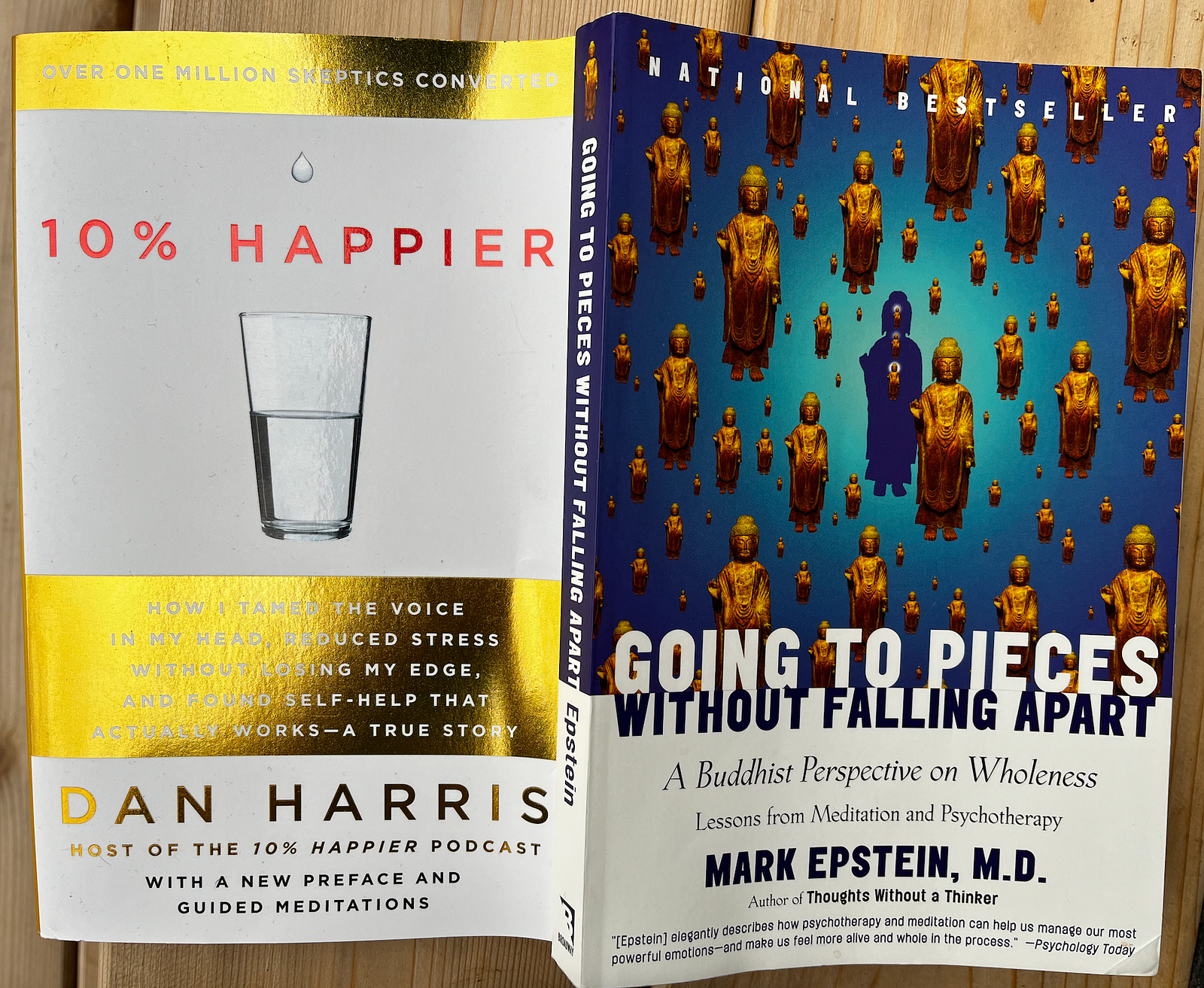
This mix can be found on Dan Harris’ channel, 10% Happier, which I stumbled on when he had comedian Bill Hader as a guest. Harris was a journalist who had a panic attack on air, then turned to meditation for help. I dove into his 2014 book, in which he chronicles his skeptical and very gradual buy-in to the whole idea in a very relatable way. He debunks a few well-known gurus over the course of the book, and then he ends up guided by a few contemporary Jewish Buddhists, including psychiatrist Dr. Mark Epstein (an unfortunate last name in these times). I went back to re-read his 1998 book, Going to Pieces without Falling Apart to flush out some concepts.

ACCEPTING CHANGE

No man ever steps in the same river twice, for it’s not the same river and he’s not the same man.” ~ Heraclitus

These are both books that hope to show us a way to calm our mind enough to be able to think more clearly. Epstein calls the Buddha the original psychoanalyst who teaches us to take a step back from our monkey mind, or the “imperialistic tendency of mind” (prapañca) that can get us spiralling from one tiny error at work towards a vision of living in a cardboard box. We overthink all the time, but it’s possible not to do that. We don’t have to let the spiralling continue. Harris has a metaphor I like of our overwhelming thoughts and feelings bombarding us like a waterfall: we can take a step back to stand safely behind the waterfall to watch it all go by. Harris and Epstein agree that we need to practice this strategy of stepping back through meditation.

Sunday, October 12, 2025

Managing So Much Suffering

It feels like I understand the idea that all suffering comes from expectation in a way I didn't used to. Now it seems so obvious, but I'm not really sure what flip was switched. It's not just that if we stop expecting to get things, we'll be happier, but how ridiculous it is to expect anything to stay the same at all, much less get better, ever. And that understanding seems to help reduce some anxiety over the things that can't be easily changed. Suffering is inevitable, but it can be somewhat diminished in order to have more contentment. We can change what counts as suffering, and we can change our perspective around tragedies, so maybe we can also change how we can continue to bear witness to, or experience, absolute atrocities.

One simple way to reduce suffering is to narrow the definition. Comedian Michelle Wolf jokes, "It's hard to have a struggle and a skin care routine," which clarifies that we might be considering some difficulties as suffering in a way that doesn't fly when we widen the scope of our horizons. Pain is pain and can't definitively be compared, yet I believe many of us have an automatic judgment in our heads that lists events in a hierarchy. Typically suffering from having to do a task we don't want to do, like write a boring report or clean out the fridge, or from wanting luxuries we can't afford, like another trip, might be relegated to the bottom as whining. The pain from it is there, though: the agony and stress from uninteresting maintenance that's necessary to further our own existence or the grief over lost opportunities. Furthermore, it can develop an extra layer of shame on top of the suffering if we try and fail to elicit sympathy for having so much food that some is left to rot and needs to be cleaned. When we realize we can't afford that trip after all, this is a suffering we are expected to bear without complaint.

Monday, January 2, 2023

A Buddhist Perspective on Addiction: Nothing is Vital.

Now that the hangover from New Year's Eve is abating for many, and we might be freshly open to some self-improvement, consider a Buddhist view of using meditation to tackle addictions. I don't just mean for substance abuse, but also for that incessant drive to check social media just once more before starting our day or before we finally lull ourselves to sleep by the light of our devices, or the drive to buy the store out of chocolates at boxing day sales. Not that there's anything wrong with that on its own; it's a sale after all, but when actions are compulsive instead of intentional, then this can be a different way of approaching the problem from the typical route. I'm not a mental health professional, but this is something I've finally tried with earnest and found helpful, but it took a very different understanding of it all to get just this far (which is still pretty far from where I'd like to be). 

Meditation is not about escaping the world but sharpening our awareness of it. Addiction comes from the Latin dicere, related to the root of the word dictator. It's like having an internal dictator usurping our agency. And Buddhist mindfulness meditation can help to notice that voice and then turn the volume down on it so we can get our lives back.   

In many ways the Buddhist perception is closer to Stoicism than to Freudian tactics, but don't toss the baby out with the bathwater. Many people benefit from the psychoanalytical method of finding themselves before they can work on losing themselves. This is particularly true with traumatic experiences that might need to be worked through enough before allowing the mind to wander into dark recesses unrestrained. 

Some research has found Buddhism to be as effective at treating addiction as typical methods, which is never anywhere near 100% because addiction is brutally difficult to overcome. One study of 500 opioid addicts had half use a detox program with counselling and the other half study in a Buddhist monastery with a focus on meditation and virtuous living. The abstinence rates were the same. The monastery used meditation to help clients (clients?) recognize the path they're on, then contemplating virtuous living to find their way back to a preferred path that's less frazzled and chaotic. Before researching the role of Buddhism in addiction treatment, it hadn't occurred to me that mindfulness meditation had anything to do with the Buddhist Noble Eightfold Path of virtuous living. All these years of dipping into meditation here and there, I had just been arguing with myself to stop my thoughts from racing, craving the perfection of enlightenment, and missing the most important aspects in the process. Like Stoicism, Buddhism has us check our thoughts and actions to intentionally get on the right path. 

Monday, December 26, 2022

SARS #1 and Collective Amnesia


SARS #1 (Severe Acute Respiratory Syndrome) was a deadly coronavirus that hit Canada in February of 2003. It started in China in November 2002 then entered Toronto in a traveller flying in from Hong Kong. 

SARS #1 differs significantly from SARS-CoV-2 because the OG killed people faster, so it was easier to contain! It took 44 lives, but the first cases succumbed fast enough that the city shut down tight, so there were only 438 cases in total in Toronto from March to August 2003. 

Symptoms included a high fever, severe cough, and difficulty breathing. The first patient in the hospital, the son of the traveller who had died just two days earlier, waited in the ER for hours, unknowingly infecting others. He died within a week. Toronto hospitals closed ERs and refused new admissions, then public health jumped into action to contact trace and quarantine suspected cases. Toronto hospitals suspended non-essential services, restricted visitors, and created isolation units for SARS patients. Health care workers were put in "work quarantine" and were not allowed to use public transit or go anywhere besides work and home. 

It was able to die off completely because of drastic public health measures, but also because it was primarily contagious through people who were sick. It didn't spread much from people pre-symptomatic, and didn't have a third of all cases hiding quietly in a carrier, and finding and isolating sick people is easier that isolating anyone who might have had a contact. 

I was untouched by it all, just 90 minutes away, and would likely have no personal memory of it except I had planned a class field trip to Toronto months before that had to be cancelled, and it caused some outrage. Even back then, some parents thought they should be able to override public health concerns. One memorable mom was beside herself because this field trip was going to be part of her daughter's 16th birthday celebration! Sorry, but we have to follow public health rules. 

Compared to SARS #2, only 1 in 1,000 die, not 1 in 10, so it feels like less of a problem in the short term. But that very sentiment makes it more of a problem long term. 

Tuesday, December 6, 2022

What I've Learned So Far: My First 2 Weeks as a Trustee

The boardroom is smaller than it looks on camera, and cozier and everyone's very nice and welcoming. It doesn't feel as formal as it looks, so I started out a little less formal than I should have been. It's hard to remember all the "through the chair" things to say. They gave us two books on procedure (Roberts Rules), and I haven't opened either one yet. Something I knew to expect and that was entirely reinforced by this experience, though, is that the corporate secretaries or managers, the ones you've never heard of, run the show and keep everything organized and are an incredible resource and remarkably accommodating. 

When I first considered campaigning, I asked how much a trustee gets paid, and I was always given a range from about $6,000 to $25,000. It's a honorarium based on student numbers, so it has no benefits or any extras attached to it, and it changes a bit each years. But I wasn't sure if that would be a yearly lump sum dumped in my bank account without notice or what. I started Nov. 14th, and got my first pay on Dec. 2. It's $541.64, so I assume that's paid bi-weekly, and I imagine for 26 pays, for a total of $14,082.64. I was just emailed that my gross pay is $16,185.31 per year, so that sounds about right. Funny that nobody will be upfront about that! It's very much a part-time job. If I work twenty hours/week, which is likely, then I'll be making minimum wage. For comparison, a trustee takes home $240/week and a crossing guard makes $170/week; as a teacher, I took home $1,270 a week, and the associate directors - we have two of them now - make over $4,000/week. But, on top of my pay, I also get a small allowance for phone use (not sure how much yet), and mileage if I drive to to meetings, and free subscriptions to The Record, The Star, and The Globe and Mail. I already pay for a Star subscription, and I'll just keep that one myself.

Saturday, September 17, 2022

On not Grasping for the Good

 I'm taking a university course on Asian Wisdom, which I'm really enjoying.

My prof told a story about Buddha that concludes that we should only tell others of a better way to live if we're asked for advice; otherwise, we should never impose our morals on others because our moral purpose is personal. Whoops!! Lao Tzu's story is similar: he wrote the Tao Te Ching only after people asked for him how to live our best lives. Otherwise, he would have just gone on doing his thing and being a good role model, but never suggesting anyone should follow him. Kind of like Jesus and maybe even Socrates.

But does that stand even for the most basic moral tenets, like do no harm? Doesn't that go without saying?

And isn't the rule a bit of a paradox as it's telling us that we shouldn't tell people how to live?? But maybe I asked when I picked up the book and signed up for the course. Maybe there's a get-around if we leave advice strewn about, but don't present it to anyone specifically. It's just there for the taking, like this blog.

But what if we see harm about to happen? I can get with the idea of just living rightly and hoping others follow our model, but aren't we complicit if we see preventable harm and don't act? And what about the role of parents and teachers and legislators to tell us which values to follow or precisely the right thing to do? Or do more laws just make more criminals?

Saturday, January 19, 2013

A Stoic Resurgence

In reading a few other blogs lately, Stoicism has come up a few times, and I'm seeing it in a few books I've been reading lately too.  Maybe it'll stick this time.

In Robin Hanson's blog discussing why middle aged people are most pessimistic, I suggested that maybe it's a point in life where we know too much horrible crap happening in the world, and it's making us miserable.  And we're just before a point in which we've found a way to cope with the unending tragedies that are part of being alive.  Maybe my cohort will become happier in a stoic manner - once we get our heads around how little control we have over the world, accept that many of these problems aren't ours to solve, and develop a tranquility around it all.

Then stoicism came up again in arguments about the relationship to Cognitive Behaviour Therapy via Lieter Reports, a N.Y. Times article by Kathryn Schulz about self-help books' suggested dualism of selfhood.