Showing posts with label ASD. Show all posts

Friday, June 26, 2026

On Relationship Standards: Is Reliability a Necessity?

I'm on the autism spectrum, and I have kids on the spectrum and with ADHD and former partners with ADHD. I love them all to bits, but it can be tricky to navigate what behaviours should look like without an attainable standard of comparison. 

People who are neurodiverse are a minority in society. We perceive and think differently, so we will behave a little differently as well. It's a bit similar to being left-handed. We used to force people to write with the right hand which caused all sorts of problems. Now we're in a place where we accept this difference and have accommodations in place, like left-handed desks. But ND is different from left-handedness, of course, in that it affects our basic personality -- who we are, and some traits common to ND brains are overwhelmingly seen as undesirable.

Like being unreliable.

About twenty years ago, I had a partner who commonly got distracted from tasks. The only time he wasn't distractible was when he was engrossed (hyperfocusing) on something of specific interest to him. This is a common ADHD issue -- or a common way of being for a specific group of people. One day he offered to make dinner for me as I marked final exams on my front porch: fresh fish on the BBQ. I watched him leave for the market and then return. A few hours passed, and I went to get an ETA for dinner only to find the fish unwrapped and sitting on the counter, covered in flies because the back door had been left open. I found my partner under his car changing the oil. It had occurred to him on the ride home with the fish that he hadn't done an oil change in a while, and something in his brain told him it's vital to do it RIGHT NOW. Not after dinner, but immediately. When I asked him about his choice, he insisted that the problem is that I just don't understand cars. It's kind of hilarious, if we're allowed to laugh at idiosyncrasies, but also kind of annoying. It didn't always happen like this, but it did just often enough to make it hard to trust that he'd follow through. 

CAN'T OR WON'T

How do we best live with people who just can't do what they say they'll do? Part of the problem is what it means to us when people let us down. We associate caring and loving with remembering things: our likes and dislikes and what makes us feel cared for and special dates. I have a mind like a sieve, so every recipe card has a list of who likes and hates it, with many crossed out as their tastes change, and I have an ongoing list of potential gifts for people, which often end up returned anyway, so it's complicated. Our level of memory for detail is sometimes used as proof of our level of care, when it might be more of a fluke. Some people are just better at keeping those facts in mind, so they appear to be more invested in us when they might not care about us at all. It's not always clear evidence of affiliation, yet we can't let go of it as evidence.  

Monday, February 26, 2024

Changing Perceptions of Autism

I compiled some posts from here into a summary of recent studies on Autism at 3 Quarks Daily, but the word count limit there forced me to cut this bit on the history of our understanding of autism:

1908 - "The term ‘autistic’ was used to classify schizophrenic patients who were “severely withdrawn,” setting a trend to diagnose ASD as 'childhood schizophrenia' until the 1940s.
1924 - Grunya Sukhareva published reports on children she described as having “schizoid psychopathy.” Despite the name, her theory is very similar to how autism is described today.
1938 - Hans Asperger received funding from the Nazi party to research children to determine which are more worthy of life. He noticed that some children were very cognitively advanced despite isolating socially, which he named Asperger's Syndrome.

Saturday, December 30, 2023

The Questionable Mindblind Theory of Autism

There was a cute social media post recently that asked kindergarten kids what gifts would be best for 30-year-olds. Of course there were lots of hearing aids and hip replacements in the mix. And it struck me that this could be a good exercise to gently raise awareness of our own stereotypes. Considering what give you would suggest for ___  type of person (slotting in an age, race, gender, ability, etc.), might be a way to flush out the tiny prejudices we might harbour about individuals that are part of a group. We always need reminders that we are each individuals despite all the group affiliations we have. This is especially true when we're talking about people with Autism Spectrum Disorder (ASD), who can be dramatically different from one another. This is a super long one with headings to help!

Saturday, December 16, 2023

Mini-Study on ND vs NT Use of Masks

Abstract: 

An online survey was conducted to compare the rate of masks wearing behaviour between neurotypical and neurodiverse populations. A greater number of neurodiverse participants reported always wearing a mask.

Introduction:

The impetus for this study came from a post by Lucy (2023) who asked why "neuro atypical" people are so over represented in the Covid conscious community. I responded that it could be likely for the same reason that a higher percentage of Autistic people are 2SLGBTQIA+: "Autistic individuals may conform less to societal norms compared to non-autistic individuals" (Warrier et al, 2020). Lucy suggested a similar study be conducted on mask use. I set up a study to compare the neurotypical (NT) and neurodiverse (ND) self-reported mask-wearing behaviours.

Wednesday, November 22, 2023

Diagnosing Mental Illness During Difficult Times

A guest essay in the NY Times makes some excellent points about the way we're framing mental health issues in kids. 


Psychologist Darby Saxbe discusses the well-intentioned but problematic way many schools have added mental health resources, like those focusing on emotional regulation or mindfulness:

"Recent studies have found that several of these programs not only failed to help young people; they also made their mental-health problems worse. . . . Researchers suggest, convincingly, that the teenagers weren't engaged enough in the program and might have felt overwhelmed by having too many tools and skills presented to them without enough time to master them. . . . I would venture three additional explanations for the backfiring. . . . First, by focusing teenagers' attention on mental health issues, these interventions may have unwittingly exacerbated their problems. Lucy Foulkes, an Oxford psychologist, calls this phenomenon 'prevalence inflation'--when greater awareness of mental illness leads people to talk of normal life struggles in terms of 'symptoms' and 'diagnoses.' These sorts of labels begin to dictate how people view themselves, in ways that can become self-fulfilling. . . . Greater awareness of mental health problems risks encouraging self-diagnosis and the pathologizing of commonplace emotions--what Dr. Foulkes calls 'problems of living'."

I agree that framing every negative emotion as depression or anxiety can be self-sabotaging for people. On top of that we're also forcefully ignoring how withdrawn and exhausted people can become from chronic illness from repeated exposure to viruses and from watching friends and family members suffer, not to mention seeing catastrophic news about climate change and the many conflicts around the world and the burgeoning rise of authoritarian governments. Nothing feels stable anymore. Many of us in my part of the world have lived relatively comfortable lives for a few generations, long enough to forget what it might look like and feel like to struggle profoundly and to watch the suffering around you. Our problems of living have changed dramatically in the last few years, and it can be hard to come to terms with that change, so we might end up thinking something's horribly wrong with us instead of the world at large.

Tuesday, October 31, 2023

Inaccessible Accessibility

Why is remote learning suddenly so difficult to access when we have all the tech we need to pull it off?

When I was in grade 12, I started to just show up to classes I needed to go to. I had high 90s, so I just went for clarification when I couldn't understand the textbook, and I showed up for every lab and test. That's what worked best for me as a learner. Unfortunately, missing classes didn't go over well with admin, and I was "disinvited" to be in school. I loved learning, and I did very well on tests and assignments, but I never actually finished high-school.

I didn't feel like a rebel or the trouble-maker they might have seen me as. I just found it painfully tedious to sit through lengthy explanations of something I already understood, and I was unable to (and not allowed to) just tune it out and do other work during class. Could you even imagine bringing a walkman to class?? It's rude to do other work while someone's talking, so every class was an exercise in tolerating the repetitive droning on and on until everyone understood and was quiet enough for me to finally start the homework questions. 

Then I went to university a few years later, as a mature student, and nobody took attendance, and I could actually learn in the way that worked best for me. I went to most classes because they were full of rousing discussion, but I didn't go when profs (often "instructors") just literally read out the textbook to us. I thrived in that environment that enabled autonomy over my own learning and went on to do a masters as well. 

Now universities take attendance, and it's vital to attend, in person, even if nothing significant is gained from my presence in the room for myself, for my prof, or for the class. 

Monday, August 14, 2023

Cultural Differences of ASD

I was once introduced to a new colleague who made very direct, sustained eye contact, and I thought to myself as I spoke with him: he's on track to be in admin. He just seemed the type to make connections and get ahead and would likely end up at the board office. But then, after talking to him a few more times and seeing him in moments of awkwardness, I thought, "Oh, he's autistic." That didn't change my reaction to him at all, of course, but it did help me figure something out.

That interaction was a lightbulb moment that helped me understand the many many times someone gloms on to me as if somehow I'm the most interesting person in the room, then, after a few conversations in which nothing appears to go wrong, they completely ghost me. They thought, because of my sustained eye contact boring into them, that I must be someone important, an alpha even. Then they figured out their error and shunned me, embarrassed by their own mistake. I'm fine with someone changing their mind about hanging out because that happens to the best of us, but the absolute worst part of it, worse that literally being pointed and laughed at by other adults, is when they suddenly understand that I'm on the spectrum and start talking to me like I'm a flippin' space cadet

So, just last month you wanted to take me to lunch at some fancy place, and now you've concluded that I'm practically brain dead. Curious. It's always startling how abrupt that transition is for people. And how reliable.

Then mix that in with "you can only do that because you're autistic" like writing every day, which is a thing that writers do, but if you can't motivate yourself to do it, then the reason I can do it despite clearly being inferior to you must be my hidden superpower of being autistic. So things I can't easily do are laughed at openly and the things I can do are discounted. Lovely.

It's not tragic, but it is trying. These little things can eat away at people. Surely we know it's not right to behave this way with others, though, right?? 

A few studies show that people notice something different about people with autism in the first few seconds of an encounter (h/t Callum Stephen). In one study (Sasson et al, 2017), they filmed a variety of people, some with ASD (level 1) and some neurotypical (NT), in a 60 second mock audition. The study participants were assigned to one of five groups to watch the videos and assess each candidate on likability, intelligence, attractiveness, trustworthiness, etc.: audio only, visual only, audio-visual, static image, and transcript. Only in the transcript option were people with ASD rated as highly as NT interviews. Even the still image set them apart. (Is that why there are no good photos of me: Internalized ableism??) The study concluded,

Monday, July 17, 2023

ASD Assessments

Assessments for Autism Spectrum Disorder (ASD) are sometimes a piece of work. I'll look at two of them here.  As a reminder, everyone with ASD is really different from one another. If you know one person with autism, you know one person with autism. The diagnostic categories are general and symptoms can be incredibly broad. 

The ASSQ is about 25 years old but still used today. It's to be completed by people who live or work with the person in question. It mainly just asks, "Is this person weird?" Check out the use of language: Do they behave in a way that's eccentric, idiosyncratic, with a deviant style of communication, fussy, old-fashioned, robot-like, with a deviant gaze, unusual facial expressions, ungainly, awkward, bullied by others yet surprisingly good at some things, and, of course, lacking empathy.

Lacks empathy is a highly contentious item on ASD assessments. Many people with ASD have no problems experiencing profound empathy, and many are even empaths or highly-sensitive individuals (HSIs). The belief that there's no empathy in place is sometimes from misunderstood social cues, but sometimes it's from an expressionless reaction (flat affect) to a person despite a whole host of empathetic feelings going on internally. Communication differences for people with ASD can be in receiving or sending unspoken information.

Monday, July 10, 2023

On Training Children

I have some nuanced or maybe fence-sitting views about Applied Behaviour Analysis (ABA) that I'll try to sort out below. As a trustee, I went to a PD session in part about the WRDSB's use of ABA, which I questioned, and I'm currently taking a course with some material about Autism Spectrum Disorder (ASD) that I questioned. But this post is prompted by a new book, which I haven't read, that's been briefly and scathingly reviewed by Ann Memmott. I'm just interested in the anti-ABA arguments presented, which I'm seeing more and more:

Behold. Here it is. Our new reading material, the book entitled, Handbook of Applied Behavior Analysis for Children with Autism - Clinical Guide to Assessment and Treatment. Brand new. 2023. So, the new ABA, eh? Shall we take a look? . . . 

We start with their fascinating summary of autism:

"...difficulties with social initiation and responsiveness, reduced creative and imaginative play, interfering behaviors including inflexible adherence to routines, repetitive speech and atypical sensory reactions . . . a history of difficulties developing and maintaining friendships and relationships  . . . aggression and self-injurious behaviour and behaviours of deficit"

Then we are straight into saying how wonderful Lovaas is. Let's remind ourselves of Lovaas's methods...content warning. [from an interview in 1974]

Sunday, June 18, 2023

Autistic Pride

Today is Autistic Pride Day. It's well researched that people with autism are disproportionately 2SLGBTQIA+. 


A study, from the Journal of Autism and Developmental Disorders in 2010, studied people who had visited a gender identity clinic, and found that almost 8% were ASD, compared to 1% of people with ASD in the general population. Then a study of over 600,000 people, published in Nature in 2020, found that people who are trans or gender-diverse are three to six times more likely to be autistic than people who are cisgender. They theorized that it's possibly not that there are more trans neurodiverse people, but that people on the ASD spectrum generally don't care nearly as much as neurotypicals (NTs) about how they appear to other people. They're far less affected by cultural norms of behaviour - for better or worse. 

"Autistic individuals may conform less to societal norms compared to non-autistic individuals, which may partly explain why a greater number of autistic individuals identify outside the stereotypical gender binary."

The following year, a study published in Autism Research reported that significantly more autistic people reported being bisexual or homosexual than neurotypical people, and they also cautioned that, 

"autistic individuals may have been more candid about their experiences than others due to differences in communication style and/or lessened concerns about adherence to social norms." 

The upshot of these studies, then, is that autistic people are themselves more than NTs, more publicly authentic and more honest about who they are. And, the corollary: that most neurotypical people do not expose their real selves to the world; they hide parts of themselves from others and maybe also from themselves. And that's a shame.

Sometimes that open authenticity is embarrassing for friends or family, and that's the very thing that we need to overcome as a society: difference isn't bad. Instead of shunning, ostracizing, or humiliating people just for being different, we need to take all that rabid, judgey energy and focus it on people actually causing harm to others out there, particularly those in power.  

Because those people coming for the 2SLGBTQIA+? They'll be coming for the neurodivergents next if history is anything to go by. All the deviants could be rounded up or forced to conform to a narrow version of normal in order to hide themselves. When that circle widens enough, eventually what counts as deviant could very well include YOU, so this is an absolutely vital time for overt solidarity!

ETA - Okay, I'm a dope and didn't realize it's not a day about people who are autistic and 2SLGBTQIA+, but about being proud of being autistic! It's confusing because this is Pride Month, so I thought it was a subset of that. Nope! But all the rest stands - there is significant overlap, and we have to stick together. But also, yay for autistic people! Everyone's brains are different and that's awesome. Haters just don't get that - yet. 

Thursday, May 18, 2023

Neurodivergent with Hindsight

Maybe because I finally have some time to just exist without anything to plan or prepare, or maybe because I'm back in school as a student, whatever the reason, many childhood scenarios have been resurfacing, playing out in my head, and I'm all, WTF? No trigger warnings necessary - nothing like that. I was just so incredibly daft that it's amazing I've gotten this far relatively unscathed. And it makes me think of the many kids who are confused without direct explicit instruction and reasoning. 

On top of being autistic, I've also had many concussions from falling out of trees or off the top of our rickety wooden fence or from falling out of my stroller or wiping out on my bike before the days of helmets. When I was taking Neuroscience courses, every discussion of a different part of the brain brought to mind a different time I smashed my head just about there. I seemed to have zero sense of self-preservation. I remember my mom walking me out to the front lawn to actually teach me to put my arms out in front of my face whenever I felt like I was falling. She had to get me to actually practice tripping and protecting my face because somehow I didn't have that reaction instinctively. I would just fall straight forward, arms rendered useless dangling at my sides. 

And I remember arguing with my many older siblings about whether to put the shower curtain on the inside or outside of the tub. This was after I was old enough to have showers on my own, so I was likely school aged, but I still couldn't figure out which would better keep the floor from getting soaked, and even argued that the puddle on the tiles definitely wasn't my doing. My mom had to take me to the end of the tub furthest the taps and get me to peek in with the water running to show me how the water stays in the tub when the curtain's on the inside and gets on the floor when it's on the outside. Seriously, why couldn't a simple explanation suffice? That's never really changed for me. I need to see things with my own eyes to really understand them. It's likely why I love science labs so much. 

Saturday, December 31, 2022

Year in Review

I don't normally do a year in review, but his was my most tumultuous year in decades. It's right up there with the year I dropped out of high school and moved in with my sister in Ottawa on a whim, and the year I moved six times mainly by bicycle. This year, I went from 31 years at the same job in the same building, doing more or less the same thing, to .... not that. And my oldest moved out to Guelph, with the middle one likely to follow, which is also a big change.  

Monday, December 27, 2021

On "Fixing" ASD

I watched a course-load of videos by Dr. Alok Kanojia (@HealthyGamerGG) this past summer. He's a therapist specializing in addiction in his day job and focused on gaming addictions online, but he has broadened his videos to encompass many other issues. He doesn't do therapy online but "coaches" people instead. And typically right there I'd be out. Coaching?? It all sounds a little goofy and new-agey. But I got hooked when I first saw his video with Natalie Wynn (aka ContraPoints) the previous October because of his openness to really listen to her experiences and learn from them before asking the precisely right questions necessary to get her to understand herself at further depth. And then they meditated. It's a mix of Freud and a mountain top guru; at the very least I'm learning lots of Sanskrit words in the process.

I appreciate how he let Natalie explain her experience as a trans person, BUT then I saw a more recent video with a streamer, DesMephisto, taking about being autistic. Dr. K focused on fixing their ASD (Autism Spectrum Disorder). He often uses an addiction analogy to explain that, generally, first we need to understand and accept who we are, like we have to accept being an addict, but we don't stop at acceptance; the next task it to change ourselves so we can better live in the world. And then he asked Des what many consider an offensive question: "If I gave you a pill that would make you no longer autistic, would you take it?" 

Yikes. 

If that doesn't seem offensive, then imagine if he had asked Natalie that same question about being trans. It doesn't even make sense. 

Saturday, July 17, 2021

Self-Diagnosis with Checklist Criteria: the Big Five and ASD

When I was a kid, my folks said I was a little slow to warm up to people and sometimes needed a nudge to interact. Then, in grade 11, we all had to do this really long test, filling in stacks of Scantron-type cards with our answers, which were fed into a giant computer that generated reports for each of us, which required a specialist to come in to interpret. The upshot of it all? I'm introverted, an INTP, and I should consider a career as a minister. Then twenty years later, I went to grad school and took a course in Carl Jung, including his typology. We were given a test to do, on paper, which was sent away to be carefully analyzed by a specialist. I got a 30 page typed report in return that said I'm still an INTP, and that can't predict my career goals (assuming it can is a fallacy of affirming the consequent*), but it can help me understand and accept why I need so much alone time, why I struggle to notice the mess I leave in my wake in a way that my partner (ex-partner) finds inexcusable, why I'm good at getting stuff done, and why I'm so scattered. This was a special privilege, getting this 30-paged report, offered only to us because we were taking the course. But another twenty years went by (damn, I'm old!), and now anybody can do these tests online and find out all about themselves. And it's FREE!!!  

Saturday, April 3, 2021

World Autism Day

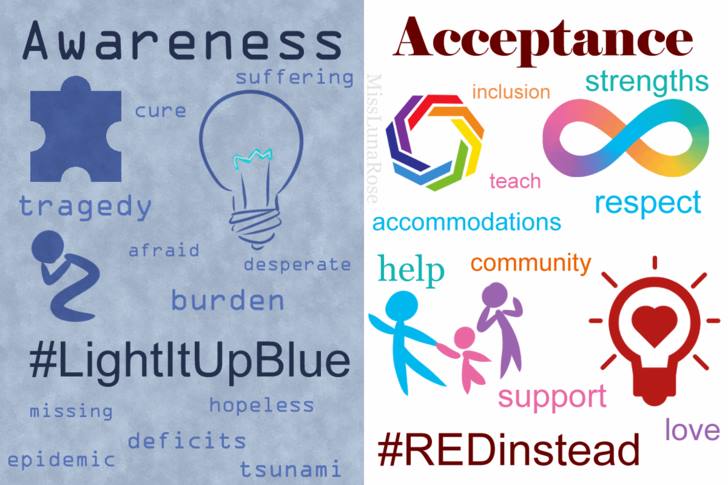
I've come up for air from this crazy year of teaching for World Autism Day - and I'm a day late. Many autistic people find April an awkward time because much of the messaging around autism comes from non-autistics. Miss Luna Rose made this great graphic to illustrate some of the concerns with the Autism Speaks organization's campaign to have everyone in blue for the month:

The #REDinstead goes back to 2015 with Alanna Rose Whitney's #WalkInRed alternative. It was Judy Singer who coined the term "neurodiversity" as well as creating the infinity loop way back in her sociology thesis paper in 1996. These are preferred by the autistic community, and that's what should matter.

Monday, August 26, 2019

On Maintaining Firm Categories: Do Labels Matter?

This link about people on the spectrum came to my FB feed as "Sponsored Content," so I'm wary at the get go, but they present this argument to be addressed: "Autism is a neurological difference in processing, and simply having a collection of traits or quirks without this difference in processing does not make someone autistic." They argue that "there does need to be some clarity, to get away from the ‘We’re all a little bit autistic aren’t we…’ phrase."

My position: But, why?

And, right before that came one of ContraPoint's latest video in which Natalie's characters argue about who counts as trans with a gender dysphoria anti-trender argument countered by a more fluid gender performativity stance.

I'm going to mesh the issues together here because of some similar arguments. I lean towards 'why does it matter?'. Whether someone's got dysphoria or is trending, it takes minimal energy to use whatever pronouns they asked to be used (while, of course, forgiving the forgetful who mean well). What's the harm in letting people try on the other gender or non-gender to see if it fits better? What's the benefit of doing brain scans on people to get some illusion of certainty about how people feel instead of just trusting how they say they feel? Similarly, who is harmed when people acknowledge their struggles with adhering to behavioural norms by latching on to a recognizable diagnosis? With ASD or ADHD or any other checkbox of symptoms that we've rolling into together under a label, why is it important to delineate who is in and who must stay out via an often expensive and sometimes questionable process? When one of my kids was diagnosed (incorrectly, I believe), the very reputable psychometrist badgered me to find that one thing they're obsessed with when one didn't immediately come to mind. Curious.

Saturday, January 12, 2019

On Continuums: ASD, OCD, ADHD, Alzheimers, and Allergies

Since the Aspergers designation was excluded from the DSM V, many people were, and are, outraged that all cases fall under the Autism Spectrum Disorder (ASD) instead of the separate categories of Autism and Aspergers. There is a world of difference between someone who has some mild problems understanding social cues and a strong interest in birding but is highly functioning, and someone who is unable to use spoken language and exhibits almost continuous self-stimulating behaviours.

Then there was a storm of controversy over Stephen Fry's comments about having "OCD eyes" that found it uncomfortable to have a anything appear out of order. For some people, having OCD means feeling discomfort when things are out of place and having an unstoppable need to put them right before the anxiety around it becomes too painful to ignore. In an article in the Guardian, David Adam suggests that OCD is far worse than a dislike of things out of order, as if people who have a mild case don't really have it at all. It's definitely the case that some people have horrid obsessions that affect their ability to function in the world. But it's also true that people can have intrusive thoughts that provoke repetitive actions in a way that don't noticeably affect their function. They're not desires they have, but random thoughts that people can't prevent coming to them. I understand not wanting to abuse the term until it's meaningless, like having an occasional day of high energy isn't the same as having ADHD, but there is no cut and dry line. It's very difficult to determine to what extent thoughts and routines have to disrupt a life in order for it to be considered a true case of OCD.

Wednesday, April 25, 2018

On Entitlement and Unfettered Rage

One of the benefits or downfalls of the internet is that it allows fringe groups to find each other online. When it comes to feeling like nobody in the world knows about climate change or the Myanmar genocide (or philosophy), because nobody in my immediate vicinity is too concerned or interested, then it's invaluable to find clusters of intelligent people writing about them regularly online. Finding people with the same concerns about the world can be a game-changer when you've all but given up on working towards a solution for a grave social injustice.

But it's a tragic downfall of cyberspace when the "social injustice" is that you can't get laid. People in some fringe groups who, as individuals, would all be seen as rare deviants in need of help, are able to find each other now, and cluster together to reinforce and normalize their warped version of reality.

Such is the case with the van killer in Toronto. I won't use his name because I hope it's forgotten and he's forgotten rather than becoming infamous. But we can't forget that he was part of a movement of "involuntary celibates" (incels) who are outraged at their misfortune with women. Instead of blaming their own approach or attitude or maybe something they said along the way, they put all the blame on women for not flocking to them they way they expected would happen.

Sunday, March 5, 2017

On Rising Anxiety Rates

A couple weeks ago, CBC ran an article about a high-school guidance counsellor, Boyd Perry, concerned with the increase in anxiety in students, and I've been dwelling on it ever since. This is crazy long as I'm just figuring all the angles here. Perry thinks we need to assess anxiety differently because these kids, some of them in kindergarten, aren't disordered but merely ill-equipped due to the bubble parenting that's become a trend, the swooping in to fix every little thing rather than letting kids feel the pain and learn to cope. According to an annual survey of counselling centres, the most common issue raised by students used to be around relationship concerns. In 1996, anxiety took over as number one spot, and it's stayed there gaining a wider lead ever since.

I agree parenting trends and misdiagnoses are an issue, but I also think it's more complicated than that.

I raised a similar concern a year ago; maybe mid-winter is the season to discuss our discontentment. My students last year were quite sure school is significantly harder than ever before regardless my claims to the contrary backed up with binders of old assignments and exams spanning the decades. I don't think they felt like it's harder just because life has been too easy for them because of overprotective parents, though. At the time I said it's also because of their parent's anxiety over the job market, the demands social media have on their time, and everyone's heightened expectations of themselves and their lives including, but not limited to, the quest for a gratifying career that allows them to work to their potential in a field they find fascinating. Today, I'd add the decrease in face-to-face interactions and feelings of community, the umbilical cord of cellphones that prolongs separation anxiety (with friends as well as parents), unceasing change that keeps us in a state of perpetual turmoil, concern with the state of the world, and even pollution. There are numerous societal, environmental, and personal factors intertwined that are pushing this trend.


WHAT IS ANXIETY

But what does anxiety even mean? A separate issue is that 'anxiety' is a word like 'cancer.' Decades ago I saw an interview with an oncologist (and sometimes comedian and philosopher), Robert Buckman, who insisted that we should use the word 'cancer' the way we use the word 'infection'. Both are very broad terms that could mean someone needs a minor procedure or they're on death's door. You might need a benign mole removed or a blister popped, or you might have pancreatic cancer or AIDS. We don't generally gather family together to tell them "I have an infection" because that's meaningless information. We're more specific about it. We need to apply that specificity to cancer discussions always including the location, the spreading potential, and the stage. The word has become too loaded, typically cueing people to think the worst.


Saturday, November 21, 2015

On Aging and Playfulness

My city is full of construction in preparation for Light Rail Transit. I hit the bookstore today and was walking towards the hardware store for some blinds when the sidewalk abruptly ended. An orange mesh fence framing a "Pedestrians, use the other sidewalk" sign stopped me in my tracks. I considered turning back, but I had come this far. So I made my way across four lanes of traffic to the other side where, lo and behold, there was a twin sign and fence bookending the highway. There WAS no other sidewalk!

After determining that there was absolutely no other way to get from point A to point B, I slithered my way around the fence and into a 2' deep trench that once featured a walkway. Sloshing through lovely suctiony mud, I was further pleased that I wasn't able to find my sneakers at home earlier and had resigned myself to heavy boots on a reasonably mild day. And as I was happily stomping through the muck on the busy street, just 20' or so from where the sidewalk would begin again, I thought about a book I had just paged through but hadn't bought.

Ian Brown is a favourite writer of mine. I even e-mailed him about a bit of writing I had done once, and he courteously responded (which I printed and saved). His newest book is about turning 60. He wrote a diary-like entry once a day for a year, and I immediately regretted not doing the same at the start of this year, my 50th, except I know I'd never keep it up for a year. Once I started a blog taking a picture a day of myself - no words or ideas, just a snapshot. I lasted three days. Routine is not my forté.

But I didn't buy the book because it would make me too introspective. I buy books to face me outside of myself. John Ralston Saul's The Comeback was my choice today. A book about someone turning 60 would have me dwelling on turning 50. Even just paging through it a bit has done that well enough, obviously!  Brown wonders about what 60 looks like, what pleasures are found and lost, what it means to be 60 these days. I understand those questions as I find myself searching out which famous people are close to my age. Woody Harrelson is close, and Robert Downey Jr. But famous women my age don't often look like anything I could recognize in the mirror. What does 50 look like? It's so hidden it's become foreign to us. And how do 50-year-olds act?

I thought of Brown's book as I enjoyed my muddy journey trespassing around barricades on a busy street in broad daylight, and I became briefly self-conscious, suddenly aware that I'm not 10-years-old, but a middle-aged lady intentionally splashing mud like a crazy* person! This makes it all the more hilarious. Somehow I'm typically saved from acknowledging the gaze of the other through some magical built-in obliviousness to norms, which allows for a strange sort of freedom. I might look ridiculous, but I'm causing no harm.

Why is unself-conscious playfulness the thing we give up as we get older when we could just as easily give up judgment and spite and crabbiness. Because shouldn't we all enjoy a bit of a splash now and again?

__________

* I waffled over how to word that line for ages. I considered "like something's wrong with me" or "like I'm on drugs" but both have the same problem of stereotyping behaviours. Yet I do want to get across that childhood behaviours in an adult are ridiculed - people think less of us as they would someone with a mental challenge or illness. And the whole point is, wouldn't it be cool if they didn't?