Showing posts with label Jung. Show all posts

Sunday, October 12, 2025

Managing So Much Suffering

It feels like I understand the idea that all suffering comes from expectation in a way I didn't used to. Now it seems so obvious, but I'm not really sure what flip was switched. It's not just that if we stop expecting to get things, we'll be happier, but how ridiculous it is to expect anything to stay the same at all, much less get better, ever. And that understanding seems to help reduce some anxiety over the things that can't be easily changed. Suffering is inevitable, but it can be somewhat diminished in order to have more contentment. We can change what counts as suffering, and we can change our perspective around tragedies, so maybe we can also change how we can continue to bear witness to, or experience, absolute atrocities.

One simple way to reduce suffering is to narrow the definition. Comedian Michelle Wolf jokes, "It's hard to have a struggle and a skin care routine," which clarifies that we might be considering some difficulties as suffering in a way that doesn't fly when we widen the scope of our horizons. Pain is pain and can't definitively be compared, yet I believe many of us have an automatic judgment in our heads that lists events in a hierarchy. Typically suffering from having to do a task we don't want to do, like write a boring report or clean out the fridge, or from wanting luxuries we can't afford, like another trip, might be relegated to the bottom as whining. The pain from it is there, though: the agony and stress from uninteresting maintenance that's necessary to further our own existence or the grief over lost opportunities. Furthermore, it can develop an extra layer of shame on top of the suffering if we try and fail to elicit sympathy for having so much food that some is left to rot and needs to be cleaned. When we realize we can't afford that trip after all, this is a suffering we are expected to bear without complaint.

Sunday, March 2, 2025

Accepting Difference

I recently watched the lovely film, A Real Pain, about two cousins (played by Jesse Eisenberg and Kieran Culkin) who travel to Poland to visit their departed grandmother’s home. In the first 20 minutes of the movie we’re shown two dramatically different personalities, both neurotic in their own way, but one more inward and the other laser focused on other people. It’s in our vernacular to understand the characters as introverted and extraverted, but there is still disagreement over what that means and, more importantly, what to do with that information.

I think we’ve veered off course since Jung’s Psychological Types, now over a century old, the precursor to the Myers-Briggs Type Indicator (MBTI) and more recently the Five-Factor Model (FFM) or “Big Five.” There are lots of other personality inventories like John Holland’s six Personal-Orientation types, Arthur Brooks’ mad scientistscheerleaderspoets, and judges, and Martin Seligman’s top five strengths, but MBTI and FFM seem to have sticking power.

Tuesday, December 3, 2024

Developing the Capacity for Rational Choices

"As the world falls around us, how must we brave its cruelties?" -- Furiosa 

Imprisoned climate activist, Roger Hallam, recently wrote about the necessity of expanding emotional well-being as we face bleak events happening around the world. While climate scientists try to "help people through the horrific information that they are being given," they also need a way to manage their emotional reactions. We can no longer afford to merely distract ourselves from the inner turmoil. Beyond climate, we could very well be entering into a period of much greater conflict at a time of even more viruses, some destructive to our food system. When the watering hole gets smaller, the animals look at one another differently.

To move forward with compassion, at a time when divide and conquer strategies have created polarization and infighting, seems to require an effort from each one of us.

Hallam writes,

"We might want to think about why saint-like people are enormously influential, even powerful. . . . They see the world as dependent upon the mind. . . . They are not enslaved by the world; their minds are intent, driven even, to change it. They do not see this as an end in itself."

Saturday, August 10, 2024

Embracing Fallibility

Many of us live in a punitive, carceral type of society that can make it difficult to have compassion for ourselves or others. It's an era of the glorification of the individual over the group, leading to perfectionism and narcissism and so, so much loneliness. We can't connect when we're working with blind determination to find our place above the rest. We can't connect when we don't dare show an ounce of vulnerability for fear of being taken down like a wounded gazelle on the Serengeti. Our quest to rise to the top for the security we think comes with status and money is completely at odds with our very real need to feel authentically known, within the security of a community.  

We're no longer following that love and forgiveness bit from Christianity, if we ever really did wide-scale. And we project our fear of losing on anyone who has suffered through difficulties, no matter if it's a natural disaster or massive layoff. We distance ourselves from the suffering of others by convincing ourselves they must have done something stupid to be in this position, and, therefore, we're safe as long as we keep on going hard. It's just a trick to make us feel safer, that unwittingly keeps us from too consciously noticing the floods and fires, layoffs and illnesses lapping at our heels.  

Monday, May 20, 2024

Transformation of the Self

Over thirty years ago I was in an on-again-off-again relationship that I just couldn't shake. After months of a variety of attempts of different types of therapies, I lucked into a therapist who walked me through a version of the Gestalt exercise of talking to a chair that ended my longing for this guy on a dime.

The exercise had me reimagine many ways he had enraged me, bringing all that to the surface. Then it raised any guilt I had around my own actions towards him, sadness around missing him, and finally ending with celebrating what I learned from him. It took just an hour, and I left feeling completely finished, excised of any clinging or craving, and able to effortlessly say "No thanks!" to his next late-night phone call. Pairing words and actions with emotions in a contained and structured time and space, that gives some order to the chaos, might do next to nothing -- but it might help to move through a difficult transition. I was so impressed with this power hour that I went to grad school to study ritual work. Gestalt psychotherapy is a far cry from cultural anthropology, but I perceived a connection to rites of passage that help neophytes transition from one state to another.

I recognize the cringe-factor in all of this, but it's worked for thousands of years to take children into adulthood, and we've kept at it when marrying and burying, so there's likely something useful in the process. And it feels like we need something transformative more than ever.

Monday, February 6, 2023

Dating for Dogs

Lots of people discredit the Myers-Briggs as just a horoscope, but it's significantly different and can be useful in recognizing that we're all innately different kinds of people. This awareness can help us get along in this world and maybe even find love, or at least a better roommate.

Our Tendency to Notice Differences by Type

Dividing people into types based on intrinsic tendencies has been around for millennia, born of scrutinized observations of human nature. Ayurvedic Doshas were recorded about 3,000 years ago identifying people who are Vata (energetic but scattered), Pitta (systematic and ambitious, but dogmatic), or Kapha (methodical but slow moving). The four humours came around 500 years later with
Alcmaeon of Croton to differentiate those who tend to be sanguine (enthusiastic, active, social), phlegmatic (reserved, intellectual, solitary), choleric (ambitious, decisive, short-tempered), or melancholic (depressive, cold, dry). If you think of those categories long enough, you can easily find yourself playing a game of slotting your friends and family under each term.

Then Jung wrote Psychological Types in 1921, outlining opposing traits along three continuums: extraverted/introverted, sensing/intuitive, and thinking/feeling. (That last one might be better updated to task-oriented/people-oriented.) Although it produces only nine specific types, the continuum set-up provides infinite possibilities within each set of letters. It's similar to being mainly melancholic with a touch of sanguine, or having a primary and secondary dosha. Jung explains his stance on innate personality:

Saturday, July 17, 2021

Self-Diagnosis with Checklist Criteria: the Big Five and ASD

When I was a kid, my folks said I was a little slow to warm up to people and sometimes needed a nudge to interact. Then, in grade 11, we all had to do this really long test, filling in stacks of Scantron-type cards with our answers, which were fed into a giant computer that generated reports for each of us, which required a specialist to come in to interpret. The upshot of it all? I'm introverted, an INTP, and I should consider a career as a minister. Then twenty years later, I went to grad school and took a course in Carl Jung, including his typology. We were given a test to do, on paper, which was sent away to be carefully analyzed by a specialist. I got a 30 page typed report in return that said I'm still an INTP, and that can't predict my career goals (assuming it can is a fallacy of affirming the consequent*), but it can help me understand and accept why I need so much alone time, why I struggle to notice the mess I leave in my wake in a way that my partner (ex-partner) finds inexcusable, why I'm good at getting stuff done, and why I'm so scattered. This was a special privilege, getting this 30-paged report, offered only to us because we were taking the course. But another twenty years went by (damn, I'm old!), and now anybody can do these tests online and find out all about themselves. And it's FREE!!!  

Tuesday, August 14, 2018

On Transgressions

I've been enjoying a podcast "This Jungian Life," in which three Jungian analysts discuss various questions. This one in particular discusses the difference between sin and transgression, but then it goes further to help us understand the state of the world today.

A transgression is an act of stepping across a boundary. To feel any guilty for our actions, we have to know that there was a cultural or internal boundary. And we often know we're crossing a boundary and doing something immoral, but we do it anyway, like having an affair. But Jung isn't puritanical. Known transgressions aren't necessarily bad things. Life is too complex for morality to be so certain.

To determine the value of a transgression, one of the analysts suggests to ask, 'Will this action make my life bigger, or will it make it smaller?' Sometimes a transgression can significantly improve our lives and our society. Holding hands with a partner of a different race or of the same gender was a transgression that helped develop equity in our culture.

But even if we realize the action is making our lives smaller, then it's important to benefit from recognizing that fact and becoming aware of our moral fallibility. It's vital to us individually and to society collectively for us to get to know our deepest darkest shadow side. There's a gravitas to being fully aware of our worst parts. And then once we see it, the simple effect of suffering guilt is profoundly transformative.

What seems to be happening more and more, instead, is scapegoating. It's a false resolution that seeks to ignore any possibility of a personal flaw, avoid that painful experience of guilt, and transfer it through vengeance on others. They want to shift their sin to another, the way we once had animal sacrifices to help us atone for our actions. The result is that individuals aren't going to begin the process of  'individuation,' as Jung would say, but, in plain language, too many of us are just not growing up.

It takes courage to see ourselves clearly, especially when the leaders in our society are choosing otherwise.

Saturday, April 21, 2018

On Peterson, Political Correctness, and Postmodernism

Peterson was on Bill Maher last night. They're both people that have some clever ideas, but also promote a few questionable notions in a way that's slick enough to just get a pass from some intelligent people instead of necessarily getting the scrutiny deserved. Here's an innocuous and pleasant exchange between mutual fans:


ON POLITICAL CORRECTNESS:

In the video Maher defined political correctness as, "the elevation of sensitivity over truth," and lamented the "emotional hemophiliacs" who will bleed at the littlest thing, but instead of avoiding sharp objects, they make the world cover everything in bubble wrap. Peterson went one step further: "It's more like the elevation of moral posturing of sensitivity over truth." He explained a bit about resilience: "Security doesn't come from making the world safe, because that's not possible. You make people resilient by exposing people to things that make them uncomfortable . . . over-coddling leads to stupid and narcissistic people."

Monday, February 19, 2018

On Hari's Lost Connections

"There's violence to knowing the world isn't what you thought. . . . Sometimes the world doesn't make a lot of sense, but how we get through it is, we stick together, okay?" - Gloria Burgle, Fargo


I watched Joe Rogan's interview with (interrogation of) Johann Hari about his new book, Lost Connections. Rogan wasn't quite buying what Hari is selling, which is unfortunate because his premise is intriguing. He told a few stories through the podcast, but his book, while still a casual read, is heavily footnoted, and his view thoroughly supported with the most up-to-date peer-reviewed research. He even encourages us to "Kick the evidence. See if it breaks. The stakes are too high for us to get this wrong" (14). It's just this: Anxiety and depression are not primarily caused by a chemical imbalance in the brain, and drugs only work a little bit for very few people.

He needs all the footnotes because his claims are extraordinary, and the worst thing would be if this were seen as a mere conspiracy theory against Big Pharma. This is just a brief summary without all the data and examples. He interviewed many contemporary researchers and compiled the evidence necessary to convince the masses of our wrong turn on this one. And it's not about the cellphones!

Sunday, June 11, 2017

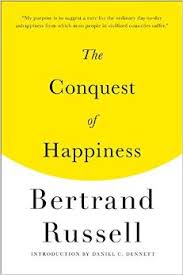
On Bertrand Russell's The Conquest of Happiness

Some  Russell quotations have been floating around lately, so I read The Conquest of Happiness, first published in 1930, and, boy, did I need this right now! The main ideas and some bits I liked are below by chapter. The book is really just a mix of Stoicism and Epicureanism, so you could just read that instead, but they're not nearly as palatable. This summary is really long, but not nearly as long as the book!


Part I: Causes of Unhappiness

1: What Makes People Unhappy? 

This chapter has some racist bit, but I imagine he was still more progressive than most at the time. We won't throw the baby out with the bathwater at any rate. He raises his thesis here: we can only be happy by being prudent with desires and by focusing outward.