"When we remember that we are all mad, the mysteries disappear and life stands explained." Twain / "I write to keep from going mad from the contradictions I find among mankind - and to work some of these contradictions out for myself." Montaigne / "I write because I have found no other means of getting rid of my thoughts." Nietzsche / "Writing is an integral part of the process of understanding." Arendt / "Writing, to me, is simply thinking through my fingers." Asimov.
Wallace Shawn sat down for a chat with Noam Chomsky (video link here), and here's what they talked about - slightly abridged and loosely quoted (for clarification purposes) with links. It's a great recharge for activists!
Shawn - Many people are shocked to see the president is now a cruel, brutal, greedy type of a man, and this is now the face of America, but I'm not shocked because this has been the face of the United States for decades. What do you think is not new, and what do you think actually IS new? [For more on this, check out Cenk Uygur's interview with John Cusack. It's pre-election, and the president he's criticizing at the beginning is Obama.]
Chomsky - My wife is from Brazil, and she predicted the Trump win before the primaries. From the outside, there's much that is not new. Recently the U.S. demanded that Cambodia pay back a debt incurred when the U.S. was destroying their country. There was secret bombing. It seems probably hundreds of thousands were killed. The Khmer Rouge was a small group, but ended up become a mass army of peasants starving and driven off the land by American bombing. The U.S. offered aid to get them to purchase American agricultural produce, and now they want payback. The American ambassador to Cambodia couldn't understand why Cambodians often make anti-American comments, but that's the America plenty of people see all over the world.
What is new, and dramatically new, is the U.S. withdrawal from the rest of the world on the issue of greatest significance for the prospect of human survival: climate change. The Washington Post had images of receding glaciers that will raise sea levels by many feet and pretty much drive tens of millions off land. A good part of organized life in coastal cities will be devastated. Every country in the world with the exception of the United States is committed to at least some actions on this issue. The US alone is not only refusing to participate, but is actually moving in a dedicated fashion in the opposite direction: trying to maximize the damage.
Chris Hedges is in Standing Rock, back to his original career as a war correspondent. The natives there are preparing for winter, and I'm struck by the contrast to the Occupy fight that dwindled away when things got cold. I'm curled up on the couch as I write that, so I mean no disrespect. But the world needs the kind of activists that can batten down the hatches for the long haul, so I'm so grateful we have such a strong contingent on sight for this battle. You can donate easily here.
Try to take 15 minutes to watch. They get into an excellent bit on environmental racism and climate justice: how poorer areas are disproportionately targeted by fossil fuel industries, and the strong ties between fossil fuels and cancer, and the problem with accepting the methods of the colonizers - the master's tools.
The Onion also has a perfect bit that's only a 2-minute read!
ETA - Sorry, the embed video was taken down, but here's a link to a full version. It's longer, but the first half is an explanation of what's happening.
In a recent article in my local paper, Peter Shawn Taylor says that anyone who wants to stop Nestle from draining aquifers doesn't understand economics and is hostile to capitalism. He implies that we can't just label water a human right above the fray of the market without doing the same with food, clothes, and housing. And "this sort of knee jerk hostility toward capitalism inevitably raises prices and reduces availability."
I don't understand the implications he suggests of that last bit. If we stop Nestle from taking groundwater to sell, which it's paying municipalities for at less than the going rate, then water will be more expensive and less available??
Taylor makes a false analogy implying that if we expect water to be free then we must also expect housing to be free because they're both human rights. The water warriors he refers to want to ensure that no company can take something essential for survival, get it for less than citizens pay for it, and then sell it back for 1,000 times the cost. So I think a much better analogy is, if we're going to allow Nestle to take water needed by a community, at a discount, then sell it at an enormous increase, then we must allow companies to take housing that's currently needed by people, get it at less than market value, and be allowed to sell it for 1,000 times the cost. See the problem with that version of capitalism now?
That's not something we worry about legislating because it'll never happen: nobody's going to buy a house that's so overpriced. Unfortunately, we still have a ton of people brainwashed by the cleanliness myth of bottled water who will continue to buy the product regardless the harm it causes to watersheds and communities. Free market principles suggest that the consuming public is the problem. If it's such a bad thing, then people just won't buy it and everything will equalize beautifully. But people don't work like that. We're a lazy and thoughtless lot. So sometimes we have to stop problems at the source in order to ensure longterm benefits to the people.
We already treat water like food, like apples for instance, as we pay for the labour mixed with the food. Farmers take the time and energy to grow the apples, pick and package them, and stand at a table in the market. We pay for all the people working down that line. In our parts, water is just there, under the ground, and we pay the city to treat it, monitor the quality, and pump it into our homes. Nestle is a company that wants to rip off the farmers by taking all the apples off the trees at a fraction of the cost so there's virtually none left for the local market, advertising them falsely as significantly superior, then selling them at 1,000 times the cost. It's right up there with WalMart for lowering prices by exploiting people along the way. We don't want to stop capitalism, just crony capitalism.
Furthermore, working to stop the control Nestle has in the area is imperative to impede any potential industry-influenced-government moves towards preventing citizens from collecting their own water in barrels or cistern like has happened in some jurisdictions in the U.S.
He suggests that native reserves run out of water because of gross incompetence by governments, not businesses. But when native reserves suffer from a lack of drinkable water, the blame often absolutely lies directly on the shoulders of industries like the Dryden Chemical Company and Reed's Paper Mill for poisoning the water with mercury and other toxins.
Finally, suggesting that "water is the most renewable of all resources" because it just keeps raining over and over shows Taylor's ignorance of the crisis we currently face. It's NOT continuing to rain in the same ways as it used to. Some areas are flooded and some are in drought. Groundwater is a different quality of water than surface puddles, and we need rain falling at the right intensity to be soaked into the ground to recharge our water table. Clean drinkable water must be protected. It's not something we can cavalierly use up expecting more to come tomorrow. That's the real irrational mysticism here.
The next world wars won't be about land or oil. They'll be about water. And Canada could be the next Iraq, invaded and decimated for the abundance of our natural resources. We have to stop corporate control over our most necessary resource now before it all slips out of our hands.
I watched Maude Barlow speak Thursday night in Guelph, and it was fitting it was in a church. I was in turns choking back tears and roused from my seat to applaud more than any preacher could compel me. She's a fascinating mix of intellectual brilliance and folksy warmth. She can rattle off an analysis of facts and figures at lightening speed, but as she signed my copy of her book and listened to me rave like a teenager about having her picture and words on my classroom wall, she put her hand on mine and looked into my eyes to thank me for being part of the fight. I saw Maude speak before, decades ago, and despite spreading the word far and wide since then, educated people in my midst still buy bottled water. "But I like the taste." Drinking water from the tap is a small price to pay (actually you'll save a fortune) for public control over waterways.
The evening was hosted by the Wellington Water Watchers, a small group of dedicated people with a huge fight on their hands. Our hands. Spokesperson Arlene Slocombe referred to Nestle as a multinational predator in our midst. They've been drawing water from Aberfoyle (near Guelph) and Hillsburgh (near Erin) for years, and now they've gotten hold of Middlebrook (near Elora). Studies have found that the quantity water in Middlebrook was needed for the citizens. The township offered to buy the land, but Nestle outbid them with full knowledge of the effect it will have on the people in the area. Profits over people all the way.
When Nestle's permit expired in July 2016, the provincial government passed a law that allowed Nestle an unlimited extension without any transparency. Wynne thinks the solution is to raise the fees for corporate water extraction, but that will have a negligible effect on the outcome. Nestle will profit from climate change, which is the foundation of Klein's concerns around disaster capitalism. We must put the public's right for water first, and overwhelming public support and political pressure is necessary to stop the renewal of permits. Aberfoyle is up for renewal now, and Hillsberg is coming up next summer. Nestle pays fees and taxes to the municipality it's situated in (for Aberfoyle, money goes to Puslinch, but the water draw also affects Guelph), so sometimes poorer municipalities prioritize immediate cash over the future livability of the area.
WHAT CAN WE POSSIBLY DO? (Barlow's words are further down, below the selfie. This is the important bit.)
Personally:
Check out all that Nestle owns (brands are all listed here and in this graphic or get the buycott app for your phone), and boycott Nestle products. Then take another step to tell them about it. Socially:
Tell your friends and family about the issue. Tell everyone on social media. Start a petition. Tweet it to celebrities and TV producers en masse. Nothing changes a society's behaviour as quickly as regular-type sit-com characters changing their behaviour. Remember when Rachel changed her hair? Boom! If the cast of Brooklyn Nine-Nine carried re-usable water bottles and were shown filling them from the tap instead of carrying bottled water and hanging around the water dispenser, it could change people's mindless behaviours. Locally:
Call, e-mail, and/or visit your Mayor to insist we ban single-use water bottles in our city like Montreal's trying to do or, at the very least, ban them in all municipal events and buildings. The Blue Community Project can help it happen in your area. So far 18 municipalities in Canada have succeeded in this ban. They're early adopters of this new mentality. At times the speakers seemed to suggest that a Nestle boycott would be enough to save the day: "Just close your wallet!", but Chomsky says personal boycotts have the same effect as committing suicide. I signed the pledge card, but I'd argue that they're useful mainly for our own sense of integrity. To really fix things, we need to legislate Nestle out of business by petitioning municipalities (and provinces and the whole flippin' world) to ban bottled water everywhere. Provincially:
Call, e-mail, and/or make an appointment to see your MPP. Tell them Wynne has to get tougher with Nestle. It's not enough to just raise the fees. She has to stop them from selling the water that our municipalities need to flourish. Federally:
Call, e-mail, and/or make an appointment to see your MP. Tell them that Trudeau has to reinstate the acts decimated by Harper: the Fisheries Act, the Canadian Environmental Assessment Act, and the Navigable Water Protection Act. (See below for more info on this one.) Tell them that if he doesn't, then we may as well be living under Harper's rule. No shirtless photo op will make you forget that he allowed Harper's mess to continue unabated. (Maybe don't tell them that last bit.) Still PUMPED about it? Then get involved with... The Council of Canadians, the Ontario Greenbelt Alliance, and/or the Wellington Water Watchers. If you're local, then show up to Guelph council this Monday, Sept. 26. There's a rally at 5:00 and you can try to follow Councillor James Gordon in at 6:30 (if they'll let everyone in). He plans to introduce a motion asking council to send a letter to the province opposing Nestle's application.
WHY DO WE NEED TO DO SOMETHING?
Here's what Maude told us (highly paraphrased - she spoke a mile a minute - and organized so I can make sense of it all, but linked. Note that some links go to corporate sites to illustrate the types of profit-driven arguments being made on the other side of the issue.):
We Don't Have as Much as We Think:
The world is in crisis, and Guelph is a microcosm of these world issues. We're in a place where we've been conned by a myth of abundance. Most of Canada's fresh water is in the north. The available water in the south is decreasing yearly. Canadian lakes are warming more than anywhere else, and there's no protection for groundwater. It hasn't even been mapped yet, so we don't really know how much we actually have.
We dump toxins and sewage in our water making it largely undrinkable. Europe has much higher standards around polluting water. CETA (the new TTIP) will make this whole situation much worse. If CETA is passed (there are some constitutional challenges from Germany right now), and Nestle is denied rights to water, Nestle will be able to sue us. Right now Coke and Pepsi can sue (with an ISDS) because they're American companies. But Nestle's European. CETA is not yet signed, so they can't sue yet. There's not enough public understanding of how CETA works and how damaging it will be.
Legislation has been Dismantled:
The National Water Act of 1970 handed power to the provinces, so most activist work needs to be done at the provincial level. Federally, Environment Canada's water budget is starved. There's a loophole in the Fisheries Act that allows the government to essentially designate lakes in order to allow dumping in them. About four years ago, under Harper, bill C-38 gutted the Fisheries Act and the Canadian Environmental Assessment Act, and bill C-45 removed protection for 95% of our lakes and rivers originally protected under the Navigable Water Protection Act (which was originally drafted in 1881!). These moves were on a directive from the Energy Industry.
Our Jobs Shouldn't Destroy our Lives and our Future:
Our manufacturing used to be 26% of GDP, and now it's 11% because our jobs have moved overseas. We're turning to our natural resources for jobs, but it's having a disastrous effect. 11 million litres of toxic waste are leeching into water every day around the Alberta tar sands. Alberta will be first water-insecure province. The Energy East Pipeline would cross 3,000 waterways and put the drinking water of 5 million Canadians at risk. For the past 30 years, pipelines in Canada have averaged three breaks per day. It's not a matter of if they'll break, but when. BC and Alberta are fracking and mining due to a move to public-private partnerships (PPPs). Suez and Veolia, water 'servicing' corporations profiting off human need, argue that once we're in a PPP agreement, then they must be compensate if any municipality breaks their contract with them. There's also serious issues with allowing water trading (already started in Alberta), water pollution trading (euphemistically called 'water quality trading'), and water exporting. We already export bottled water, all in plastic, to the tune of close to 465 billion litres of bottles a year.
Politicians are Acting Cowardly:
This is a global fight. Peter Brabeck-Letmathe, CEO of Nestle, thinks the human right to water is ridiculous. He's also the advisor to the World Bank Water Resources Agenda 30/30 that delivers water to poorer people worldwide. This is a conflict of interest, and an abominable abuse of power. It's also a local fight (that's being watched across the pond). Nestle pays less than $15 per day for the water they take in Aberfoyle. 11,000 people of the Six Nations have no access to running water. Two-thirds of First Nations have been under drinking water advisories here in the past few years. It's a travesty that's largely being ignored.
Provincial politicians "clearly don't know what they're doing." They just want to raise the fees attached to taking the water, which will have a negligible effect on a huge corporation like Nestle. This is our water, and Nestle needs to leave this community.
Federally, Trudeau had some positives in his budget. He added a lot to water and waste water services in First Nations communities and into the fisheries an oceans, but he didn't increase allotments to Environment Canada. If they don't undo the damage by reinstated the gutted bills, it'll be as if Harper is still in office. Trudeau launched consultations on those acts instead of reinstating them because the oil and water industries are pushing back. We must tell MPs that they have to fight for this for us.
This is all Possible!!:
"Boiling Point is a cry from my heart to yours." We have to abandon the erroneous belief that Canada has lots of water. We need a federal plan to protect our groundwater. We need to ban pipelines, fracking, and bottled water. We need justice for First Nations. We need a new water ethic that overrides all policies involving water use or that has an impact on water (agriculture, trade deals, etc.). Water is a public trust. It must not be allowed to be taken piece by piece.
Oscar Olivera was leader of first fight in the water wars in Bolivia. Bechtel privatized water and tripled the price and fined anyone capturing rainwater. People fought back and got Bechtel to leave. He explained his dedication with this line: "I would rather die of a bullet than thirst." This is similar to Mike Mercredi's struggle right here. He lives with the tar sands, and when children swim in lakes nearby, they get covered in sores and cysts. He says, "It would be kinder to come in with guns and kill them quickly."
At Site 41, near Barrie, people fought a dump being scheduled on top of an aquifer of exceptionally clean water. In the spring of 2011, Mayors were ready to go ahead with it for the tax money. Equipment was moved in, but First Nations women set up a peace camp and held prayers on the road in front of traffic. They were able to stall the equipment all summer until the frost made the work impossible. Their arrest was ordered, and the community was split three ways on the issue. Pro-dump, pro-water, and undecided. Then one of the leaders of the pro-dump group was presented, by his grandchildren, with the opposition's sign. They pleaded with him, and he announced his job description had changed to being a steward of the water.
THE LAST STRAW (my two cents on activism):
This event was covered by Guelph Today news, and the Council of Canadians site, where both report a 'packed hall' or a 'big crowd'. The thing is, it wasn't all that packed. I was worried about getting a seat, but there were many to choose from. Papers like to suggest that this is important news because everyone who's anyone was there, but in reality this is really important news because so few were there. So few people, particularly younger people (I felt like I was younger than most there), are concerned or "woke" enough to come to a talk or rally or write their MPP or try to fix this vital and life-threatening problem in any concrete way. Writing about small numbers won't sell papers, but it's an important part of reporting the problem. Hopefully it was truly packed in Toronto last night.
When I talk to students about what effective activism looks like, they often focus on people who became famous. Martin Luther King Jr. is a name they hold up as the model of an activist that changed the world. But then activism becomes something far too difficult for an ordinary person to do. How do we possibly get thousands of people to follow us? How do we write and deliver all those speeches? It's not in the skill set of the best of us.
I tell them to keep in mind that MLK didn't start the civil rights movement. He was there at a high-point in the movement, when things dramatically turned a corner. But, and he's said as much, the movement started decades earlier with thousands of people whose names you've never heard and wouldn't recognize. He happened to be the last straw that broke the backs of a racist system. He didn't make it happen. The people who paved the way before him, each one of them were absolutely necessary for the country to galvanize around him. And we never know when we'll hit that corner, when we could be that last straw.
We have to add ourselves to the numbers. We can't do this for fame or fortune; we can't expect that we will be the ones to save the world. We have to work on these issues knowing we likely won't be known or remembered for our work, but it's simply the right thing to do. That people are suffering, literally dying of thirst, so a corporation can increase its profits by duping the public is a travesty. Barlow said the fight is on our doorstep, but I say it's right in our home. This world is where we live, and Nestle needs to get the fuck out.
How pivotal is that number? It seemed huge on the way in, and still lingers on the way out.
A year ago (way back here), I lived with my three kids, and now I just have one left at home. The house is quieter and cleaner, and I talk to the older two about as much thanks to texting. With one in the attic and the other in the basement, I admit we used to text each other within our home. I'm not really sure why I'm sheepish about it; it's damn handy. Now our face-to-face time is limited, so I think we pay more attention to one another when we're together. And they're still close enough to get me to hang pictures for them. This is definitely a time of life of changes for anyone with a family. Spending twenty-plus years with people who then move on can be a bit disorienting.
I've written some stuff this year, but not as much as I would have liked. Collaborating on a book was a great experience! I rarely get writerly feedback on articles or blogposts. I spent far too much time distracted by elections this year. I'm not sure how much they matter. There was scant time for a brief sigh of relief before I started questioning Trudeau's leadership. Notley seems owned by corporations, and I don't think JT's off leash either. I think over time I'll care less, but right now I still operate under the illusion that my letters and marches can possibly make a difference. It gives me something to do.
After years and years of begging friends to take up long-distance cycling with me, I finally got brave enough to go out on my own. I still haven't been hit by a car or attacked or stranded too far from home to walk. It's such a commonplace thing to say, but I really regret all the time I spent unsure and fearful. I regret all the bike trips I could have taken but didn't because I couldn't find someone willing to come with. One benefit of growing older is that people don't look down on me when I cycler slower than they expected. The expectations diminish to the point that getting out there at all gets you kudos.
I'm falling apart a bit. A year ago it was only my knees giving me grief. Now I've got arthritis in my toes and have been saved by orthotics. I miss walking in bare feet though. A few years back, I dislocated my pinky finger. Months later it still hurt, and my doctor said, "Yup, everything takes longer to heal now." The little aches and pains make me think of this...
My feminine bits are turning on me, and a few procedures will be in order. Nothing too frightening, but life-altering none-the-less. It kinda makes me wish I were married but only for utilitarian reasons, which isn't enough for me to regret never marrying. Drinking buddies aren't really up for hanging out during one boring, sober appointment after another. They have spouses and families to take care of and lives to live on a path that doesn't include me. Appointment buddies require someone who's gotten in a share of good times already, and who's had some prior care-taking give and take with you to establish the requisite temperament. It helps if they've seen you at your worst already, maybe even helped you out of your clothes on more auspicious occasions. I'm not ready to lean on my kids for that kind of care yet.
This too shall pass.
I always found it unsavoury when people suggested I need to find me a good man because I'll want someone to take care of me later. Practically speaking: men tend to die first, so I'd likely end up taking care of him. And morally speaking: yuck. That is to treat someone as a mere means to an end. Kant would shake his sickly old head at me, and I can't have that. It's not right to snag a partner just for financial gain or to have someone hang on your arm or to get laid or to get some hospice care. They have to have a draw that makes you want to do right by them, makes you want to be a better person for them, makes you want to share your life with them. Maybe my parents' idyllic marriage just ruined me for anyone. I feel like it's too late at this point, but life's full of surprises.
This has nothing to do with mid-life, but this year, I was struck cold by the number of colleagues and students we're losing to suicides. Possibly up to five educators in our board took their own lives in an 18-month period (see here after the passage). It took the death of seven indigenous teenagers in Thunder Bay within a ten-year period to spark a national inquest, but we're not talking about these local "sudden deaths" as if there could be any pattern. They're each seen as isolated events. Nobody's mentioned contagion effects or anomie or changing relationships in schools. Maybe it's just as well. But maybe we need a more personal inquest of our own. I'm not sure this one will go away quietly. I'm much more accepting of death than earlier in life, but these are different.
But actually most impactful this year, something that has changed my thinking and outlook profoundly, was being forced to teach Native Studies. I had no idea I was so ignorant. I didn't want to teach it because I knew so little. Now that I know, there's no turning away from it all. I'll be spending time over the next month developing easy-to-teach curriculum that could be incorporated in other specific class, and working on convincing other teachers to teach about all of Canada in any Canadian-linked courses. This shouldn't be a token course for a few interested kids; it should be general knowledge necessary to graduate high-school! I love that there's still so much to learn. It's easy to get settled in with our current level of knowledge, so it's important to shake that up a bit.
It's useful from time to time to be reminded of the gaps in my education, of the tenuous nature of our lives, of my strengths like a burgeoning courage and tenacity, and of my weaknesses.
I went to see this at the Perimeter Institute last night, and was so excited to meet the star of it, Caleb Behn, Eh-Cho Dene and Dunne-Za hunter, fisher, activist, and lawyer. Unfortunately, he cancelled. It was disappointing, but the film made it clear that he's a seriously busy guy! It was worth going to see the film anyway.
It's a perfect film for my Native Studies class. It brings in the notion of a split identity, of the relationship with the environment, the need to regain legal control over the areas being destroyed, and the challenge of putting it all together.
Behn's parents are polar opposites: his dad endured the residential school system and spoke at the Truth and Reconciliation Commission, and his mom is the highest ranking female executive at an oil and gas company. He's trying to cope with a system that destroyed his people, and she's trying to change the system from within. They divorced when Behn was ten, which he refers to as the first great break in his life.
The film lets us dwell on some beautiful scenery juxtaposed with concerns about checking game for contamination before eating it and the quickly dwindling number of animals to hunt. Behn lives in Northeastern B.C., land covered by Treaty 8, and the third largest hydrocarbon deposit in BC. It took 88 years to turn the pristine land into an industrial wasteland. The area is rife with cancers and birth defects.
The bulk of the film is about the treaty obligation required of any corporation or government entity to consult with Indigenous peoples on any action that could impede their rights. But they reveal that most of the consultations were for show, a quick by-the-way long after all the paperwork was completed with little in the way of real information provided to allow impacted groups to make an informed decision. Behn's grandfather commented that the government "makes the words dance on paper."
At this point one gets the sense that it's all so much about money and greed. The energy corporations rubber stamp the consultation and, in one historic day, they were able to make $476,000,000. Fracking is facilitating a new land rush. Behn relates, "They came for the trees, then the gold, the fur, the children, the oil, and now the gas." The government propaganda ads suggest that washing a car near the roadway is worse for the groundwater than pumping chemicals and fresh water down 2.5 km for the shale gas, leaving behind tailing ponds that end up back in the water system. The oil and gas company activities are regulated by their own industry. And LNG (Liquified Natural Gas) is being targeted for international markets in Asia. It's not about the jobs; it's about the fortunes they'll make. The attitude is one of getting not just what we need to survive, but as much as we possibly can - in the words of Rich Coleman, "to win this race before the rest of the world." Except the faster we extract, the faster we destroy our own land.
The film brought in many voices to add to Behn's experiences. Hydrologist Gilles Wendling explained that nobody has clearly examined exactly where the waste water goes. Dr. Robert Howarth, Professor of Ecology and Environmental Biology at Cornell warned that LNG emissions will soon rival the tar sands. An industry spokesperson from CAPP suggested that gas below the earth is a gift from the creator, and she explained that the industry will shut down a fracking site in a minute if there's any problems - except they never have despite all the many concerns raised. If they destroy the headwaters of the Tahltan River, they will destroy everything downstream.
Behn had only positive things to say about the good heart of the people working on the ground in the industry. It reminded me of Julia Butterfly Hill, two years up a tree to save it from logging, explaining how fond she grew of the loggers, reminding us that we need to change the system, not demonize the players:
But many of the workers on fracking sites are itinerant who move on after 4-6 weeks to another of the 28,000 wells in B.C. The landscape is disappearing under the weight of one proposal after another, a death by 1,000 cuts.
Behn was able to speak at a moratorium on fracking and realized, "If we get this dialogue wrong, things will be very very dangerous in our territory." His speech was well-received, but then they moved on to the next item on the agenda. "There's so much more to politics than speeches and young people raising their voices." It's hard to get our heads around the slippery inner workings of the system.
The film also raised some interesting psychological issues about suffering, authenticity, and the burden of fame. Behn was born with a cleft palate, and he believes it made him more empathetic towards others. I've often commented to classes about the number of famous activists who were raised with some type of early hardship. Behn suggests it's good to have suffered: "Sometimes pain can be good." Personal pain can open our hearts to others in a way that might not be reached if we've never been a little cracked. Behn grapples with his own authenticity as he recognizes the benefits he's had from having a mom in this lucrative industry. And some of the Indigenous protesters insist that "you can't tear down the master's house with the master's tools" because he has a law degree from their universities. There's a split between the old traditions and modern day culture that's hard to bridge. And Behn is startlingly honest discussing his new fame as an activist, how girls made themselves available and he didn't always act honourably: "Relationships are the clearest expression of my failures as a man." The film did a brilliant job of getting us to really understand the complex experience of fractured people, of all of us.
I didn't leave the film feeling any better about the world, but I felt less alone in the fight, and really really lazy for the pittance I offer compared to the men and women on the front lines.
I'm teaching First Nations in Canada this semester, and it's a bit of a challenge for me. I spent 7 years in school studying philosophy and social sciences - all from a western European point of view, so I feel confident teaching those subjects from that perspective, but I know little more about First Nations than what I've read in the paper and a few books (by John Ralston Saul and Charlie Angus). I have a general sense of the history, but I'm not up on the specifics of the treaties and the various groups that I feel I need to learn to do an adequate job. The last time I took a history course was when I was in grade ten. It'll be a busy semester, and I'll only be teaching it this once during a department transition.
The course is actually called Current Aboriginal Issues in Canada, but we looked at some articles on the first day that criticize the name, so I've changed the official title for our purposes. There's no history in the course description, but I can't imagine diving into current issues without looking at the background to each issue first, so I've added in some historical research, major tribes, languages, and locations circa 1490 to today (with a bit from 10000 BCE to 1490).
We started by looking at some stereotypes seen in media, and jumped on the "tribute" to the First Nations in the front hall of our very own school. A wooden figure was gifted to the school by graduates about 20 years ago, and it stays regardless some concerns with it. Here's what the description of it says:
"This statue is a compilation of various First Nations of Turtle Island. The breastplate, made of bone and bead is most commonly worn by the northern and central plains Nations such as the Lakota and Dakota people. They are often referred to by their language group, the Sioux. Likewise, the scalp lock seen here is not a Mohawk, but a "Pariki" or "horn." Pawnee is a derivation of Pariki and this Nation is found in the central plains and Oklahoma regions."
First of all, when is creating an amalgamation of many different people ever a act of honour? To create something emblematic of my family, I'd make something that showed our similarities, or, if I wanted to show one interesting thing from each member, I'd make sure not leave anyone out. Here three groups have to stand in for many different tribes. It's also curious that the depiction is of peoples far south of here rather than in honour of people of our region. The whole display make it seem like this is a foreign, alien group, so my class created our own version of an amalgamation of Europeans. We titled it, "Is This What Respect Looks Like?" and taped it right beside the statue, but it was quickly removed. Apparently it's offensive to stereotype people like that.
Our school teams are called "Raiders," and our school used to have a horribly offensive First Nations mascot which was pretty recently changed to a pirate. I don't understand why we're so married to "Raiders" though. A nearby school changed their teams from the Marauders to the Mustangs, so it's possible to change names. But not for us. At the time of finally letting go of the images, I suggested, if we must be Raiders, that we have a raccoon as a mascot. They raid things! I didn't win enough support. And, of course, shortly after the mascot change, Somali pirates started attacking ships in the Indian Ocean. Are we supposed to be encouraging the bravery and tenacity of pirates in our sports teams? It's not something I really understand at all.
I tried to embrace the change like a good stoic and get people on board to celebrate talk like a pirate day, but that didn't take off either. If we're going to do it, then can't we have some fun with it? Apparently I don't have much clout in these parts. But back to the course.
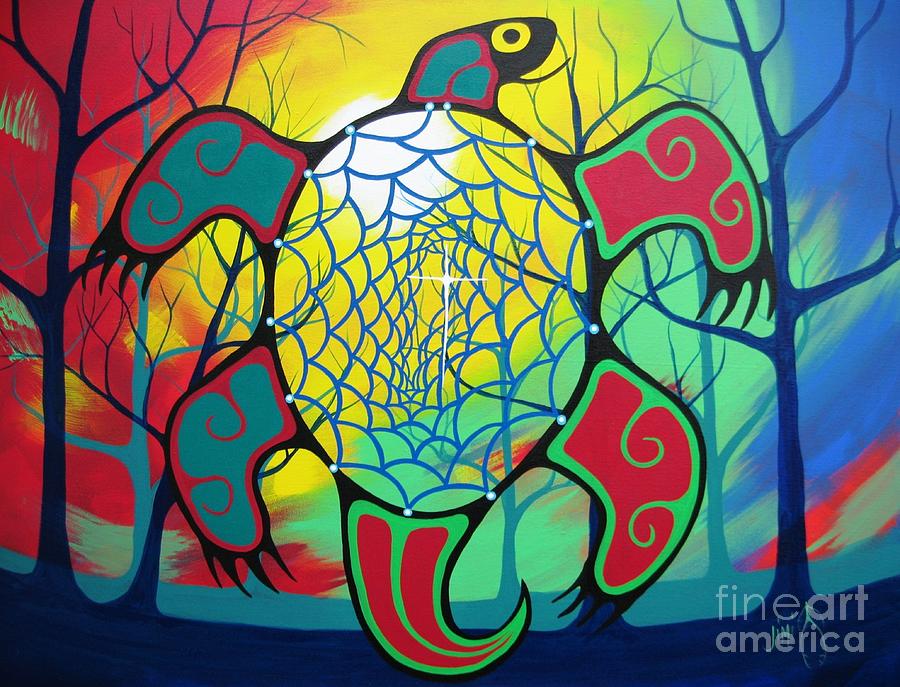
I decided to have students do a novel study which they'll present in a month. Because it's not an English class, they don't have to write a report on the novel; they're free to present in any way they like. Since it's sometimes hard for kids to think outside the box, I figured I'd read a book and present it in a non-essay format myself. I barrelled through Richard Wagamese's Indian Horse, then yesterday I painted a summary of the gut-wrenching book about an Ojibway boy's life, and I used art from a variety of Ojibway artists as inspiration for the depiction. But the whole time I wondered if I was in appropriation territory.
It made for a disjointed composition that doesn't work artistically - it's a weird mix of flattened images on a landscape - but it's useful to start a discussion on the story as it mirrors the painful clash of cultures. I interspersed quotations through select scenes to summarize the essence of the text. There's a little piece of it below to give you a sense of it, but I'm won't share more online.
I sourced the artists I imitated right on the painting, Norval Morrisseau, Jim Oskineegish, William Monague, Simone McLeod, and Christian Morrisseau, and I'll likely be painting over it after the course is over. I'd ditch it entirely except it got my 11-year-old daughter asking lots of questions. She had no idea about the residential schools and wondered why it's not taught in regular classes. She knows all about the holocaust because they all read Hana's Suitcase, but they read nothing about this Canadian holocaust. My piece is clearly effective as a way of teaching some of the issues in the story.
But even with the citations, it still feels a little wrong. In art classes we were often encouraged to copy the masters to get a feel for how to paint in a certain style. My house is full of my copies of Picasso, Matisse, and Rousseau. I obviously can't afford the originals, and I prefer paint on canvas to prints, and they're just for my purposes. I painted Three Musicians full size on my basement wall after seeing it for the first time. I don't feel any guilt over that. But it's not the same as copying a Morrisseau.
And I looked at student projects done in the past years of the course: pipes, longhouses, dream catchers, medicine wheels.... That really doesn't feel right. It's fun for kids to create, but...
Part of it is shocking ignorance. Some of the creations are re-creating something of honour as if it's a toy. Without intimate knowledge of the background and meaning behind artifacts, it's too easy to inadvertently offend. It's like if someone created a marker of our culture, but accidentally got the flag upside-down. It would be offensive to Canadians regardless the intention.
The goal is to amplify the voice of people who have been marginalized, to tell their stories without speaking for them. That can be tricky for a white teacher. Years ago I considered teaching The History of Mary Prince, but I was taken to task in an online forum for being a white girl who dares to teach a black story. So it went untaught. That's not the optimal solution either.
Perhaps it's best if I just supply the original material, add in some field trips and guest speakers, and summarize as little as possible.
So, why did I even paint the piece with a bit of the style of some Ojibway artists? I could have just depicted the scenes in my own style, but I wanted to add the flavour of the culture within the piece. I haven't studied the iconography the way I have with Byzantine art, for instance, but I did research each of the artists and where they're from to ensure they have a connection to the storyline. But I'll keep that final product within a small circle of my six students where we can discuss my internal struggle as well.
There are dueling petitions out to continue and to stop statues of all 22 prime ministers being planted on the grounds of Wilfrid Laurier University, my old school that I loved all to bits. I wrote about this statue project on its inception two years ago. The statues were originally to be set up at Victoria Park, but a survey of our citizens showed 79% rejected the idea. This debate has made news at The Star, The National Post, and The Globe and Mail, where one professor noted,
"Parliament wants to encourage the participation of diverse groups for the 150th celebrations. No one here was asked what they wanted,” said Nelson Joannette, a history professor at the university. . . . "Imagine any other marginalized group walking around campus and seeing those 22 monuments celebrating great white leaders. What kind of message does that communicate? It flies in the face of what contemporary universities are about."
I talked to my grade 10 students about this issue. They were in full support of the project, but their arguments are telling. They more vocal respondents fell along two lines:
1. "If it's free, then it's good. If someone wants to give you something for free, you'd be crazy not to take it."
The fact that it's privately funded takes away some of the concern of taxpayers, but it raises a different issue. Should wealthy benefactors be allowed to dictate the art that permanently represents our city? As Joannette suggests, if we want to celebrate the 150th anniversary of Canada, our voices should all be heard with respect to what type of display is warranted. Our voices were heard once in this city, and now the majority that protested the statues is being ignored.
2. "I don't see a problem with the First Nation issue. It was so long ago, who really cares about that anymore?"
Yikes! And, exactly. People don't get the connections and the long strings of history that sit behind the current occupation of land, and they don't understand problems with some of the policies of the past that have left a lasting negative impact on our nation. Missing and Murdered Indigenous Women and the disproportional number of Indigenous people in jails are just skimming the surface of the number of problems created by colonization.
I recognize that we have to understand people's lives within a historical context, much as I praise some of Plato's work even though he was cool with slavery. We can't attack their entire body of work because of one piece. But some PMs don't have much of a piece to praise, certainly not compared to other Canadians focused more on social reform than personal status.
Some American cities have been takingdownconfederatememorials. It's curious we'd want to put up something that could be seen as glorifying a dark history, just as our neighbours are becoming more enlightened.
And our own Luisa D'Amato tried to explain the problems with the opposition to the statue project:
It will be one of the ways that visitors, students and employees get information, both critical and supportive, about the behaviour and legacy of that prime minister. Perhaps a conversation or two will happen. "We're not trying so much to celebrate as we've tried to document," said one of the proponents of this privately funded project, Jim Rodger.
They want to display the PMs with warts and all to elicit further discussion about our history. The problem with Rodger's argument is that he wants to change the meaning of erecting a statue, but we can't arbitrarily change the symbolic vernacular of a culture. We don't look at statues and think, "This group of people obviously wanted to discuss this person further." Culturally, we understand statues to be a commemoration. We can't just change that definition as it suits us.
We should celebrate people who have sacrificed and fought in order to help our nation flourish. Terry Fox, the Famous Five, and Shannen Koostachin are good examples. Being a politician that gets to the top through trickery, dumb luck, or honourable means shouldn't be enough to warrant a bronze legacy. Some politicians fight for the top position for power and prestige, not necessarily to make Canada a better nation. Title alone doesn't make one laudable.
If the statues are about learning about history, then a smaller version of the statues could sit in a display travelling through museums and galleries across Canada. As a temporary display, people will come to see the statues when they're near where they can remark on the trajectory through one PM to another and look for the hidden iconography of the pieces. Maybe they can end up housed in the foyer of Kitchener's The Museum. In a museum, they are clearly an educational tool. As public art, they are celebrations of former Canadians. There's no getting around that.
D'Amato closes with these words: "When people at a university start instantly dismissing something because it makes them uncomfortable, that makes me uncomfortable."
Professors openly discussing and debating an issue in the news is not the same as "instantly dismissing" them. They're presenting their views for larger consideration, and the debate will continue.
But what's really interesting to me about this issue, is how passionately I feel about it. Beyond all the rational discourse, it should be noted that I am shaking with rage at the very idea that a statue commemorating Stephen Harper could go up in MY city. After all he has done to destroy what made Canada great, if he is to be celebrated here, then I WILL MOVE!
First of all, Hedges talks about the pivotally necessary moment in revolutions when the guards of the upper class refuse to protect them anymore and, instead, turn around to join the people en masse. I don't see us moving in that direction any time soon. We need the population to be educated on how the current system works against most people, but, more importantly, we need the police (and the army) to be educated as well on their part in this bigger picture. Hedges tells a story of being arrested at a demonstration and an officer quietly encouraging him to keep fighting as he's taking him away. Always a glimmer of hope somewhere I suppose.
But secondly, we are very likely to experience many crises in the years to come, and we have to maintain an attitude of fearless compassion through to the end. It all makes me think of Tolstoy's story, The Godson:
In a nutshell, this guy meets his mystical godfather, kills a guy in order to save his own mother, then has to atone for his sins as well as the sins of the man he murdered. The bulk of the story is about this godson trying to figure out how to stop evil in the world, and he discovers he can't stop it by chasing it or using force against it because that just adds more evil to the world in the end. Evil spreads evil. He has to be still and stand firm and make sure his heart is pure and full of compassion, and then offer only love to anyone he meets. And this is all an enormous act of courage (from the word 'heart') because it's hard to stop following the rules we've been trained by, and, once we can do that, it's hard to stop being afraid of one another and to stop acting defensively or aggressively.
It takes great courage to think for ourselves and to care about everyone else.
In class once I was discussing all the different aspects of environmental and labour injustices in the clothing industry to try to clarify the complexity of these types of issues, and I illustrated it on the board with stick figures as I spoke. Then I solicited any solutions for each of the problems no matter how idealistic. And when I got to "get a PM who will stand firm against child slavery and sweatshops," I drew an androgynous figure with giant balls of steel.
In my classroom, I have an 8 by 10 glossy of Harper, which his staff sent to me after I sent numerous letters. It's like he's Justin Bieber, and a fan wrote to complain about a song lyric - all he sees and cares about is that someone listened to him. We need leaders who listen to the people, and have the courage to be principled even if it means lasting one-term only.
And when the leaders fail us, we need more of that First Nations spirit that refuses to tippy-toe around issues and flat-out demands justice, and we need to do it without resorting to attacking one another.
I went to the Jobs, Justice, Climate march on Sunday. It's taken me a few days to think about what I think about it.
Klein so close at the pre-pre-rally.
I got to Queen's Park way early and sat under a big tree to read and wait, and I happened to sit where the media were setting up, so right next to Naomi Klein and Bill McKibben. I missed seeing David Suzuki, and I somehow didn't recognize Jane Fonda. But the usual crowd was there. In the pre-rally show, they faced the media with their backs to us, which felt odd at first, but then I decided it was as if they were at the front of the crowd, on the same level with us, part of us. Except the sound system was so bad we could barely hear anything. I was, literally, three people back, but I gave up my spot because I couldn't see or hear anything anyway, and I went back to reading my book. I caught it on the news at home.
Then there was a larger show with the celebs facing us, trying to work us into a frenzy, but I couldn't hear much of that either. It didn't help that people were walking around playing accordions or talking loudly- you know, doing their own thing. But that show went on from 1:00-2:15. That's a long time to strain to hear something in the blazing hot sun and to allow to fester a burgeoning sense that we're not one solidified group.
And then we marched. There's always something exciting and invigorating about marching in a crowd. It feels powerful. It's the same feeling I got as a teenager walking as part of a group down the middle of the street because we couldn't all fit on the sidewalk. We walked like we owned the place. And I met some really interesting, strong, vital people. That's why I go to these things: to remind myself that we aren't just cogs in a machine, and to recognize that I'm not alone in my little scheme to work towards environmental and economic justice against all odds.
Then after the march, there was apparently some food somewhere, and we all dispersed.
But, more interesting, there were protesters of the protesters. Like the People's Climate March last September, some people felt that regular citizens weren't involved enough in the organization. The marches are running on a top-down hierarchical model, which is the problem in the first place. Klein says in her book that there are two things necessary for effective environmental change: bold national policies and the willingness to say no to fossil fuels. But I agree in part with the protesters that a third thing is necessary - to ensure that we don't replace one power hierarchy with another.
The problem isn't just climate change and economic policy, but the wielding of absolute power by anyone over anyone. When the celebrities that show up are bigger news than the people, we've got a problem. And, I think, when the leaders speak to the media instead of the people being led, then we've got a problem. It starts to feel like it's spectacle instead of something remotely revolutionary.
Here are four of the specific claims from a primary anti-march protester, The Hamilton Institute and furthered by Why Not 350. I'm on board with half of them:
1. The Big Green organizations are "hijacking local resources to build their own fundraising opportunity, while turning us towards the most pacified forms of opposition....This funding model impedes radical, transformative change by privileging the spectacular while concealing less glamorous day-to-day organizing. The Big Green organizations in fact parasitize local organizing to support their one-off fundraising opportunities....They talk about including diverse groups and viewpoints, but they set the terms and limits of the discussion." "350.org promotes a token, one time support of indigenous peoples and lacks real solidarity with indigenous communities."
Or, as Paulo Freire insists, "Attempting to liberate the oppressed without their reflective participation in the act of liberation is...to lead them into the populist pitfall and transform them into masses which can be manipulated" (65). This is a concern I wasn't specifically aware of, but merely had a sense of, which isn't enough to make a compelling argument. This video has some of the specifics.
2. There is "a long history of NGOs denouncing militant forms of resistance taken up by frontline and impacted communities and of NGOs not supporting diversity of tactics."
On the bus ride up, well-organized by a local 350 group, I listened to a discussion on this line by an activist who felt strongly that we should denounce militant forms of resistance because "we lose legitimacy if we use violence." At one point in the conversation I spoke up that we need to bring pitchforks and torches and a guillotine to these rallies, dammit, and my small audience fell awkwardly silent. Whoops! But I'm afraid this is too serious a time to just try to talk things out reasonably Neville Chamberlain-like. I applaud the groups that take a risk by boarding oil rigs or damaging equipment in order to directly stop a pipeline going in the ground. Yes, smashing windows at the G20 is pointless, typically hurting the franchise owner and leaving the CEO untouched, but some acts of trespassing or destruction of property can be necessary to prevent a larger, more permanent destruction. This was illustrated in The Cove and, of course, Ferngully.
3. "The divestment campaign touted by 350.org is focused on publicly traded stocks and bonds, even though much of fossil fuel divestment takes place in private hands. Fossil fuel companies hardly make money off of their stocks, they make their money by selling fossil fuels; one of many issues with fossil fuel divestment."
Okay, but every little bit helps. I don't think it's a problem for different groups to have a different focus, as long as they don't work against one another. Some can work on divestment while others are boots on the ground. Coming at it from all angles at once can be very effective.
4. Finally, "Their framing is positioning political and economic leaders as actors who might make a choice in favour of people as a result of a large demonstration. We know this isn’t true."
This one is triggering. If a large demonstration won't work, then we don't have a democracy (which we largely don't anymore, I know), and this is another problem to add to the list. It should have been called "Jobs, Justice, Climate, and Democracy." They might be right, that it has no effect, but I can't believe it. I just won't accept the possibility that we won't be heard if there are enough of us and we're persistent. We have to be heard. And it sometimes does have an effect. Speaking up and gathering en masse has to have an effect. Weak argument, I know, but it's a faith necessary to keep going.
In one interview, Hedges said that one of the current problem that makes activism much more difficult than it was at the turn of the century is that we're a "post-literate society." Most people just don't read books - history or philosophy or political books. He says it's the reason he doesn't have facebook or twitter or a website or TV; he doesn't want to be distracted from spending several hours a day reading. That's key to our ability to understand ideas in a complex way, and it's gone. Now we skim and share headlines without getting to the bottom of how it all plays out. This could mean we'll be easily led in any direction, which is dangerous. If people won't read, we have to keep them in the know otherwise. The anti-350 group was there at the pre-rally, handing out pamphlets to help people understand their position, but the marchers have no literature to pass on to the public on the sidewalks. We need ways to make the problems transparent and easily understood by everyone to the point that they'll be compelled to join.
Like feminism, left-leaning politics, Protestantism... a group's focus on freedom from an oppressor can devolve into multiple factions that begin to fight, weakening the face of the movement so it can be too easily dismantled. This can't be allowed to happen this time. We have to focus on joining together and living with a social and environmental perspective, and working to stop specific acts of injustice in a variety of ways that are applauded by the other factions within the group. Being against something or someone feels empowering, but harder and more necessary is getting it together.
Guilty of one selfie in the reflection of a building.
I went to see Chris Hedges speak last night. His words brought forth a mix of devastation and elation, with some in the congregation compelled to applaud after every few sentences. He's a brilliant storyteller, and I could have listened to him all night. It went far too quickly.
I had a chance to speak with him in the time it took him to sign my well-annotated copy of Empire of Illusion and my brand spankin' Wages of Rebellion, and I regret not buying all of his offering in order to extend our conversation. My voice actually shook a little when I started talking, and I talk to people for a living!
I told him of the impact Sam Harris has had on my students who now say openly bigoted things in class, and he gave me some words of encouragement and signed my book "keep resisting." Well, he signed everyone's book like that, but still. I felt sincerely encouraged, and he looked me right in the eye when he spoke to me.
He was being interviewed by Susan G. Cole, whose books I gobbled up twenty years ago. I actually called her up once and asked her if she'd present to my students at a conference I organized in the mid-90s, and she agreed but for a handsome fee. Unfortunately I didn't have the wherewithal to ask the school board for money, and I was a dirt poor mom of two babies - all I really had were the balls big enough to call her up - so I had to decline her acceptance. But she was a great moderator.
Here are the bits that stayed with me after he finished. These are his words, only somewhat paraphrased and out of order (I'm a fan, not a journalist), but they lack the stories that give them colour, so you still have to buy the book!
On Intellectual and Emotional Knowledge and the Necessity of Faith
When confronting climate change, we know intellectually that change is necessary. But the emotional knowledge of our fragility is hard to acquire. The existential issue of our time is how to digest issues intellectually and emotionally in order to rise up and resist. Rebellion is an act of faith. It's what we become, not what we achieve. The religious (not necessary a belief in a god, but those with belief in our inevitable historical progress) are less susceptible to emotional highs and lows.
We need to fight fascists, not to win, but because they're fascists. And we need to believe in the good in order to want to take action. Most people don't want to change anything because their religion is a belief in the system (e.g. they believe we have a free press). It keeps people doing nothing. The American religion glorifies the hyper-masculine, patriotism, strength, and the right to use violence to impose virtues on the rest of the world. It's a sacralization of empire.
Faith isn't irrational, but non-rational. It can't be empirically measured much like beauty, truth, justice. Wisdom involves enveloping the non-rational forces into our life - what artists do. The utilitarian tech culture severs us from these forces: arts, education, journalism - anything that has the power to transform. But we can only achieve wisdom with the capacity to be in touch with the non-rational.
The christian right are heretics. Jesus was not about making money. Like Popper said (p 543), in the name of tolerance, we've accepted intolerance. The christian right has infused the state with religion. They've misused the gospel to sacralize elements of the state.
On Prisons: "The only act left is civil disobedience."
People are convicted before trial. They stack charges, then plea bargain away most so they never go to trial. It's criminalized poverty. They prey on the poor knowing they have no resources. They prey on families who are fleeced for hundred of dollars for phone calls. Due to austerity measures, in cities like Baltimore and Ferguson, 30-40% of city funds are raised by fining residence for things like not mowing their lawn. There's a 64% recidivism rate. Dostoevsky [possibly*] said we understand civilization by looking at the prisons. To corporations, these are the ideal workers. They live there; they're never late, and they cost little.
Inmates know the horrible things that can happen to them if they step out of line. They're a deeply religious community because they have so little else to hold on to. Like in Gaza - the only thing to give structure or normalcy to their days is the call to prayer. And, with respect to Charlie Hebdo, I'm angry at the idea that it's amusing to make fun of religion.
The privatization of the prison system means each prisoner makes the prison some money. Prisoners are charged for everything: they have to buy their own shoes, blankets, phone calls.... There are fees charged to send money home to your family. An emergency visit to a relative's deathbed will cost you $900.
Corporations write the legislation. Slavery is integral to the U.S. economy. We're seeing sweatshops being recruited by prisons. They can pay 22 cents/hour here instead of in some factory in Bangladesh. It's neo-slavery. The 13th Amendment allows us to use it as a form of punishment, and it's used by Hewlett-Packard, Johnson & Johnson, Starbucks, Victoria Secrets....
Appealing to the systems that are profiting off the exploitation of prisoners is useless. The only act left is civil disobedience inside and outside the prisons. Prisoners had a demonstration knowing the consequences they would face.
This nascent moment in the US is about organizing prison labour to get minimum wage. It would collapse the system built on neo-slavery. This is a perfect example of how we have to organize in that manner.
ETA - John Oliver on the inequity of bail:
On the Right and Left
Nader was destroyed by the Democrats when he ran as an independent. They were frightened by him. Sanders won't run as an independent because he doesn't want to be hit like Nader was. It would mean not being at the debates and not having enough money.
The Liberals are more dangerous than the right. Under Clinton and Obama, there were more executions and we filled more prisons. Clinton brought in the 1993 Omnibus crime bill and drug laws, which are key to understanding the rise of the surveillance state. This is "omnipotent policing" as Arendt calls it in Imperialism. These are mechanisms that prey on the undocumented and the poor.
[In an different interview, he clarified that Sanders made a mistake not running as an independent. The democrats are saturated with corporate money so they're under the control of corporate power. Obama proved that in an 8-year assault on civil liberties worse than under Bush. It's the role for the 3rd party candidate with the understanding that we have to recognize that the goal is to build movements; that you may run a candidate not to win, which is almost impossible, but to further empower the movement. Sanders is giving legitimacy to the Democratic Party. The democrats aren't reformable. We must be able to agitate on the outside.]
On Activists: "People are complex. There's no perfect hero."
These people are messianic. The rose up against corporations. They have the DNA of constant rebellion. No uprising is possible without them. They feel passion for social change. Community is key; we can't effectively resist without it, so we need to create acts of solidarity.
On Canada: "There are signs of life here, but you're not going in the right direction."
There's no hope in the U.S. We're finished. It's remarkable how often the U.S. blunders, and then Canada replicates it. But Canada's not nearly as far gone. The U.S. is very violent, founded on genocide and slavery, with corporate-owned politics. Canada doesn't have nearly the same level of violence, and its political system isn't completely closed.
To stop Harper, read Popper's The Open Society and Its Enemies. The question is NOT about how to get good people to rule. The question is how to make the power elite frightened of you. Power is always the problem. We need movements to keep power in check. Elections are fine, but the last liberal president was Nixon because he was the last one still frightened of movements.
In Canada you have Idle No More and the Quebec student protests, which are great. You have to begin movements that might have a political wing, but every action must be about nourishing the movement.
On Rebellion and Madness: "A protest of one is still a protest."
Nothing gets done if we're enraged or overwhelmed. We need to embrace sublime madness to make real change. There's nothing rational about rebellion. When rebellion starts, people are not striving towards a vision, but driven by it.
Movements are monitored and infiltrated. There is a psychological warfare waged against you. We can't compete on the state's level of violence or security. What we do have is transparency and non-violence. If we try to play their game (snitches...), we'll eat ourselves alive. We can create tiny committees to mess with the heads of state. Consider: What can we do as an act of resistance that they won't expect? It says to the state, 'You don't know everything.'
The most powerful weapon we have is speaking truth about discrediting the system of power that many can hear. I talk to people about the difference between police in blue shirts and the white shirted assholes. The blue shirts have to listen to the white shirts all day. But there are always people even at that level that can hear you.
We're standing up as forces of life. Saving the ecosystem so the future can have life is as stark a battle as you can get. Our capacity to speak truth is relentless, and non-violent, and there's a real possibility of bringing foot soldiers to our side. Once we do that, then the state has no security.
I sued Obama over section 1021 of the National Defence Authorization Act which allowed military to take over in cases of domestic law. We won federally, but Obama appealed and won. The law was enacted because the state doesn't trust the police not to defect.
The state is corrupt and decadent. In marches we find hope, light, creativity. We are blessed by new generations of rebels.
* Sources suggest it's in The House of the Dead, but I couldn't find it, and I wonder if this is similar to the situation with Voltaire's quotation on free speech that he never said.
The twin-cities, Kitchener and Waterloo, have both decided to put a rainbow flag inside city hall for the duration of the Olympics rather than fly one outside the building.
[Coun. Frank] Etherington [who proposed the motion] was critical of the city's flag solution.
"My argument was (putting the flag inside) in no way was as good as a very open, very public demonstration of the city's support for gay athletes and to protest the Russian laws which discriminate," he said. "There's no comparison between the two (flag options) … one tucked away inside the rotunda and the other flying."
Many cities have decided to fly the flag outside their city hall including Ottawa, Edmonton, Montreal, Guelph, Hamilton, and, yes, even Toronto has a flag on a "courtesy flagpole" outside city hall despite Ford's protests.
Some Mayors, like Ottawa's Jim Watson, "ordered the pride flag raised immediately."
But not us.
I'd like to address one type of comment in support of K-W's position runs along the lines of, "But the Canadian flag already supports being inclusive. That's all we need." Some see our flag as representative of the Charter even though the flag came out in 1965 and the Charter in 1982.
The flag is a symbol of Canada, and Canada is not inclusive. We need to acknowledge that fact and a few raised flags might be a symbol of our effort to develop that myth of inclusivity into a reality. I'd like to go further than the Olympic issue to see at least three flags raised until no longer necessary, until we've proven ourselves in the eyes of the excluded:
1. The Rainbow/Pride Flag. We just put a transgender woman in a male prison cell. We still have way too many LGBTQ teenagers committing or attempting suicide because they can't take the bullying - much of which happens in our public school systems. We are so much better than many countries on this front, legalizing gay marriage nine whole years ago. But being better than some, doesn't make the slip-ups any more acceptable. We're still working on this one even if we like to think we're done.
2. First Nation Flags. Do I have to say anything about the unbelievable treatment of First Nation peoples in Canada? About the schools being inequitable even though it's right in the Constitution Act of 1982, Part III (the charter is Part I), that Parliament and the legislatures are committed to...
"(a) promoting equal opportunities for the well-being of Canadians;
(b) furthering economic development to reduce disparity in opportunities; and
(c) providing essential public services of reasonable quality to all Canadians."
People often call on residential schools as the main indicator of Canada's poor treatment of the First Nations, then respond to their own concern with, "But that's all over now. It's all in the past." Straw man much? We haven't stopped discriminating. If we can't take the land, we'll use it as a garbage dump. On it goes. Blarg.
3. Anti-Slavery Flags. I'm not sure how to word this one, or what kind of flag to encourage, but we haven't stopped using slaves to do our work, we've just outsourced them to other countries. We benefit from the work of teenagers working over 60 hours a week for token pay in China so we can have cheap products here. We turn a blind eye to actual slavery, just as bad or worse as anything that happened in 12 Years a Slave, on cocao plantations so we can eat cheap chocolate. Until we refuse to support slavery conditions worldwide, I can't understand how we can call ourselves inclusive. Inclusive shouldn't be allowed to mean, "We'll be nice to you and give you equal rights and all if you're on our soil, but otherwise we'll totally screw you over for our own benefit. "
No, Canada is neither inclusive nor equitable. I think we're trying, though. And I hope that the one good thing Harper's government is doing is helping us find one another, find the marginalized and supporters among us who are willing to rally for real change. Something like that.
 What is new, and dramatically new, is the U.S. withdrawal from the rest of the world on the issue of greatest significance for the prospect of human survival: climate change. The Washington Post had images of receding glaciers that will raise sea levels by many feet and pretty much drive tens of millions off land. A good part of organized life in coastal cities will be devastated. Every country in the world with the exception of the United States is committed to at least some actions on this issue. The US alone is not only refusing to participate, but is actually moving in a dedicated fashion in the opposite direction: trying to maximize the damage.
 What is new, and dramatically new, is the U.S. withdrawal from the rest of the world on the issue of greatest significance for the prospect of human survival: climate change. The Washington Post had images of receding glaciers that will raise sea levels by many feet and pretty much drive tens of millions off land. A good part of organized life in coastal cities will be devastated. Every country in the world with the exception of the United States is committed to at least some actions on this issue. The US alone is not only refusing to participate, but is actually moving in a dedicated fashion in the opposite direction: trying to maximize the damage.