Showing posts with label cycling. Show all posts

Wednesday, October 23, 2024

Saving You Time

 ...but destroying the environment and likely killing some cyclists in the process. That's Doug Ford's new Bill 212: Reducing Gridlock, Saving You Time Act. 

Despite all research, knowledge and reality to the contrary, Ford is trying to convince people that RIPPING UP bike lanes will save them time on their way to work. This is, without question, another in a long line of tactics of pitting one group of citizens against another in order to get away with a giant grift, stealing billions from the province! He's giving us all $200 in hope we like him and take our rage and frustrations out on our neighbours!! Hate the cyclists, the maskers, the environmentalists, the science centre nuts, the tree huggers, but love the gov! 

But I digress.

Tuesday, May 21, 2024

On the Importance of Hobbies

I taught grade 10 Careers for a bit. I changed it completely from how it was typically taught, though, which was largely one Myers-Briggs-type test after another. Kids in other classes came out knowing what colour they are and what kind of job that might relate to. The biggest take-away that I heard from kids in other classes is that they can do absolutely anything they set their mind to do. My class went down a different path.

How does this help me find a job??

I did have them think a bit about who they are, their personality, goals, skills, passions, values, and lifestyle to start, but only for a couple days. Then we created the standard résumé and cover letter, but now there are templates that do the formatting, and I have no idea how teachers stretch that into more than a day or two (checklist here). Then we looked at the many, many types of jobs out there and requirements to get them with tons of guest speakers to help. But then we moved on. 

Tuesday, January 30, 2024

The New Impaired Driving Issue

We're having a rash of car accidents near me.

On a few posts, a left turn on a red in front of a school bus and a collision with a building, I referred to that recent Lancet study as possibly pointing to the cause: 

"19.4% of people who've had Covid and recovered (not officially Long Covid) show signs of SEVERE impairment in brain functioning. I expect we'll see more of this. Buckle up for safety, and keep your brain alive with an N95." 

(The study lists them as not having Long Covid, with more than half of Long Covid suffers having severe impairment, but, really, they just don't count as having it for the study because their other symptoms cleared up.)

Friday, November 17, 2023

Putting the Brakes on Car Culture

I'm sure I've used that title before!. It's a funny time of year for this, but lots has been reported recently on the trouble with cars. 

Part of it may have started from this video put out by the RCMP, depicting the car fatality issue as if it's equally a problem caused by motorists as pedestrians.


Tom Flood made a much more accurate version, clarifying that the problem isn't 50/50, but that it rests primarily on the shoulders of motorists to be more careful:

Wednesday, July 14, 2021

MacKinnon's Call to Stop Shopping

J.B. MacKinnon co-wrote the 100-Mile Diet years ago, which was a good read. It didn't have much effect on my eating because it was a bit too extreme for even me, but it DID affect my awareness of where I get produce from. For his most recent book, he compiled stories from various people to get different perspectives of one question: What would happen if we reduced consuming by 25% immediately? It's very readable, but it circles around a bit, and he doesn't really provide a clear or persuasive argument for reducing our shopping, as I was expecting. He's mainly just pondering the notion. 

He starts with a series of famous quotations, and I like this one by Ivan Illich: "In a consumer society there are inevitably two kinds of slaves: the prisoners of addiction and the prisoners of envy" (from Tools for Conviviality, p. 57). Of course I got stuck there a while and had to read some Illich, so here's the context: 

"The parallel increase in the cost of the defense of new levels of privilege through military, police, and insurance measures reflects the fact that in a consumer society there are inevitably two kinds of slaves: the prisoners of addiction and the prisoners of envy. Political debate must now be focused on the various ways in which unlimited production threatens human life. This political debate will be misled by those who insist on prescribing palliatives which only disguise the deep reasons why the systems of health, transport, education, housing, and even politics and law are not working. The environmental crisis, for example, is rendered superficial if it is not pointed out that antipollution devices can only be effective if the total output of production decreases. Otherwise they tend to shift garbage out of sight, push it into the future, or dump it onto the poor. The total removal of the pollution created locally by a large-scale industry requires equipment, material, and energy that can create several times the damage elsewhere. Making antipollution devices compulsory only increases the unit cost of the product. This may conserve some fresh air for all, because fewer people can afford to drive cars or sleep in air-conditioned homes or fly to a fishing ground on the weekend, but it replaces damage to the physical environment with further social disintegration. To shift from coal to atomic power replaces smog now with higher radiation levels tomorrow. To relocate refineries overseas, where pollution controls are less stringent, preserves Americans-not Venezuelans-from unpleasant odors at the cost of higher levels of world-wide poisoning." 

Sunday, October 20, 2019

Cycling Rant

If cycling is part of your life, it looks like the NDP comes way ahead in terms of addressing cycling concerns. Extinction Rebellion is clear about the need for car-free streets as part of action to decrease the threats of climate change. And even my city claims to be moving away from our car-centric planning (paywalled in the local rag, but available in full on Reddit). But we still have problems.

About a month ago, a cyclist in my city was hit by a car, and then charged with cycling across a crosswalk, and I have so many questions! The big two:

(1) What's the difference between being in the crosswalk and being 6" to the left of the crosswalk?, and (2) What do we do with the many areas of town where a crosswalk is in the middle of a bike path with a slanted curb at each end, provoking unwitting riders to bike straight across them? That should be considered entrapment!! Should we instead veer into the road and then back up the path on the other side of the intersection? I've pondered that question before as I got off my bike to try to cross a busy street, with a walk signal, and left-turning cars repeatedly cutting me off, with a flippin' COP waiting at the red watching me gingerly step off the curb and jump back on over and over again. It might be good to remind the police that failure to yield right-of-way to a pedestrian is illegal. It has a set fine of three demerit points and $180.


Sunday, July 29, 2018

End of an Era: On Buying My First Car

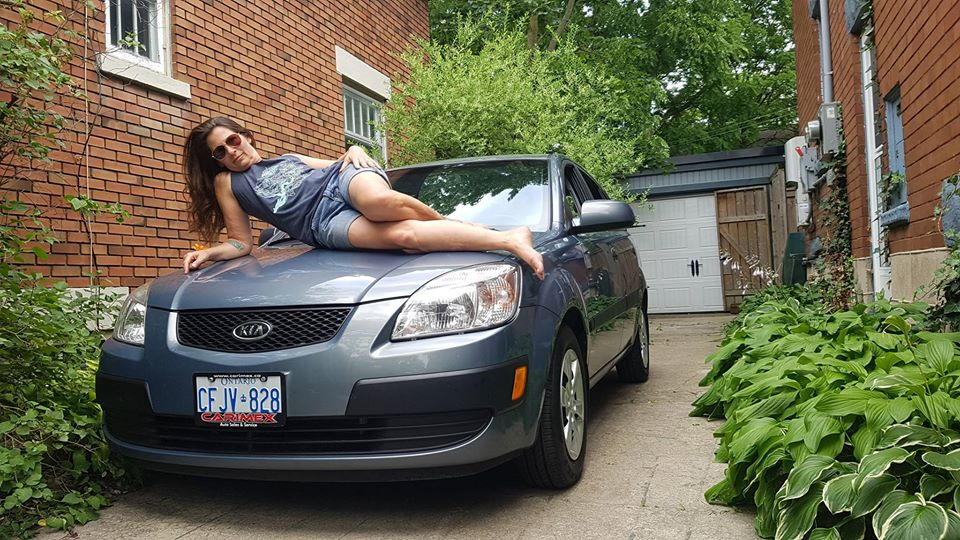
I bought a 2009 Kia Rio. I went with a friend because I had no idea how it all worked, and I had lots of stupid questions, like: How do I get license plates before I have the car, or do I leave the car at the dealer and get them afterwards, and then walk up to the dealership carrying them? And when does insurance happen? I was a bit baffled by the sequence of events about to transpire. I thought I'd leave with the car, but it took three days to do all the things to be done.

I intend to live north when I retire, so I knew a motorized vehicle would be in my future eventually, but I was banking on getting a car in another year or two, once some of the newer electric cars had been out and tried and tested for a while. Once Ford got in, and that rebate disappeared, though, I reconsidered. I went for an old car that will hopefully make the five years until Ford is gone and the rebates return with a more reasonable premier.

If we're not all burnt to a crisp by then.

Three other events provoked decisive action:

1. My youngest leases a horse now, thanks to her dad, but she needs to get back and forth to the stable, thirty minutes away by car, three times a week. I had been borrowing vehicles to take her, since her dad can rarely make it, but that route was wearing thin. The deal I made when I agreed to the horse, of course, was that I'd only have to take her once in a while here and there, but we know how those things work.

2. My older two suddenly started making noises about getting their licences. Neither wants a car of their own, but we're beginning to realize how handy it would be if they had the ability to drive - not to mention how much more employable it makes them. And the youngest is just two years away and chomping at the bit to be at the wheel. It's hard to learn to drive without access to a vehicle to practice with. Rentals won't allow it, and I wouldn't impose that on my closest friends.

3. Whenever I rent, I throw a bike carrier on the back (like this, but for three bikes), and it often leaves some little scratch or indent, and I stress out about it for the entire trip. Before returning cars, I've sometimes had a buddy take a piece of wood and a hammer to tap the dents back out. It made it more tolerable when a slimy rental guy charged me for a dent I definitely didn't make when I used a car for a brief trip sans bikes. I figure that's just karma. I wrap the entire carrier in towels and sponges, and put socks on the pedals, but there's no great way to install one without a trailer hitch. With my new car, I pretty much immediately made an indent on the tailgate thingy, so I don't have to worry about that anymore!

A neighbour who was also scammed by the same slimy dealer considered buying a car together with me, but that started sounding complicated. It makes a whole lot of sense for neighbourhoods to share vehicles, but so many just want their own. And, with four of us using the car on my end alone, sharing with another family would be difficult.

So it's done. And now I'm dealing with a bit of buyer's remorse.

The car is really, really small. We all went up to a cottage, and it barely fit one bag each. Then a camping trip was a feat for a Tetris master, with the cooler just barely making the cut. I almost got a slightly larger car, but it was shiny orange, and it felt a bit ostentatious buying something so bright. That's the mennonite in me talking.

And the hills! I'm used to driving almost brand new cars when I rent, and the crappiest of them can easily overtake tractors with minimal extra pressure on the pedals. I never think twice about passing. This baby can barely make it up the hills once you get north enough that the roads run through blasted rock. I'm not used to being that annoying person everyone is desperately trying to pass, but 80 is a bit of a struggle sometimes. Sorry everybody. It helps to laugh at myself by listening to John Mulaney's bit about driving:
"If you're ever on the highway behind me, I hear you honking, and I also don't want to be doing what I'm doing."
Driving a piece of crap is reminiscent of driving my first boyfriend's car: a Chevette with 300,000 km on it. Whenever it hit 60, the entire car would shake. I was always pretty sure one of the doors would fall off from the vibrations. It was low to the ground, like my car, so it always felt securely on the road, and you could take the corners crazy fast, but I worried about breaking through the floor like Fred Flintstone. I drove it on its final trip: a block from home, the brakes completely failed, and my bf had cut the emergency brakes the last time he replaced the brake pads (They were in the way!!), and it was just a magical stroke of luck that the lights changed just in time for me to be able to turn left at the bottom of a hill and coast my way home in one piece.

But it's great on gas. Muskokas and back for $40.

I figured if I could drive it for five years, that would be about the cost of renting each year, but I forget insurance. Insurance alone is about the cost of all my rentals and taxis and bus rides. So it definitely won't save me any money. It's just saving me the time and trouble of booking a car, trudging to the rental place and filling in the forms to get the car, and having to bring it back later. And sometimes there isn't a car available. Rarely, but it does happen. Yes, of course I've looked into car sharing, but it costs more than renting and isn't significantly more convenient.

So now I feel a bit like a traitor to the movement. I let convenience tip the scales away from concern for my GHG production. But, really, I'm not driving more (hopefully), I'm just driving an extra car that wasn't in circulation previously. Philosopher Luke Elson, in The Conversation, recently concluded that buying carbon offsets makes air travel a moral option, and his argument could be extrapolated to work for cars as well, except I don't really agree with it. He takes a consequentialist stance banking on offsets actually having a 1:1 exchange, which is a thin premise creating a shaky foundation. Even if it were the case that we could pay someone to plant a tree whenever we drive and the GHGs produced would be fully subtracted again by the tree growth or some other fix, it's still adding GHGs to the total. Morally, it's clearly better to avoid adding those GHGs to the atmosphere AND to pay for some trees instead of paying money for a flight or a car or an air conditioner or a steak dinner. We need to get into the negatives when it comes to GHG production. There's no time for bargaining on this one.

If we all run on Elson's moral code, then we'll keep burning fossil fuels and just trying to plant trees faster than they can burn to the ground. The overriding problem with consequentialist ethics is that we can never guess the future with accuracy. For this issue, we have to err on the side of contributing less GHGs, rather than being hopeful that subtracting them might work.

There's no moral way to justify convenience of my family over the survival of our species.

But now I'm one of the normies. I was invited to a far away cottage this summer, and the owner gave me a convoluted route to take to get to there including trains and several busses, rather than the obvious choice of carpooling with another guest. Many people just can't get their head around how to live without a car. They aren't intuitively aware of all the other options, like getting rides from friends, and borrowing vehicles, and they don't recognize how far they can actually comfortably walk and bike, or how cheap it can be to take cabs and use rentals. I'm thankful my family made it this far so we've got the knowhow that makes alternatives obvious and second nature.

I still plan to bus when I go into Toronto. It's just over $10 if I book it online ahead of time, which is cheaper than parking downtown, and I can read on the way instead of stressing out on the 401.

And today I biked 7 k to MEC for my very first life jacket for my next trip. Look at me, buying all my own stuff instead of renting and borrowing like I have for five decades, starting with all my sib's hand-me-downs! To too many people, my life looked like I was cheap, or worse (because of inherent prejudices), a "poverty case." Nobody congratulated me on going without for so long. Nobody encourages others to borrow instead of buying - well, nobody in my circle. That's a paradigm shift that's got to budge soon.

Isn't this the photo everyone takes with their first car??

ETA: June 6, 2025, almost exactly 7 years later, the car died in the driveway. The back tires were completely seized. My daughter and I tried a bunch of things advised to us to get them turning again, but no luck. I tried to get it towed to a mechanic, but the tow driver said it would completely ruin the tires to drag it out, and there's no other way to get at it with my stupidly narrow driveway, and then he started telling me there's no way I could drive it with all the rust on the sides, anyway. The MTO would pull me over for that. To be fair, the body was hanging on by a thread between the back wheel and the back door on one side. He said I might get a hundred bucks from a scrapyard, but he could just drag it out and take it off my hands. I made an impulsive decision and signed it over to him, took the plates off, and watched it be dragged away. As he explained what crap it is, I was pretty sure he was conning me. He said he wasn't getting paid for the tow because I have a deal with my insurance, which is curious. He seemed to think it made us even, and clearly it didn't but whatever. I'm glad not to have to think about it anymore. So I've made peace with it. It doesn't feel like it makes sense to own a car I only drive for 2 months of the year now that my kids have their own cars. It served us well to get us my kids licensed and made it back and forth up north without ever dying on the way! 

I track everything, and the total cost of owning this car, including purchase price, service, maintenance, gas, and insurance, was $40,688.41, or almost six grand per summer. If I par down the yearly costs to just the two months of summer that I use it, insurance alone works out to almost $800/month. I have to keep that in mind next time I rent! 

I actually feel lighter from no longer being a car owner! 


The Kia's legacy!

Wednesday, March 15, 2017

On the Philosophy of Mr. Money Moustache

A friend pointed me towards this podcast in which Tim Ferriss interviews Mr. Money Moustache (MMM), a man who retired from work in his 30s to live on the interest from his investments and then got a significant following as a blogger.

The podcast describes the kind of life I've tried to live (except for that early retirement bit), and MMM talks about ideas I've been writing about for ages. I'm successful in actually following some parts of this lifestyle and horribly disappointing in others. Like me, he loves to build things, and I'm going to have his explanation for why he doesn't love travelling at the ready next time I'm asked why I don't travel: he gets his joy from creating, which isn't travel-friendly. Absolutely!

He hates cars as much as I do, and cautions, "You should never get a job that requires you to drive to it." Once I started a permanent job, I moved closer to it to cut my daily travel time down to a ten minute walk. People don't do things like that anymore. He thinks walking is the best medicine in the world. Tim adds, "We've evolved to be able to walk very long distances. Humans are better humans, less neurotic, when they walk a lot."
MMM's billboard of choice.

Saturday, July 16, 2016

Saving Cyclists' Lives

It seems like every year we have cycling deaths in our community. In the past, the local paper reporting has held a subtle anti-cycling stance, but this summer, some tragic accidents have been clearly cyclist error.  People are calling for greater education for cyclists, which is important, and I'll get to it in a minute (scroll down if that's more your interest), but it's only part of the problem. Our city has too many areas that aren't set up well for cycling, particularly around bike paths (ironically), and the rules aren't entirely clear to enough people. There's often heated debate about what cyclists should be doing. As I've said before, statistically, it's no more dangerous to bike than to drive here, but things could certainly be made a whole lot safer.


A FEW EXAMPLES OF QUESTIONABLE BIKE PATH PLANNING (a bit of a rant, so maybe scroll down to the next heading):

"Sometimes it's necessary to go a long distance out of the way in order to come back a short distance correctly" (Jerry, The Zoo Story.) - Well, in K-W it is because you often have to turn right in order to go left if you actually want to follow the rules.

According to a recent Record article, "Riding into a crosswalk off the sidewalk is one of the most common scenarios for cyclist-vehicle collisions....Cyclists are not supposed to ride on sidewalks or in crosswalks." The region and city have been adding bike paths and are working on more bike lanes, which is really wonderful, but there are areas in town that have bike paths that end at crosswalks or that encourage cyclists to ride on the sidewalk. People won't risk their lives to follow the rules, and people won't go a long way out of their way to get where they're going, so sometimes the rules are broken.

King and Weber: The bike path from Conestoga Mall ends at the crosswalk on Weber. If I want to continue on the other side of Weber, it's significantly safer for me to cross in the crosswalk (from the circled X to the arrow) than for me to join busy Weber Street traffic to go half-way across King, then join King street traffic to make a left-hand turn on to Weber. But I'm not supposed to bike in the crosswalk. If I were a car, I'd be doing a U-turn, but I'm not really sure how to do that on a bike (or in a car) without travelling straight until the next driveway or side street to turn around. That can be far to travel on a bike just to turn in the opposite direction. I could dismount and walk the crosswalk, but it's hard to convince a cyclists to walk beside a perfectly good bicycle.

Victoria Street and Iron Horse Trail: The bike path hits Victoria at a sign that instructs cyclists to cross at the lights a block away rather than travel directly across the street. Cyclists have to choose between biking the wrong way on the street or biking on the sidewalk, and both are illegal (or ignoring the sign and zipping across the street). To stay mounted means riding to the right until it's possible to turn around. Well, they could also walk their bikes on the sidewalk, but that's unlikely to happen, and, practically speaking, there would be less room for pedestrians to get by, not that there are many pedestrians on that sidewalk anyway. I regularly break the law there by biking on the sidewalk.

Waterloo Park Trail and Father David Bauer Drive (Why are our street names so flippin' long?): As you leave the park from the trail, you'll hit a median. I can't imagine why the median doesn't have a break in it for cyclists to cross the street there. But it doesn't. So we ride on the sidewalk to get to the open crossing at Avondale Ave. I'm not going to ride in the opposite direction on the street to get to a break in the median, then turn around to go where I had originally intended. Imagine asking motorists to do that - turn right and then turn around in order to turn left!

Homer Watson bike paths: To get from one path to another, you have to travel a little bit on Homer Watson. It's a busy four-lane road, but it's got a wide, paved shoulder, so it feels very safe. But if you're travelling west, you need to take the shoulder against traffic (which is illegal) or else cross four lanes of traffic twice, which would be illegal and insane, or you could join traffic to the lights then cross (at the crosswalk, which is illegal, or make a scary U-turn) then ride down Homer Watson to the next set of lights, then ride back up to get to the bike path again. That's not going to happen. Taking the shoulder the wrong way for a few meters is typically the safest choice, except...


there's sometimes a freakin' truck parked on the shoulder. The grassy part is a narrow strip at the top of a steep hill, so travelling against traffic on the road actually seems the safest bet, which should never be the case.  A little more bike path connecting the two away from the road would be pretty cool.


Homer Watson and Stirling: The bike path ends at a crosswalk with a walk signal that EVERY SINGLE CAR ignores. On the way there, I waited at the lights to cross Stirling, sitting on my bike at the ready, but cars continued to turn left from Homer Watson to Stirling in front of me until the light changed from a walk signal to a red light. At my next turn, I got off my bike to see if being a pedestrian would help - I got a chance to cross at the "1" of the light countdown, so boarded my bike to cross before the light turned red. I wouldn't have made it across in time on foot. On the return trip, I tried to film the number of cars crossing the crosswalk against a walk signal, but I was trying to cross with my phone in hand, so it was mainly just sky. In this direction, I can understand cars turning left on the walk signal because a pedestrian is almost completely blocked from view by traffic posts. I thought my bike would help visibility, but I ended up crossing at the "0". AND there was a police van waiting at the opposite light, watching the cars turn left as I tried to cross. Nobody was stopped and ticketed even though the MTO's Driver's Handbook clearly states,
"At any intersection where you want to turn left or right, you must yield the right-of-way. If you are turning left, you must wait for approaching traffic to pass or turn and for pedestrians in or approaching your path to cross."
Where's the local paper's report on that?? Until car drivers follow the rules of the road, we're all in danger. MPP Eleanor McMahon's is calling for stiffer penalties for careless drivers since her husband died when he was clipped by a truck while out biking, but what we need is simple enforcement of the laws. I don't think it matters if motorists face a $100 fine or a $1,000 fine if police never stop them. That being said, I also don't get ticketed when I ride through crosswalks or on the sidewalk.

So wait a minute. What's the difference between motorists wanting to get home faster and therefore driving through the crosswalk illegally, and cyclists wanting to cross faster so biking instead of walking through the crosswalk? Potential for harm. When I bike through a crosswalk, I'm out of everyone's way faster and I don't pose a threat to anyone because I'm on the outside edge of the crosswalk. Motorists who ignore the walk signal and turn left in front of pedestrians and cyclists trying to cross, have a greater potential to hit people in the crosswalk.

We have to figure this whole thing out better.


THE RULES ARE CONFUSING:

I'll be so arrogant as to say 'the rules are confusing' rather than say 'I'm an idiot' even though the latter may very well be the case. After all, I don't know how to properly make a U-turn on a bike.

First of all, the Region's Cycling Safety booklet says "Fluorescent fanny packs are trendy," which is totally inaccurate.

What's an intersection and what's a crosswalk and what's a crossover? The distinctions aren't always clear. I'm also not sure what's a regional road, a township road, and a city road.

A crossover has the XX markers and lights overhead or the walking signs and a striped crosswalk. It's the only place (except where there's a crossing guard) that drivers must wait until the pedestrian completely crosses the road before continuing. I'd love it if that rule could be extended to all crosswalks.

A crosswalk "is a crossing location usually found at intersections with traffic signals, pedestrian signals or stop signs. A crosswalk can be: the portion of a roadway that connects sidewalks on opposite sides of the roadway into a continuous path; or, the portion of a roadway that is indicated for pedestrian crossing by signs, lines or other markings on the surface of the roadway at any location, including an intersection." According the MTO "it is illegal to ride across a crosswalk," but I assume we can ride beside one, where cars drive.

Ride a meter from the curb according to the Region's booklet, but the Ministry of Transportation says, "You must stay as close to the right edge of the road whenever possible." Another MTO site says, "it is legal to take the whole lane by riding in the centre of it." It makes sense to be a bit from the road so you're not swerving around garbage and storm drains, and it's wise to stay away from parked cars for fear of being doored, but I'm not ballsy enough to take the lane. There's a fine of only $365 for causing death or disability by opening a door into a cyclist.

In our region, riding on the sidewalk, is okay for kids, even though, in the same pamphlet, it says it's "a contributing factor in 86% of all bike collisions." A City of Waterloo bylaw says it's all about wheel size with diameters less than 50 centimetres acceptable on sidewalks regardless the age of the rider. They also say skateboards aren't allowed on sidewalks, but we all pretty much ignore that one. I still use the sidewalk in areas that feel too risky to use the road. I'd rather pay a ticket than die. Nothing will change that rule-breaking behaviour except making the roads safer.


Cars must give cyclists a metre of space according to the MTO: "All drivers of motor vehicles are required to maintain a minimum distance of one metre, where practical, when passing cyclists on highways," but that 'where practical' bit can allow for a lot of exceptions. But further down it says, "A motorist may, if done safely, and in compliance with the rules of the road, cross the centre line of a roadway in order to pass a cyclist. If this cannot be done, he or she must wait behind the cyclist until it is safe to pass." There's a fine of $110 for motorists who violate this even though clipping a cyclist just a bit can kill them.

Ride single file, according to MTO, and keep at least one metre apart form other cyclists. Large groups should break up into smaller groups of 4-6 which stay a km apart. But in Waterloo Region, it's now legal to ride two abreast on regional roads, but not on city or township roads. I have no idea where the dividing lines are there. Good thing I typically ride solo.


EDUCATE THE MASSES:

As the father of a recent victim said, "Telling them what to do and (them) doing it is two different things." In many cases, accidents aren't so much a matter of missing knowledge but of simple negligence either because the cyclists feel safe enough to allow themselves to zone out, or they choose to ignore the rules for their own perceived safety.

Regardless, there's no harm in schools taking part of a class every spring to re-teach road safety facts. Some people suggest that this will be an arduous undertaking because the training will have to be by volunteers and will take tons of people in order to get to every kid. Here's an alternative suggestion: Get some professionals to take four hours of their time on one PD day every couple years to train all elementary teachers in the region. Give them curriculum to take home or access online that's grade-appropriate in order to help them plan lessons. The Ministry of Education should enforce maybe two or three hours of mandatory road safety in each grade in April or May of every single year and ensure kids are tested and re-tested until they're able to pass the knowledge necessary at each grade.  We can't wait for kids to take driver's training; it has to be part of the regular schooling. Then we'll all know the rules. Here are some key ideas to impart beyond basic rules of the road:

Be seen: Have lights and reflectors everywhere. Wear clothes that contrast with the background. Have kids bring in their helmets so they can decorate them with reflective tape stickers. Fun!

Be aware: When I took driver's training, my instructor would periodically cover the rear-view mirror and ask me what's behind me. That was good training to develop an awareness of what all the cars are doing around me. Cyclists need to learn to develop this kind of awareness of everything around them. That's key to their survival. It's not safe to get lost in your own world when you're on the road. The other way driver's ed changed my driving practice was watching terrifying films of accidents. Kids need to be scared into cycling more carefully. They tend towards illusions of immortality, and they need to be reminded of their potential demise if they don't pay attention for a minute.

Signal intention: Everyone should be able to tell what everyone else on the road plans to do next.

Learn how to turn: How to turn left in traffic safely and legally (many still move from one crosswalk to the next) and how to do a U-turn without using the crosswalks. I need to sit in for this one. OR allow cyclists to use the crosswalks when it would be more dangerous to do otherwise.

Maybe some of that might help.

Saturday, February 27, 2016

On That Time I Fell and Hurt My Head

I fell on ice a few days ago. My feet were swept clear out from under me, and apparently I injured my brain. At the hospital, they said it's either a migraine or a concussion, and since I don't have a history of migraines, and since I wiped out earlier that day, it's probably a concussion. The lack of conviction in the diagnosis was a bit unnerving. It sounded more like a guess than a judgment, but I guess I have to go with it.

It's like that time I had a plumber come when my basement was flooded, and he couldn't find a problem with the pipes, so he deduced that it was coming from outside and that I needed to make sure the ground sloped away from the house. But I was dubious because it hadn't rained in weeks, yet suddenly my basement had water. Together we found that the water softener hose had slipped out of the washtub. He duct-taped the hose to the inside of the tub and charged me a pretty penny for his detective work. The hospital trip felt a lot like that.

It worried me right away when the emergency nurse insisted I sit at one of those machines you see at an optometrist's office, because she kept motioning me to the doctor end of the machine. "Have a seat! Sit down there. Yes, THERE!" Had I remained in place, the doctor would have been resting his weary head on the little chin rest, but I switched sides after she left the room. That kind of thing gives one pause.

ETA: I forgot the funniest part. I was in and out of emerg within 2 hours because I'm not just someone who fell, I'm a WOMAN OVER 50 who fell. They kept calling referring that way whenever I changed hands as if to further elucidate my frailty. But it got me to the front of the line.

My eyes are fine, and everything feels symmetrical, and I'm equally weak on both sides of my body, and I didn't even have much of a headache. My butt hurt way more than my head.  But it's still a bit of a challenge to read for any length of time. It's far, far easier to write. I can do it without looking much. Not reading anything or looking at a screen for three days is really, really boring. I tried just listening to The Office, but I was missing too many sight gags, so I admit to cheating a bit and peeking from time to time. At this point, four days in, nothing bothers me as long as I don't read.

Truth is, I forgot about wiping out by the time I got to school. I hadn't given it a second thought. It registered at all only because I had actually said, "Oof!" right out loud like they do in cartoons. I pride myself on falling with some measure of stoicism, particularly since I'm perpetually surrounded by students. But this was an exception. It knocked the wind out of me. I was wearing Docs, which are notoriously slippery, and it had just started freezing rain, so I was walking at a good clip instead of carefully. After it happened, a student across the street called out to see if I was okay, and I noticed others take to the uneven lawns instead of risking the smooth, hard cement of the sidewalks. Smart.

I even forgot that I had had a headache, and it wasn't until the admissions nurse asked if I had taken anything like Advil or Tylenol, that I remember I had taken BOTH shortly after getting to work. So, logically, I must have had a headache and treated it myself, then soldiered onwards ready to attack the day. I felt fine.

During my first class, I was showing a film, We Were Children. It's a haunting video about the horrors of child sexual assaults in the residential schools. I had previewed it and warned the students up and down, but one viewing was enough for me, so I busied myself with marking online. Except I struggled to see the words in a brief response paragraph. I could see them, but it was as if the right side was faded, and it didn't change if I covered my right or left eye. I had just gotten reading glasses, so I tried them too, but they made no difference. I started reading each word separately, and it felt like I was making some headway, but then I couldn't put all the words together to make sense of them. They were separate entities without connection to their neighbours.

I decided I was going blind, and it's curious how quickly I resign myself to tragedies. Decades ago, when my oldest was stung by a bee and her face started swelling up dramatically, I just stared at her, stunned and useless, until a neighbour happened by. Shoved in the back of her car, with my toddler in my lap, I remember thinking that it's nice that Mother Teresa had just died to help her on her way. You can take the girl out of the Catholic church...   Anyway, I had resigned myself to her death long before anyone had a chance to take her pulse, much less call it. But she recovered completely and life went on as before. I tried googling sudden blindness, but I could only read enough singular words to solidify my uneducated diagnosis. I would have to get a program to read to me and that could type what I dictate. I started wondering about the cost of such a thing, when there was a pause in the action of the film. It might be a good place to stop for the day.

I stood up and checked the clock at the back of the room to judge if it was a good time to stop and re-cap before the bell. But I couldn't seem to read the clock. Not being able to see words on a screen is one thing, but losing my vision entirely meant no more biking. That's a different kettle of fish, and I'm not sure I could afford whatever mechanics might be necessary to allow my life to continue as is. I sat back down and just waited for the bell to pause the film.

With the lights on like a stadium, and the next class filtering in, things got so much worse. I started explaining taxation - where the money comes from at each level and where it goes. It's something most kids don't really have their head around, so it's an important lesson. But the kids were confused. Except instead of typical comments like, "It's not fair they charge more taxes on cigarettes," they were saying, "What are you talking about?" and "What are you trying to say? You're not making any sense!" I told them I didn't know what I was saying, and I started to laugh. It was so bizarre. There were waves of light making their faces all woogley in my right field. It was like driving with a bright afternoon sun filtered through trees on the highway like a strobe light, and I felt the need to put my hand up to try to shield myself from the light. If someone had admitted to putting acid in my drinking water, I would have been so relieved! No such luck. I gave up on the lesson and handed out an assignment that typically takes significant instruction, but I had the handouts at the ready, so they'd have to muddle through on their own. Then I said I'd be right back, and I bolted for the office.

It occurred to me I should call the office for help, instead of deserting my class, but there was no way I could figure out the phone. It was a mystery to me.

I told our secretary that I thought I was having a migraine, which I had only heard of described like this, or maybe I had a pinched nerve or something weird, and she got me in to the VPs. I didn't tell them I was going blind. It seemed ridiculous, and saying it might somehow make it true. They turned off the lights, and I felt much better. After a few minutes, I could read and understand the clock in the room. They had the wherewithal to ask if I might have injured myself recently, and I told them about falling on the ice that morning. The one line I remember: "I don't think we can discount a possible connection between falling on the ice and what you're experiencing right now." Actually, he said it better than that (better meaning it made me laugh), but apparently there isn't even one line I can remember from that morning.

But I still don't entirely believe there's nothing wrong with my eyes. I mean, I believe it intellectually, but it's hard to take in entirely when it's so painful to look at things, and it's still an effort to read a string of words online.

But now I'm days behind on marking. Maybe tomorrow. I'm glad I can still think and write fluidly. This little exercise in descriptive writing was very encouraging - except when I tried to proof it.

I appreciate when I get to these times that have me resigned to a misfortune blown way out of proportion. I was okay with never writing anything significant or sensical again - maybe even not teaching again. I could have become that weird teacher who doesn't really make any sense but is absurdly hilarious and gives everyone 90s. And there's always taped books to listen to. But biking is more important to me than I had thought. There's just no substitute for that.

Wednesday, December 30, 2015

On Desires and Commodities

I've just been reading books and watching films lately. I'll write again soon. But check out this passage from The Obsolescence of Man by Gunther Anders, first published in 1956:

***

The mere fact that I had no car and therefore could be caught in flagrante not buying anything and, ultimately, of having no needs, was the cause in 1941 of the following embarrassing incident in California:

Diary

Yesterday, in the Los Angeles area, while I was walking along a highway, a police car pulled over in front of me with its siren wailing and blocked my path.

The policeman shouted at me: “Say, what’s the matter with your car?”

“My car?”, I asked him, not understanding what he was talking about.

“Sold her?”

I shook my head.

“At the shop for repairs?”

Once again I shook my head.

The policeman paused in thought, since it seemed to him to be impossible that there should be a third reason for not having a car. “Then why aren’t you driving it?”

“My car? But I don’t have a car.”

This simple piece of information also went right over his head.

To help him understand, I explained that I had never owned a car.

Now I really stuck my foot in it. A clear case of self-incrimination. The policeman stared at me with his mouth hanging open. “You never had a car?”

“Look, no”, I said, pondering his powers of comprehension. “That’s the boy.” And then I waved to him in a friendly and innocent way and attempted to resume my walk.

But he would have none of that. To the contrary. “Don’t force me, sonny,” he thought and pulled out his citation booklet, “don’t tell me any stories, please”. The pleasure of interrupting the dull boredom of his job with the capture of a vagrant almost gave him a friendly, innocent air. “And why haven’t you ever owned a car?”

I thought for a second about what I should not say in response. So instead of saying: “Because it never occurred to me to get a car”, I responded—and for added emphasis, I shrugged my shoulders and assumed a distracted look—“Because I never needed a car.”

This answer seemed to put him in a good mood. “Is that so?”, he then exclaimed, almost with enthusiasm. I sensed that I had committed a second, even worse mistake. “And why don’t you need a car, sonnyboy?”

Sonnyboy shrugged his shoulders, afraid. “Because I had more need of other things.”

“Such as?”

“Books.”

“Aha!”, the policeman said thoughtfully, and he repeated the word, “books”. Evidently he was now certain of his diagnosis. And then: “Don’t act the moron!”, which is how he made it clear to me that he had discovered that sonnyboy was a “highbrow who was faking imbecility” and that, in attempt to simulate an inability to understand that offers were orders, pretended to be an idiot. “We know your kind”, he thought, giving me a friendly poke in the chest. And then, with a sweeping gesture that indicated the distant horizons: “And where do you want to go?”

This was the question that I most feared, since I still had sixty-four kilometers of highway until San L; and once there, I had nowhere to go. If I had tried to define for him the absence of a goal for someone who is on the road, I would definitely have seemed like a vagrant. God knows where I would be sitting now if, at that very moment, L. had not arrived, truly like a deus in machina, if he had not pulled up alongside us with his imposing six-seat sedan, if he had not stopped suddenly and gestured to me, inviting me to get into his car, something that not only left the policeman flabbergasted, but also seriously challenged his philosophy.

“Don’t do it again!”, he snapped, as I got into our car.

What is it that I am not supposed to do again?

Evidently, I must not refrain from buying what is offered in the form of a command to everyone.

When in these offers you recognize the commandments of our time, one is no longer surprised that even those who cannot afford to do so also end up buying the commodities that are offered. And they do so because they are even less capable of affording not following orders; that is, not buying the commodities. And since when has the appeal to duty [Pflicht] respected those without resources? And since when has duty [Sollen] ever exempted the have-nots from its commands? Just as, according to Kant, one must comply with one’s duty even when, or especially when, it is contrary to one’s inclination, so today one has to comply even when it is contrary to one’s own “responsibility”. Especially today. In the same way, the mandates of the offers are categorical. And when they announce their must-have, to appeal to one’s own precarious situation of duty-and-responsibility would be pure sentimentalism.

Of course, this analogy is a philosophical exaggeration, but it nonetheless contains a kernel of truth, since it is no metaphor to truly claim that today there is hardly anything in the spiritual life of contemporary man that plays as fundamental a role as the difference between what one cannot afford and what cannot be afforded; and this difference furthermore becomes real in the form of a “battle”. If for the man of our time there is a characteristic conflict of duties, it is none other than the no-holds-barred, ferocious and exhausting battle that takes place in the hearts of customers and within the bosom of the family. True, “no-holds-barred, ferocious” and “exhausting”, because the fact that the object of the struggle can make us stupid and the battle itself could take place as a comical version of real conflicts, does not at all detract from its bitterness and must suffice as the fundamental conflict of a contemporary bourgeois tragedy.

As everyone knows, this tragedy usually ends with the victory of the “mandate of the offer”; that is, with the acquisition of the commodity. But this victory is dearly bought, since from that very moment the customer begins to experience the servile compulsion of paying in installments for the acquired object.

***

Anders goes on to explain how we become slaves to our things as we harbour a belief that if we don't use them regularly, then all that money and time spent working to get the object has gone to waste. So we use it even when we no longer get pleasure from it just to avoid wasting our hard-earned things. Which is nuts. And if we could just think a bit, we could rise above this mess of things.

It makes me think of one of my favourite lines of poetry, published the same year:
"What sphinx of cement and aluminum bashed open their skulls and ate up their brains and imagination?"
Anders comes to the same conclusion as Epicurus, Epictetus, Plato, Lao Tzu, Jesus, and many others: We can have greater pleasure in life if we reduce our desires for things instead of getting sucked into an endless battle to fulfill every desire. But it's not just about desire for commodities. We have strong desires for progress and perfection. We can't fall for that either. Life is messy, and we will always be flawed and ever unfinished. Epictetus in particular advised recognizing what's within our control and not bothering much about anything else. Reputation, honour, status are not within our control. It's just an illusion that if we work hard enough, we can get them. Once we can accept that fact, then we can let go of expectations and striving for something we might never achieve.

I don't see it as cut and dry as Epictetus does, however. To me, those things are just a greater gamble with a lower probability of success than what we can control with certainty. Instead of resigning myself to what's out of my control, I just get better at playing the odds. But imagine a life with fewer goals, with fewer expectations, like Anders' contentious walk to nowhere. That's not allowed in our age that glorifies progress at any cost.

I thought of this as I watched The End of the Tour followed by several interviews and speeches by Wallace.

And way down here, way below the fold, I've been thinking a lot about the "sudden deaths" of three male teachers from my board, ranging in age from 36 to 55. One at FHCI, one at my school, and one at SSS. All within a year. The absences of any evidence to the contrary leads me to believe they took their own lives. At our school, we were instructed to shut down that discussion out of respect for the family. And I don't understand that. So I'm whispering this here because it's begging to be cracked wide open.

ETA: And now a fourth, a female breaks the pattern a bit.  And now there's a fifth.

Our schools are all about working to reduce the stigma around mental health. Caz, my departed colleague, and I worked on a mural in honour of Clara Hughes' struggle with mental health.  But we're not to discuss his condition or speculate about possible contributing factors with an eye towards improving the odds for others. We're supposed to wade in the ambiguities of yet another 'sudden death.'

If all three were hit by a car, students and teachers would rally and petition to make the streets safer. If all three were victims of assault or cancer or lyme disease or any other single cause, we would join together to raise money and awareness to prevent similar deaths in future. But as it is, we sit silently, in anguish, trying hard to ignore the pattern of cases.

As teachers, we're afraid to get in trouble like never before, acting to avoid punitive measures rather than for the love of teaching. We have new mandates that are unclear and the dictates continue to waver with each administrator, yet teaching reviews can be labelled unsatisfactory and jobs lost if these fuzzy rules aren't followed accurately. It's a time of profound chaos leading to a general state of anomie. We have a professional organization that focuses on teacher error, from the mundane to the profane, and publishes them regularly with names and details in a magazine that we are obligated to fund, rather than discretely and respectfully working with teachers to resolve concerns and to restore professional relationships. One disgruntled student with a parent willing to go the distance can end a career.

And criticizing any of it can lead to termination. Shhhhh..... This is but a minor act of embarrassingly cowardly rebellion.

The reality right now is that keeping a job by working hard is no longer within our control. I've had more student complaints about me this year than in all the previous 24 years combined. Every time I've been supported by my administration, but the complainants are undeterred insisting they should be able to re-submit projects endlessly to get a mark that shows their best ability. There's a belief that we should mark work repeatedly until the end of term, and I will quit if I'm made to mark each piece of work several times over until they each have 100% in the course. The absurdity of the situation requires us to accept that we shouldn't expect to be able to retire in good standing regardless our dedication to the craft.

This is not to say that careers were a driving force in these deaths, but I imagine they were at least a contributing factor. We spend a third of our lives at work, and, for people like me, under the new conditions, it consumes a majority of waking hours. But these tragedies are also a piece of a new statistic that the suicide rate of middle age white males has risen by 40% in the last seven years.

Some think this increase is due to the expectation of the stoic male and the "gym culture" that has foisted unattainable goals on men. Others focus on a similar split between dual expectations of being strong and being vulnerable. Others look to the singleness of most of the men in the study, others on how coping skills fall apart with age, on alcohol use, and on our glorification of youth.  Some think it's simply a factor of the economic downturn as suicides peaked during the depression as well. And others note that it's highest in those without a high-school education.  Economic insecurity is certainly a stress too much to bare for some, but Durkheim's research found that suicide rates rise during positive changes as much as negative changes. "Even fortunate crises, the effect of which is abruptly to enhance a country's prosperity, affect suicide like economic disasters" (203).  Too much change that creates upheaval in a society affects the desire to take a quick exit. We are in a point of increasingly frequent and hurried disruptions, and we can't settle in. We can't feel secure in what we're doing to improve it before we have to change it.

The school board seems to recognize that it's causing some problems as evidenced by one perk of our new contract being a promise of no new initiatives for a year. We used to get a rush of changes at every provincial election, then those ideas would be overruled by the next government before they were ever fully implemented. Now it seems like new changes bombard us for the sake of change, as if they believe that constantly moving is the same as progressing.

Granted Epictetus would advise that the expectation that our colleagues will live full lives to their natural end is unreasonable to hold as it's not at all within our control. And yet...  An urge to act, to do something to prevent others' misery and loneliness and fear and desperation bubbles up uncontained and rudderless. Impotent.

Monday, September 7, 2015

On Achievement and Death and Stuff

This is a post about cycling further than ever before, but first, a bit about boredom:
"Boredom may lead you to anything. After all, boredom even sets one to sticking gold pins into people...one may choose what is contrary to one's own interest...one's own fancy, however wild it may be...desire what is injurious to himself, what is stupid, very stupid - simply in order to have the right to desire for himself even what is very stupid and not to be bound by an obligation to desire only what is rational...this caprice of ours....preserves for us what is most precious and most important - that is, our personality...the whole work of man seems really to consist in nothing but proving to himself continually that he is a man and not an organ stop."  - Dostoevsky 
"We are less bored than our ancestors were, but we are more afraid of boredom...A generation that cannot endure boredom will be a generation of little men, of men unduly divorced from the slow processes of nature, of men in whom every vial impulse slowly withers, as though they were cut flowers in a vase." - Bertrand Russell

Some people assert their own will by choosing naturopathy over doctors to treat their cancer, or by quitting their satisfactory marriages and careers to seek out a new mid-life adventure. I hope to make slightly more reasonable choices or certainly less self-destructive ones. According to Dostoevsky, I'm sucked into the western ideals of individuality over community, of standing out, which can make us foolish. Melting into the crowd isn't an easy option. Being one with the universe is a task for later when I've figured out how to sit still. And for Russell, who hit puberty in Wales as the Russian was drawing his lasts breaths, being able to endure boredom is essential for happiness. Seeking out excitement to avoid boredom just makes our pleasures less easily felt. He warns,
"pleasures which are exciting and at the same time involve no physical exertion, such, for example, as the theatre, should occur very rarely...certain good things are not possible except where there is a certain degree of monotony." 
In art, we'd call that degree of monotony an area of restraint necessary for the eye to relax.  It's why some beautiful gardens have an expanse of grass. But mine doesn't. I lean towards chaos.

I get antsy when I don't have a project. The house can be a mess while I deliberate what new task to take on next. My backyard took over for a couple years, and I have ideas of an off-grid home a few years off, but then what now? For better or worse, I'm obsessed with doing, finishing, accomplishing.

So I set as a project to find the limits of my cycling abilities - or, more specifically, the limits of my lungs and heart and other organs and muscles in a body as old and untrained as mine. I'll tell you from the get-go that I failed. But I'll get to that.

Before an annual camping trip with neighbours, I considered having my packed rental car, complete with youngest child, driven by a fellow camper so I could cycle the 137 km to the site. The longest I had ever biked before was 60 km, and I wanted to see how far I could actually go in one trip. I didn't train or prepare in any useful way - that would take the challenge out of it. But having a driver coming up my rear helped because I could bail at any time. It was about seeing how far I could get, not about getting to the end. That was key to the entire adventure. That, and a cell phone to call for help if needed.


This was a decision fraught with a ridiculous amount of anxiety. I tried to keep Epicurus in mind as I was deluged with worries: If pain is not occurring right now, then it’s not bringing pain except for tumults created by imagination, right? I am bringing myself pain, which is ridiculous! So stop worrying about flat tires, swerving trucks, strong wind gusts tossing me into traffic, some crazy guy attacking a lone female, heat stroke, complete organ failure, random loss of appendages, the list goes on. And there's always the old standby concern that, if I leave the house for any significant duration it will burst into flames. From time to time I was struck with absolute terror at the though of being killed in traffic and picturing my children coping with my death. I'd have to actively "X" out the thought and replace it with a vision of biking without incident. Thanks CBT. The fact that many worries are unfounded doesn't seem to lessen their intensity. At all. I actively ignored the looming date, and second-guessed my choice of directions - later to be intensified by many geographical advisors after-the-fact  "Why didn't you go this obviously better way?" serving to prove my instincts for direction weak.

So I said nothing to anyone about my hopes to attempt the journey until the last minute; I knew I would be easily swayed to give up before I started. I waited until two days before to ask a neighbour to drive and was almost deterred by her husband's concern about wind, and the night before, I told my kids and then immediately become openly worrisome and neurotic. It's like talking about it tapped the keg of concerns. And it was going to be a windy ride: 20 km/h headwinds until the final 30 k.

It's curious, in areas of insecurity, how much other people's attitudes can affect us.  The support of that one comrade, and my son's insistence that, "of course you can do it" were paramount to my leaving the house that morning. I have lots of people in my life - I'm sure we all do - who tell me why I can't possibly do this or that. I ignore the lot of them most of the time, but physical exertion is a weak spot for me, so their voices loomed louder than usual and took some effort to drown out. Some told me I couldn't join a women's ride group because I'm too slow, and others refused admittance to a guy's casual riding group because I don't have the necessary equipment provided by mother nature. I'm not recognized as a cyclist. Even the physiotherapist helping with my aging knees questioned me about my regular trips to Bamburg, a local marker of a hilly 40 k loop from our city:

"Oh so you drive there and then bike around."
"No, I don't have a car."
"Oh, so you live near there."
"No, I live a block from here."

Awkward silence. I just don't look like someone who moves quickly.

So I bike alone.

Armed with a banana, some nuts and raisons, water, my phone and wallet, brand new lights on my bike, and quality bike shorts, I kissed my kids good-bye and set off before dawn hoping to beat the heat of the day. I played music in my head to keep me pumped - possibly a skill developed in only those raised in the pre-walkman era. This one kept my cadence up:


Some think it's nutty not to train formally before a big ride - as if we'll fall to pieces if we don't work towards our goals gradually, but there are too many times the fear of being unprepared stops us from action. We think we can't do this or that because we're not quite ready. Then we dilly dally about doing prep work forever and never actually getting to the thing we actually want to do. I channelled Laura Secord who didn't train for her marathon bushwacking experience. She just got out there and started running through fields and forests.

I didn't wear any fancy duds or pimp out my ride either. I did get a pair of good bike shorts because, since about 40, my butt fat has all gravitated around the corner to my belly - and, just my luck, just in time for a big booty to be in style too. Extra padding was necessary there, but then I just threw on a t-shirt and sandals and my stand-by helmet. And I thought of Marathon Man, and Dustin Hoffman copying Abebe Bikila's run without shoes. But Secord and Hoffman's character were running for their lives. I was creating a situation as if it were a necessity knowing full well it was a luxury. I had to convince myself of an importance for it in order to develop any motivation to go.


For me, the point of cycling is to go places. It's not to work out and live longer because we could die any minute. And it's not to work out to match the current beauty standard because we could be hated anyway regardless our quest for physical perfection. For me, it's all about getting off our fossil fuel addiction. If a middle age woman without any know-how can do over 130 k in a t-shirt and sandals, with a crappy bike, then maybe you can bike to work. Amiright?!

I was once told by a colleague that I could never be a department head because I don’t have a car, but people don't understand that we can get almost anywhere without a car. And we can bike dressed in our everyday clothes. Granted I still used a car to transport my camping gear and daughter, but with more of us cycling, we could definitely use fewer cars. We need to move under our own steam whenever we can.

The trip was also about finding my boundaries, but part of it was about getting over my fear of biking further from home alone – the fear of having an accident, but more a fear of boogie men out to attack me. People are mainly nice and helpful. There are some odd ducks, but the odds are in my favour. And, with the exception of a brief trek on a major highway, everyone moved over a lane to give me space. I was completely safe.

Part of the journey was because I turned 50. I'm in a hurry to do stuff because it gets a little clearer that any day could be my last. I'm still stuck on having a leave-behind, a legacy, even though I'm pretty convinced there won't be generations to come to remember any of this. With climate change, there’ll be no leave-behinds. Having kids or writing a book or erecting a statue will have no impact on future generations if there ARE no future generations because the planet has become largely uninhabitable by our species. This death is a final death.

But some thing can still make me feel like a kids again. When I listen to certain songs, I'm 17 again. And when I’m on my bike, I’m 10, riding to the corner store in my bathing suit with a nickel in my hand for a freezie.

Just beyond the half-way point, at 70 k in, my legs and lungs were fine, but my eyes started getting weirdly blurry, so I took that as a sign to re-fuel.  I stopped briefly to stretch, eat, and drink. I just had 23 k to get to the next city where I could sit in a Tim's to wait for the car if I needed to.

I was surprised that it wasn't the hills that got me but the long flat parts where there wasn't anything to mark the passage of time. I watched this in my head as I pedalled:


The music and videos come to me of their own accord, but cycling distances alone takes me to that wonderful zoned-out place where I often come up with entire concepts I couldn't possibly find in my hectic kitchen. Like if it's a coincidence that Rex Harrison played mentor to Eliza Doolittle then later played Dr. Doolittle. Weird. It's a state that can't be as easily achieved with another cyclist there - if they try to have a conversation or if I feel pressure to keep up or have to wait at every turn. That modicum of attention somehow destroys access to the internal world.

And then there's the beauty of the scenery with light filtering through the trees, and the cows cheering me on up the hills. Montaigne said,
When I walk alone in a beautiful orchard, if my thoughts have been dwelling on extraneous incidents for some part of the time, for some other part I bring them back to the walk, to the orchard, to the sweetness of this solitude, and to me.
Prolonged activity allows time to get sufficiently bored to actually start paying attention to the details of the world. Those magnificent details!

But the trip was also about reaching a goal even if I didn't want it to be. My mom died in her 60s of cancer, and my sister got cancer in her 40s. I always expected to die young, and I've been ever impatient to finish things because I might be dead tomorrow. I update my will regularly and leave behind instructions in case I die whenever I leave for a trip. It's not the case that I'm living fearful of death, but that I'm living authentically recognizing that it’s right around the corner for all of us. My son sometimes asks me if I’m afraid to die, and I worry mainly, as a single mom, if they’ll all be okay without me – it’s been my primary worry for the past 21 years. Not just financially, but will they have someone to go to when they feel misunderstood by the world. But other than their future, I think I'm okay with it.

And the trip was also about sheer endurance. We need to suffer in order to grow. We need a bit of adversity in our lives - challenges, and since we've had it easy for so long in this time and place, we sometimes need to create personal challenges. Nietzsche wrote about wishing difficulty on others so they can find the strength to fight. It's not about training to cycle, but about training to get in there. Staying in there for that hill creates the means to stay in there to keep on about climate change and injustices and politics even when most people seem completely apathetic.

And then I saw the sign for the campsite and started singing:


And suddenly I was Rocky at the top of the steps, and Sarah Conner bein' badass in T2.

I felt completely fine at the end. I wasn't sore at all, but I was tired of doing the same thing for so long - almost 7 hours of riding plus a lunch break on top: that's a full work day!

I made it the whole way without being rescued, so I still haven't found my limit.

There will be time....

A hawk hanging out at our campsite.


***

It's curious... actually it's not at all curious... but I posted my bike trip from Runkeeper on Facebook, and I also updated my profile picture that was ten years old. The profile change got 12 times the likes as my journey.  Being able to keep my casing reasonably smooth trumps actually being capable or useful.  So if you want to impress others, stay skinny, smooth, and symmetrical. Doing stuff carries a more personal reward.

Wednesday, August 27, 2014

The Elf on the #ReThink Tour

I met "Sustainable Joe" (Stephen) at Hillside this year, and barraged him with questions about his ride.  I want one!  And, at $5,000, I could probably make it happen.  But he cautioned me to wait for the next model - upgrades to include shocks.


Apparently he gets hassled by the cops, but maybe in a few years they'll be popular enough to not get as much unwanted attention.  He's biking around Canada and the U.S. collecting reasons why we think we need sustainable change.

Here's my sustainable reason:


Monday, July 21, 2014

Shaving Minutes Off Your Cycling Time

Or, In Praise of Crappy Bikes

I'm in the middle of several books right now, and I'll write more about them as I finish.  But I was thinking about this title on my morning bike ride.

I'm often no more than ten minutes into a conversation with a fellow cyclist before I'm being told I'm doing something wrong, and I'm struck by how divisive the community can be.

I'm often grilled about the type of bike I own and how many.  There's a competitiveness and elitism to the ride itself.  I rode my dad's Sekini for decades until the early 90s when an old boyfriend convinced me I had to have a mountain bike - even though there are no mountains around here, and I don't ride on trails.  It was the thing at the time.  I succummed to peer pressure, but I was happily back on a road bike when that bike got stolen.  And now that old Sekini is retro.  But it seems it's not enough to have one bike.  You're not a real cyclist if you don't have multiple bikes - and at least one of them should be custom-made to fit your body.

Sometimes it's all just a show of normative cycling behaviour - fitting in with the form without the substance.  I know a guy with four bikes and all the bells and whistles.  I suggested we bike to Guelph for lunch one day (about 30 km).  He countered, "You can't bike all the way to Guelph!"

Chatting with two women on bikes once, they warned me, "You can't get 100% efficiency without clip-in pedals."  When I asked how they do groceries in bike shoes, the response was met with an eye roll and aside, "She wants to do groceries with her bike."  They probably didn't mean to sound condescending, but wanting a multi-purpose ride definitely put me in a different class in their eyes.

I don't wear the lycra shirts no matter how aero-dynamic they might be.  I ride in regular clothes - even dresses. If I'm going over 40 kms, I might wear bike shorts.  Even in the heat of the day, I haven't found sweat-soaked clothes to be an issue.  I mean that it doesn't happen, not that I just don't mind it.  When I get to my destination, it just takes a few minutes to wipe the sweat from my face, and I'm good as new.  Maybe my endocrine system works differently, though.  To clarify, I don't have any issues with people who do wear the gear, I'd just like people to think a bit before putting people in a different category because they don't.  

Then yesterday I was told that the way I bike and everything I've been doing for the last 45 years is entirely wrong.  "You can't get a real workout unless you're on a single-speed bike, and you should be standing on the pedals to go up hills."  Apparently, though, most people are riding incorrectly and need to be taught a thing or two because gears make you weak.  At least I fit in with the ignorant masses.

This all speaks to a culture obsessed with more and better.  That's a concern in itself.  It's about showing off your stuff instead of enjoying the day.  And it's a problem when we suggest others aren't up to par because they're not using the currently highest-rated stuff or practices.  But it's a bigger problem with cycling because we'd all be better off if more people were encouraged to ride.

I feel a bit vindicated watching this video in which a Dutch cyclist questions the bikes and outfits of Americans and their relegation of cycling to an activity for children, a hobby, or a competitive sport, but rarely a regular means of transportation.


Infrastructure issues aside (which is a bigger discussion), I think we'd woo more cyclists if it weren't so competitive - if there weren't so many arbitrary right and wrong ways to ride.  An elitist culture is exclusionary, and we need more people to get riding.  I think some people might be reluctant to ride because they can't afford that custom-made high-performance bike or don't feel comfortable in spandex or don't want to do the work it takes to build speed enough to fit in with some riding groups.  But they don't have to do any of that to get the benefits of cycling. When the bar's raised too high, it's hard for the novice to jump in.  So they stay in the comfort of their cars. It feels like you have to be an athlete to try it instead of just a mom getting groceries.

I think we need more of us in regular clothes on cheap bikes to be celebrated by cyclists, not subtly disparaged. We're impressive for how far we get with just a single crappy bike and anti-aerodynamic gear, dammit!

And it seems to me a strange juxtaposition to have hobby-cyclists so concerned with speed and efficiency.  For me, cycling fits with the slow movement.  I know I can get to a neighbouring city faster by car, but cycling has benefits that outweigh speed.  It's precisely because I think we need to divorce ourselves from our obsession with speed that I ride a bike everywhere.  The people I've talked to - and been "helped" by - about cycling don't ever hope to race professionally.  They're not prepping for Tour de France time trials.  So why is it so important to shave minutes off their time?   Or, more to the point, why are they so concerned that I shave minutes off my time?  And to what extent have people gotten sucked into just another marketing ploy to get us to buy more stuff?

I'm not saying the gear doesn't make you go faster, but that it feels like the focus on going faster or getting the best workout possible with the best stuff possible is overshadowing all the other benefits of cycling.

Environmentally it prevents creating the GHGs produced while the car's running as well as in the production of the car.

Financially, a refurbished bike is a lot cheaper than a car - or even a bus pass.

Aesthetically it beats the Met.  Even when I ride the same routes, it's always a shifting scene.  The greens are different and the clouds are often up for a good show with sunshine filtering through the trees like a strobe light.  Some loops are full of horses frolicking, and, near sunrise, rabbits are everywhere - and they're merry.  It's nice to look at.

Physically it's good for your heart with less stress on the joints than running.  Half an hour of a raised heart-rate a few times a week is necessary for optimal health.  Whether or not you get a peak muscle workout is a side issue.

Psychologically it offers me time to go into a plane of thought that I don't get to during the rest of my multi-tasking day.  It's meditative.  I've started riding with pen and paper to record the insights and ideas I get only when riding - like this entire post.

And it's fun!  I always feel like I'm 10-years-old on my bike.  Little else beats the rush of a good downhill after slogging it up a steep incline.  Especially in a dress.


ETA: This article outlines how the push for fitness outfits is all a means of class signaling - to decide who's in and who's out. I tend to agree, and I've had far too many in my life who have tried to "help" me by using superficial means to raise me to their superficial status. I'm not buying in to that shit!!

Saturday, March 22, 2014

Clara Hughes' Mental Health Tour

h/t CAAWS
Our school had the honour of hosting a visit from Clara Hughes yesterday - six time Olympic winner for cycling and speed skating.  She's biking around Canada - ALL around Canada - talking about mental health.  She biked through a snow storm in Woodstock on her way to K-W.  Very hard core!

She had a rough childhood but then turned her energy from delinquency to sports in her late teens.  She didn't start speed skating until 27, and the kids were surprised to find out she's 41 - practically ancient!    Her dad was an alcoholic and had bi-polar, and her sister also has bi-polar, so she had a tough time telling her mom when she found herself in a pit of depression.  Her mantra is "stop the stigma," and she did a great job by sharing her story so frankly.  She was such a warm, open, and authentic speaker (with a great Canadian accent!) that she'd be an inspiration even without the medals.  

She spoke of the importance of access to sports and art for kids to use as an outlet for expression and emotional energy.  They're not extras in society but essentials.

The emcee made it very clear in the presentation that Bell is paying all the costs of her tour and that every penny donated goes straight to mental health initiatives - an important note for the more cynical among us!  Mental health phone lines and care and support is costly, and there's not enough money coming from the government to give access to all Canadians.  Bell has already donated $62 million to mental health institutions since 2010.  The more people that use the #BellLetsTalk hashtag, the more they'll donate in lieu of spending money on advertising.

ETA:  I also liked that Clara encouraged people to petition the government for real change.  Her 12,000 km ride ends on July 1st in Ottawa at Parliament Hill.  Getting donations from corporations is only a part of the solution.

I was a lucky recipient of a hug from Clara as she thanked a group of us who collaborated on a mural to honour her journey.  I was just one of many painters, but the real kudos go to the teacher who made it all happen and did the final details, Caz Bentley, and the designer, a student, Jacqueline Snyder, who spoke in a CTV video filmed at a talk Clara did the night before coming to KCI.

h/t WRDSB
Here's the symbolism behind it all:  The number of bikes represents the number of medals she won.  The colours (black, blue, green, red, and gold) are the colours of the olympic rings.  But more importantly the bikes move from the black to the gold symbolic of the hilly process of emerging into the light with a mental illness.  Isn't that lovely!  (Apologies for the blurriness; t's the only photo I could find.)

And Clara got a kiss from KCI's goats before leaving:

h/t Matt Morris
Follow her ride on twitter, and don't forget to add #BellLetsTalk whenever you tweet!