Showing posts with label 3QD. Show all posts

Monday, July 20, 2026

Is Climate Inaction from Peak Individualism?

A recent article in The Guardian asked one of the UK’s top climate scientists, Professor Ed Hawkins, to bust the biggest myths about climate change. He tells us we can’t keep adapting to rising temperatures; burning fossil fuels is what’s primarily affecting climate; harvests are suffering; we’ve known the basics of all this for over 175 years, and it’s never too late to change. Does it help to clear all that up? I wonder if our reluctance to change has less to do with myths continuing to propagate and more to do with an increasingly pervasive ideology of individuality and independence. These myths might just be a way to rationalize our desire to be oblivious to our effects on one another.

From Met Office Hadley Center, based on Ed Hawkins' stripes model

I always enjoy Rebecca Solnit’s writing, and her 2025 book, No Straight Road Takes You There: Essays for Uneven Terrain is no exception. The essays start with the need for a long view when we try to enact change, and she touches on several issues including democracy, masculinity, abortion, covid, and climate change, leaving us with some hope at the end. The thread I want to pull on is a much needed shift from a simplistic “us vs them” way of thinking into more complexity and nuance that comes with the acceptance of our necessary interconnectivity. I can’t help noticing some parallels with psychiatrist Frank Yeomans’ Transference-Focused Psychotherapy, which might imply that our personal development is important for the sake of the world. Maybe funding therapy would save the planet!

SPLITTING: The problem with clarity, certainty, and comfort.

It’s comfortable to have two clear sides to any issue or between groups and to know which side to root for. We like to have certainty and predictability in our world. It’s comforting when things are clear and stable. Old Westerns and WWE and cheering for our favourite sports team all play with a good vs evil narrative that’s familiar. We can get a sense of belonging from just wearing the colours of the home team. We bank on stats and polls and other bits of data to arrive at conclusions about each side. Even if our team or our politician of choice loses, there’s still a solace that we’re on the right side and can commiserate in good company. Solnit explains that it can be so painfully distressing to experience the tension of ambiguity that we’ll rely on the most dubious evidence for backing.

“When it comes to real life, this state of unknowing is both normal and so wildly uncomfortable that we engage in foolish and delusional imitations of knowing, whether it’s trusting untrustworthy authorities or making pronouncements about outcomes with no particular basis in fact, knowledge, or history.”

Our desire for predictability can prevent us from questioning our stance or attempting to change even when it’s vital for our survival. We sometimes choose a side and stick to it, ignoring the nuance of positions and the possibility of harm in part just to have that decision off our plate, rationalizing our stance if need be. Everything is simpler when we can look for signs revealing which side someone’s on and judge them accordingly. (Wait, is a Canadian flag on the back of a pickup truck good or bad now?) This tendency towards the comfort of black and white thinking is vitally important to consider at this point in history. We’ve been living through constant change, often imperceptible, but climate change’s effects will require overt adjustments. Solnit cautions,

“We are leaving behind our old familiar world whose stability we can remember as a great kindness and entering into a rough new set of circumstances. Like refugees leaving a place, we are leaving a time. What should we carry with us? … What will sustain us through this period?”

Frank Yeomans has a compelling take on this type of divisive perspective that fosters clarity and certainty. He calls it a paranoid-schizoid organization. It’s common and harmless in small doses; the problem comes when we get stuck there. His theory suggests it’s our infantile state of being, and something we need to grow out of:

“In the early year and a half of life, as it is posited, experiences with the caretakers by the infant are seen as either perfectly satisfying or totally depriving because there’s no concept of object constancy. If you’re being caressed and fed and kept warm and cozy, you’re in heaven, but if you’re uncomfortable, you’re cold, you’re hungry, you’re soiled, and the caretaker isn’t there, you don’t have this feeling, ‘Oh, I know mom will come.’ … You’re in pain. You’re suffering and you perceive the other as the source of the suffering. So you’re either in heaven or hell. … The mind is divided between the segment of the mind that’s about positive ideal experiences and negative persecutory experiences. …

If you go through life where things are either perfect or terrible, you don’t adapt well to the complexity of life. … The positive side of the split internal world is just as pathological as the negative side that’s all about paranoia and rejection and harm because the positive side doesn’t correspond to reality. You never find the perfect caretaker. No matter how much you’re in love with your partner, they’re not going to be perfect. …

It’s called schizoid because it’s split. It’s called paranoid because in that mental organization where fondness and aggression are totally divided, the person experiencing aggression is not comfortable seeing himself or herself as the source of the aggression. They tend to project the aggression and see it as coming from outside. So as soon as you begin to get close to somebody, you’re nervous because you think something bad is going to happen. … Splitting allows you not to think as much. Splitting is simple, but in a way it’s reassuring when your mind functions according to splitting. You know what’s good and you know what’s bad. There’s no ambiguity. …

You can allow yourself to regress, to forget about all the complexity of the world … enjoy that for two hours. The problem is that political leaders can appeal to splitting when they say we’re all good; the only problems are outside of our group. Everything bad is outside. … The system breaks down because in that tribe mentality, people are not taking responsibility for themselves, but only blaming the other, and then when you get enough of that going on, somebody’s going to get into violence, and it’s going to fall apart.”

I wonder how much of perfectionism and rejection sensitivity can be framed through the lens of operating from this earlier splitting phase of life. Either we’re successful or a failure, and either people love us fully or hate us completely. Either you’re with us or against us. The projection of aggression helps to understand the sense of increasing fearfulness of one another that can come out as actual rage against others: Canada’s Freedom Convoy, ICE’s itchy trigger finger, the US invasion of the capital, and an undisguised defensiveness in people ready to fight against any request to share or have compassion for others.

At the start of the anti-vaccine protests, I had a handful of students in my civics class insist that nothing should impede anybody’s freedom ever. I countered that all laws impede freedoms, and we had a discussion about freedoms to and freedoms from and the delicate dance to find the best landing spot between them. But it was unnerving to me how quickly some had bought into the extreme individualism idea that the best society is a society in which we each survive on our own, and we should be allowed to do anything we want, which is the absolute antithesis of civilization. It’s a simple narrative, often presented with unwarranted confidence: Freedom is the cowboy with the white stetson, and responsibility and compassion and care are part of the posse that’s threatening to burn down our farm. It’s me against the world! I’m not sure I changed their minds.

INTEGRATION and Interconnectivity: The importance of caring and community.

Solnit points out that we once thought trees competed for light, but now, with Suzanne Simard’s work, we know they work together to share resources. We’re slowly recognizing the network of cause and effect that we’re each a part of. If we can acknowledge that we don’t live separated from the world, but are of the world, then we have to recognize our impacts on virus transmission, world hunger, climate change, and so many other issues we’re facing or trying to ignore. Solnit questions if our political factions should be renamed to reflect this key marker: “Isolationists and interconnectionists might be more useful terms for the political divides of our time than left and right. … You could describe the position as: ‘Nothing is mutual, there is therefore no justification for aid” (53). And later,

“A lot of why the right doesn’t ‘understand’ climate change is that climate change tells us everything is connected, everything we do has far-reaching repercussions, and we’re responsible for the whole, a message at odds with their idealization of a version of freedom that smells a lot like disconnection and irresponsibility. … Recognizing the reality of climate breakdown means recognizing the interconnectedness of all things. That connection brings obligation: to respect nature, to build domestic regulation and international treaties that protect what’s needed, to negotiate the freedom of the individual in the name of the well-being of the collective. That is, of course, a worldview in direct contrast with free-market fundamentalism and libertarianism.”

Solnit points to the crafted message that all crime and trouble comes from outside, which allows the powerful to demonize targeted groups of people. We’re still stuck in a version of the American Dream that fosters the ‘achievement society’ values that adhere our worth to our capacity for production and consumption. If we have no sense of mattering to the world in our own right, of having inherent worth, we will need to continuously prove our existence is valuable with accomplishments and acquisitions. This misses the million tiny ways we each affect one another. It also means, as Solnit says, “If you equate your wealth with virtue, you tend to equate poverty with vice.”

For Solnit, the sense of predictability in the world, the illusion of knowing, provides “a false certainty that excuses inaction. Whether you feel assured that everything is going to hell or will all turn out fine, you are not impelled to act. … Not acting is a luxury those in immediate danger do not have.” Solnit provides many examples of people who appear to be powerless nevertheless changing the world over and over. It’s historically demonstrated to be possible, but our short-sightedness makes us wary of following a path that’s been overgrown. She says,

“We have been making short-term decisions for a long time, and the consequences have arrived. … People without much sense of history imagine the world as static. They assume that if the present order is failing, the system is collapsing and there is no alternative. A historical imagination equips you to understand that change is ceaseless. … The rescuers we need are mostly not individuals, they are collectives — movements, coalitions, campaigns, civil society.”

Yeoman’s transitional stage out of the schizoid-paranoid organization is called the depressive organization, which is the preferable place despite its name:

“If you integrate those two radical polarized extremes, two things happen. One is you have to give up and you have to mourn your belief that you can ever find the ideal other or that you can ever be the perfect ideal self. You have to give up on thinking anybody can be ideal, and that’s kind of a sad awareness. The second thing that happens when you begin to integrate your positive and negative emotions is that you begin to have an awareness and take some responsibility and consciousness for the aggressive feelings you always saw as outside of you. It’s a painful trajectory from splitting and projection to integration and mourning the ideal object, and accepting that one has one’s own aggression. … In other words, does your identity allow you to assume and connect with the full range of who you are as an emotional being.”

There’s a grief that comes from realizing you were on the wrong path, and the ideals you hoped for were attached to inevitably fallible human beings. As that fantasy turns to dust, we need something else in its place. Yeomans clarifies a point he made that’s been previously misunderstood about where to look for ideals:

“Here’s what I said about religion, philosophy, and art, which is that that’s where you can idealize. … I don’t think you’re not allowed to have ideal beliefs, ideal values. They might be embodied in a spiritual system, an ethical system, an artistic pursuit, an aesthetic pursuit. So I think ideals are laudable, but look for them where they might exist, and not in another person or oneself.”

We have to look outside ourselves and other individuals for values and ideals. We need religion, philosophy, or art, or something to help us find the better path instead of glorifying the words of a politician, MVP, or influencer.

A couple years ago I wrote about the move over centuries from following religion to modernism to post- then meta-modernism, and Charles Taylor’s concern with our flattened horizon and lack of shared values. It’s a tumultuous trek to give up what’s familiar and comfortable in order to enable and enact change:

“From the pre-modernist time to now, we were encouraged to serve religiously, then to discover scientifically, then to grasp for all we deserve commercially, and now we need to recover a hierarchy of secular values that encompass more than ourselves. The problem with this retrieval of values is that we run into internal conflict and anguish — if we’re willing to acknowledge it — as we recognize how much exploitation we have become accustomed to in virtually every aspect of our lives. When we encounter cognitive dissonance as we recognize an internal inconsistency between how we think of ourselves and how we actually live, we have the choice of changing it or using defence mechanisms to protect ourselves from it. We’ve taken the latter route for long enough to destroy our planet in the process.”

We’re at a daunting yet privileged point in the timeline of our species in that we’re aware of the choices on the table and where they might lead. It seems like it’s up to us to see ourselves as part of the cause and effect of it all in order to be willing to work through the grief and anguish of changing direction.

 by Pieter Weltevrede 

Solnit’s hope for us comes with a description of the Hindu goddess Akhilandeshwari, which translates to “She Who Is Never Not Broken.” She discusses the meaning as it was explained to her:

“‘The whole is finite; in our brokenness we are infinite.’ I think she means that being perfect, being whole, means being sealed and shut off in some way, being that version of complete that needs and welcomes no more. To be broken is to reach out, to be open, to be incomplete and therefore to welcome outside in. Maybe a break opens up room for yearnings as reaching beyond.”

The illusion of completeness and perfection means we don’t need anyone else or we shouldn’t need anyone else, which merely keeps us separated and isolated. The alternative is to embrace imperfection, uncertainty, and the incompleteness of the self that leads us towards interconnection with others, in solidarity, in order to build a more compassionate future, or maybe even the only possible future. When we see ourselves as just a piece in a larger puzzle, it gives us the impetus to join together, the space to welcome what comes next, and the courage to step into the unknown.

Something like that.

Thursday, April 9, 2026

On Heroes and Role Models

Simone Weil

A couple months ago I wrote that we should not feel blame-worthy if we can’t do all the most courageous things in order to protect our neighbours or help stop a war or try to undermine the entire system. There are less courageous things we can do within our capacity. While that’s true, it doesn’t mean we shouldn’t try to push ourselves to do a little more, and it doesn’t make the people who do the incredibly courageous things any less laudable.

We have heroes for a reason. The people who put themselves in danger when they stand up to injustice often present ideals of action. They’re never perfect embodiments of living, nor should we expect them to be. After all, they’re still human. But people who are noted for their courage, persistence, strength, generosity, etc. help remind us what it looks like, giving us a direction to move towards.

This recognition came to light in reading Kieran Setiya’s Life is Hard: How Philosophy Can Help Us Find Our Way. In his chapter on injustice, he explores the life and work of Simone Weil.

Tuesday, March 10, 2026

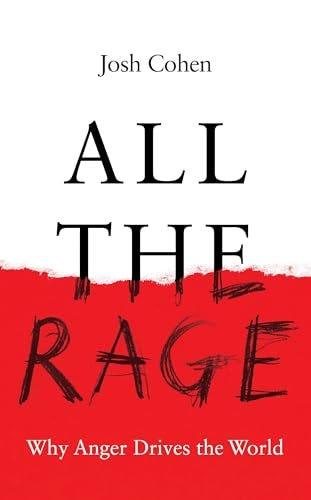
On Useful Anger: Cohen's All the Rage

How can we possibly approach the world today without being in a constant stage of rage? Philosopher and psychoanalyst Josh Cohen’s All the Rage suggests how to make this feeling more useful to us. 

He writes from a range of perspectives, everything from political uprisings to the patients in his office, and from how rage plays out in the world to how it manifests in our own minds, all with a thread of climate change activism throughout. Ideas are illustrated with examples from fictional characters, historical figures, and his own family. It hardly seems possible to do all that in just 195 pages, yet the book is a thought-provoking and entertaining read, comfortably shifting from micro to macro issues to explore four kinds of rage.

DEFINITIONS

In day-to-day conversations, we use “rage,” “anger,” and “aggression” almost interchangeably. We do the same for “emotion” and “feeling” and for “drive” and “instinct.” The book uses these terms more precisely, so a bit of a glossary might be useful. The order of events that occurs when we’re outraged becomes important. Cohen explains that aggression is often the way we respond directly to a stimulus, and anger is what happens after that first spark of action, when we choose to hold it back. He explains it succinctly in an interview with The Philosopher:

“Aggression is a kind of stimulus response. It’s what we do with a provocation, which might be an injury; it might be a humiliation, an insult of some kind, something that arouses us to retaliation. Aggression is the way that we get rid of that load of stimulus in action. … Anger is a way of holding on. Feelings are ways of holding on to stuff. When we can’t bear to feel something we instead discharge it in action. … Anger is something that you’re left with when action is unavailable to you or perhaps when you try to take the experience to a higher level, i.e. to maintain it in the consciousness as something to experience and process psychically rather than discharge in an action. That’s why psychoanalysis tends to think of anger as a human achievement.”

It’s not the case that we’re insulted, then feel anger, and then rationally decide to act or not act, even if it sometimes feels like that. Instead, the impetus to act is immediate following an enraging stimulus, and the restraint is what leads to the feeling of anger. I think that’s the idea. It’s counterintuitive to me, so it’s useful that it was repeated a few times in the book.

Thursday, January 29, 2026

Honouring Our Capacity

I've had several conversations this week about how to be in a time like this when the U.S. government is so overtly corrupted. I'm just the upstairs neighbour in Canada, but we're high on the list of countries to be overthrown. Even without being in that position, it's hard to be aware of the world today and not be in a constant state of rage. I mean even more than before. I want to fast forward to the end when all the bad guys go to prison, but that will only happen with ongoing action from as many people as possible. However, that type of action doesn't necessarily have to be heroic or extraordinary. This is just my two cents from a distance that's looming closer.

INACTION AS COMPLICITY: What's Enough? 

Viewing newly accepted levels of violence in the U.S. is overwhelming and frightening. A few people have posted lists of things we can do to help, but I wonder if, for many people, it's asking too much. This might be a controversial view at a time when it feels like we all need to get on board to shift the world back to a less selfish and violent place, but the perspective that we all are complicit if we don't act might do more harm than good.

Wednesday, December 31, 2025

The Pluribus Utopia

The recent show Pluribus has got me thinking differently about the kind of ideal state that might be a laudable direction and how to get there. The show is overtly about a hive mind interconnection, that started with a lab-leaked experiment, which affects almost all of the world except for 13 people who have natural immunity. We follow the trajectory of one of these anomalies, Carol, who gives them their titular name, not for "many," a direct translation, but as her own invention: "the plural of succubus."

There will be no significant spoilers here; this isn't about the show specifically, but about its depiction of a perfectly efficient and seemingly happy and altruistic society. Is Carol the last one left in the cave, or is she the only one who made it to the outside?

The hive all works together effortlessly as one, with a prime directive to do no harm, as they distribute food worldwide with the utmost equity. They don't step on bugs or swat flies. They will eat meat if it's already dead, but they won't kill it themselves. They also won't pluck an apple from a tree. They don't interfere with life. They can't lie overtly. It's all very pleasant. The hive won't harm a living body; however, they didn't mind obliterating the human spirit of 8 billion people without explicit consent, rendering their ethics questionable.

Monday, December 8, 2025

The Cyclical Nature of Chores

Emma Wilkins' excellent piece "On Housecraft" in The Philosopher, discusses Helen Hayward's book, Home Work: Essays on Love & Housekeeping in such a compelling way as to provoke some thoughts without having actually read the book in question. So this is a critique of a review of a book I haven't read, but on a topic most of us relate to intimately.

Like me, and many of us, Wilkins hates cleaning and is working through how to make the drudgery more palatable. She's "more likely to make the bathroom less dirty than property clean." Likewise, to take the confessions even further, cobweb strands are clearly visible from where I'm currently sitting in my kitchen.

Wilkins and Haywood raise a long-standing struggle for fairness in this field and pin the problem on daily chores being beneath our dignity, so they explore elevating the art of cleaning and finding personal benefits in the work. These paths might help, but I wonder if it could also help to revere the battle around equity and to lower and ground this regular exertion.

NOBLE AND ADVANTAGEOUS EFFORTS 

Haywood has found a way to embrace housework as a method of demonstrating caring. As an artform, it can become a noble pursuit to have a well-kept home. Wilkins writes that our disdain for chores is relatively new as Aristotle recognized that,

"...'oikonomia' or 'household management' contributed to the wellbeing of the community, thereby serving a higher purpose. … It’s not surprising that, in a secular individualistic culture, cultivating servant-hearted humility holds little appeal. Work done in the home might not earn us money, or praise, or even gratitude. But the more we’re motivated by care, and love, the more noble the work is."

Wednesday, November 12, 2025

Myth and Motivation: On Dopamine

There are contradicting views and explanations of what dopamine is and does and how much we can intentionally affect it. However, the commonly heard notions of scrolling for dopamine hits, detoxing from dopamine, dopamine drains, and craving dopamine, appear to be more like a story we've constructed to understand our actions than a scientific explanation, and I'm not convinced it's the best narrative to help us change our behaviours, particularly around tech-based habits. 

As a hormone, it's released by the adrenal glands (above the kidneys) into the bloodstream for slower, more general communications where it primarily helps to regulate our immune system. As a neurotransmitter, it provides fast, local comms between neurons in the brain where it does a lot of different things including affecting movement, memory, motivation, mood, and mornings (waking up). It makes up 80% of the "catecholamine content" in our brain, the ingredients that prepare us for action. Our levels fluctuate throughout each day, so you don't have to try to cram all your work into the early hours of the morning.

It's largely discussed as the heart of our quest for pleasure, yet for decades studies have concluded that dopamine doesn't affect pleasure, since we get a dopamine release before a rewarding activity, not after we've completed it. Instead, it affects how the brain decides if an action is worth the effort. A 2020 study found that increasing it with meds like Ritalin can motivate people to perform harder physical tasks. People with higher levels of dopamine are more likely to choose a harder task with a higher reward than an easier, low-reward task. Low dopamine doesn't reduce focus, but it's believed it provokes giving more weight to the perceived cost of an activity instead of the potential reward. Lower levels lead us to save energy.

So why do we think we crave it or, paradoxically, need to try to intentionally deplete it?

Monday, September 15, 2025

Not Selves, but Not Nothing

We're living at a time when the glorification of independence and individualism is harming the world and others in it, as well as leading to an epidemic of loneliness. According to Jay Garfield, the root of suffering is in our self-alienation, and one symptom of our alienation is clinging to the notion that we are selves. "We are wired to misunderstand our own mode of existence," he writes in his brief yet substantial 2022 book, Losing Ourselves: Learning to Live Without a Self. 

Garfield traces arguments against the existence of a self primarily through 7th century Indian Buddhist scholar Candrakīrti and 18th century Scottish philosopher David Hume, and explores where many other philosophers hit or miss the mark along the way. The book is a surprisingly accessible read about a complex topic with perhaps the exception of a couple more in-depth chapters that develop arguments to further his conclusion: you don't have a self, and that's a good thing.

Garfield starts with the idea of self from ancient India: the ātman is at the core of being. A distinct self feels necessary to understand our continuity of consciousness over time (diachronic identity) and our sense of identity at a single time (synchronic identity). A self gives us a way to explain our memory and allows for a sense of just retribution when we're wronged. We feel a unity of self to the extent that it's hard to imagine it's not so.

Friday, July 18, 2025

Mentalizing, Mindfulness, and the Drive for Evidence

 In reading about attachment theory, David Wallin's description of Peter Fonagy's work was intriguing, so I went down that rabbit hole. 

Fonagy developed Mentalization-Based Treatment (MBT) to improve emotional regulation, as distinct from Jon Kabat-Zinn's Mindfulness-Based Stress Reduction (MBSR). Fonagy sees our mental development as relational, but in order to have empathy for others, we need awareness of our own feelings, which can be helped with mindfulness work. However, in looking at the evidence of efficacy of these separate modalities, I question the attempt, since Freud, to make psychology into a natural science. Each of the various ways to help are useful, but there's an element of the unknowable in the way when we treat them scientifically.

According to Wallin, Fonagy's focus was on developing the understanding of the mental states of others, which he calls mentalizing, to let us understand the depths of ourselves and others. For instance, it can help heal old wounds if we understand that dad's rejection of us might be due to his depression and not our behaviour as a child. Other people's reactions to us aren't just caused by us, but there are always multiple factors at play affecting how people behave. It seems very similar to Theory of Mind. He met Bowby in the 1980s, and studied adults' behaviour relative to their own descriptions of childhood attachment, and found, when comparing severely deprived to well-connected adults, that a weak attachment was correlated with a weak "reflective functioning" (the ability to understand behaviours in terms of their thoughts, feelings, and mental states). From this, he says psychotherapy should be the "effort to restore or kindle patients' capacity to mentalize," to simultaneously feel our feelings and reflect on their meaning. To help people develop mentalizing requires a relationship that mirrors and guides emotional responses.

Sunday, June 15, 2025

The Necessity of Feeling Seen

Attachment theory is part of the vernacular now. Even the Norwegian show Porni mentions it, and the dramatic eldest daughter blames her mom for her “relational damage”! We’ve largely accepted the questionable idea that mom’s attentiveness in childhood creates our attachment patterns for life — the gist of the theory as it’s largely understood, but what’s usefully generalizable from the actual studies? There are many criticisms of the theory, yet some university psych courses applaud it without reservation. I’m dubious about it, but I also don’t want to entirely throw this baby out with the bathwater.

 This is a huge topic, and I’ll hardly do it justice here. There are a few excellent books on it, but part of the problem with how we understand the studies might be that the most nuanced books seem to be the most academically written, and likely the least read. As it morphed into popular consumption it may have strayed further from the original intention. On top of the reading, I went to a couple workshops on attachment to find the magic solution to all our relationship ills, and my big takeaway is this (for free!): if you’re a bit distant, consider being open to getting closer, and if you’re a bit clingy, try to step back a bit. It’s good advice to notice and change patterns that are a problem, absolutely, but I’m not sure it merits the number of workshops, courses, and self-help books that it’s provoked. At worst, some books actually counsel people to avoid any “avoidant or disordered people” as if there’s no saving them from their dastardly origins. Therapeutic discussions of childhood misconnections definitely have helped people better understand themselves, but I think this theory produces such volumes of celebration and condemnation because, in difficult relationships, it feels like the answer, but to parents, it feels like blame.

Attachment Theory Criticisms 

Heidi Keller’s The Myth of Attachment Theory (2022) is an extremely thorough takedown of the theory. If attachment notions make you feel like a crappy parent, this book is vindicating. She explores the offense of putting it all on moms both because of the narrow focus on a single person as well as on singular causation, but her best work is in exploring the creation of a norm of interaction from upper-middle class, western assumptions around what it means to be sensitive to a baby’s needs, an analysis that was made at the time as well: 

Sunday, May 25, 2025

On Approaching Death

 CW: As the title suggests, there will be discussion of death and dying and some mention of suicide in this post.

I thought nothing of following up my last post on Irvin Yalom on the meaning of life with Yalom on the meaning of death, until I started writing here. The very reality of being a bit wary of broaching the subject reveals the strength of societal taboos against admitting that we’re all going to die. Until it’s staring us in the face, we delude ourselves into thinking we will get better and better, mentally and physically, despite that our brain starts to shrink in our 30s, and our joints and organs will start to give out not so long after. We work hard to keep death clean and sanitized so the reality doesn’t seep in too much, and we try to do all the right things to keep death at bay: exercise, various special diets, wearing masks to avoid viruses. We can fix some evidence of erosion with meds and surgeries, sometimes miraculously, but some people even hope to keep their brain going long after their body dies.


Sunday, March 2, 2025

Accepting Difference

I recently watched the lovely film, A Real Pain, about two cousins (played by Jesse Eisenberg and Kieran Culkin) who travel to Poland to visit their departed grandmother’s home. In the first 20 minutes of the movie we’re shown two dramatically different personalities, both neurotic in their own way, but one more inward and the other laser focused on other people. It’s in our vernacular to understand the characters as introverted and extraverted, but there is still disagreement over what that means and, more importantly, what to do with that information.

I think we’ve veered off course since Jung’s Psychological Types, now over a century old, the precursor to the Myers-Briggs Type Indicator (MBTI) and more recently the Five-Factor Model (FFM) or “Big Five.” There are lots of other personality inventories like John Holland’s six Personal-Orientation types, Arthur Brooks’ mad scientistscheerleaderspoets, and judges, and Martin Seligman’s top five strengths, but MBTI and FFM seem to have sticking power.

Sunday, October 6, 2024

On Burnout: "Can" is the New "Should"

I started reading about burnout when I walked away from teaching earlier than expected. Suddenly, I couldn't bring myself to open that door after over thirty years of bounding to work. A series of events wiped away any sense of agency, fairness, or shared values. Their wellness lunch-and-learns didn't help me, and I soon discovered I'm not alone.

An article published in JAMA last June looked at rising rates of burnout in healthcare, where 40% of physicians surveyed intended to leave their practice. They suggest, "To prevent a health care worker exodus, experts argue that the emphasis needs to shift from individual resilience to broader system-level improvements." They are looking for standardized methods to affect organizational management with "evidence-based interventions."  


Over 25 years ago, Michael Leiter and Christina Maslach came to the same conclusion. They identified six areas of worklife affecting burnout and created a specific assessment for educators. They determined the cause to be a "mismatch" between employee expectations and employer behaviours leading workers to be closer to the bleak end of a continuum from burned out to engaged. They suggest that "the task for organizations and individuals is to achieve a resolution." This is not just a matter of throwing wellness initiatives or resilience-speak into the mix, but addressing any reasonable expectations of employees with appropriate employer interventions in all six interrelating areas. 


click for clarity

Feels vindicating, right?!

Saturday, August 10, 2024

Embracing Fallibility

Many of us live in a punitive, carceral type of society that can make it difficult to have compassion for ourselves or others. It's an era of the glorification of the individual over the group, leading to perfectionism and narcissism and so, so much loneliness. We can't connect when we're working with blind determination to find our place above the rest. We can't connect when we don't dare show an ounce of vulnerability for fear of being taken down like a wounded gazelle on the Serengeti. Our quest to rise to the top for the security we think comes with status and money is completely at odds with our very real need to feel authentically known, within the security of a community.  

We're no longer following that love and forgiveness bit from Christianity, if we ever really did wide-scale. And we project our fear of losing on anyone who has suffered through difficulties, no matter if it's a natural disaster or massive layoff. We distance ourselves from the suffering of others by convincing ourselves they must have done something stupid to be in this position, and, therefore, we're safe as long as we keep on going hard. It's just a trick to make us feel safer, that unwittingly keeps us from too consciously noticing the floods and fires, layoffs and illnesses lapping at our heels.  

Tuesday, June 18, 2024

Chomsky's Passing - NOT

Noam Chomsky passed today at 95.  --- Actually, he's still alive. He was just sent home from the hospital after a stroke, and people feared the worst!!

His efforts to dig beyond the surface level of propaganda in the media is needed now more than ever. I try to follow his call to act in such a way so you can look yourself in the mirror each night, and his unwavering optimism amid his deep dives into atrocities. Here's Jacobin's farewell and one from Yanis Varoufakis. I summarized some of his words in these posts over the last dozen years or so. 

On Chomsky (summary of Understanding Power)

Chomsky's Forward to Albert's Realizing Hope: Life Beyond Capitalism

On Chomsky's Driving Forces in US Foreign Policy

Requiem for the American Dream 

Nader Interview with Chomsky on the Requiem for the American Dream (with Ralph Nader)

Inconceivable! His Dinner with Chomsky (interview with Wallace Shawn - I don't get enough credit for my post titles!)

Chomsky's Optimism: On Climate. Change, Nuclear War, and Activism (podcast with Truthdig)

The Future of the Left with Natalie and Noam (interview with flippin' Contrapoints)

Chomsky's Lessons from 2021 (interview with Yanis Vanoufakis)

And a bunch of iconic quotes:

Sunday, June 16, 2024

The Art of Helping

"A little learning is a dang'rous thing;
Drink deep, or taste not the Pierian spring:
There shallow draughts intoxicate the brain,
And drinking largely sobers us again."
~ Alexander Pope

Is it, though? 

We're in a mental health crisis and people need more access to help. How much learning is necessary to help one another, and is it dangerous to listen and offer another perspective or even some suggestions without an advanced psych degree? In old movies, people told their stories to bartenders, hairstylists, or cab drivers for the price of a beer or trim or trip to the airport. They just needed a captive audience willing to listen to their worries Now we want people with credentials as if that will provide more certain results.  

But not all credentials are created equal. 

Last year BetterHelp got in the news for allegedly sharing confidential health data to social media sites, and was fined $7.8 million. TV writer Mike Drucker wrote:

"EVERY BETTERHELP AD: 'We're like therapy but cheaper and easier! We have people for every problem so you get care just for you!'
ACTUAL BETTERHELP: 'We're gong to set you up with a confused therapist that will ghost after two sessions. Also we told Facebook about your assault.'"

More recently, the New York Times had an article on scams in the wellness coaching industry, describing scenarios in which the new recruits were bilked out of massive amounts for "tuition" made up of a few hours of videos, and then were never helped to find clients. 

"Business is booming. . . . The number of coaches increased 54% between 2019 and 2022. Because the industry lacks standardized accreditation, it's most likely larger -- one of the dangers of life coaching is that anyone can claim the title of life coach. . . . [One coach] has spent an extraordinary amount of money on the certification and clung to the dream that had been sold to her . . . found herself short of clients and scrambling to make any income. . . . There is a problem in the industry of coaches who coach coaches to become coaches. . . . Life coaching attracts people who are vulnerable to exploitation."

Monday, March 25, 2024

On Identity: Erikson, Freud, and Sartre

 I recently listened to a podcast of Dr. Louis Cozolino, a neuroscientist and psychoanalyst, discussing what he would teach if he were training psychotherapists. The first year would be phenomenology: the power of Carl Rogers' perspective to train how to develop an alliance through reflective listening while keeping countertransference out of the session. The second year would be physiology: developmental neuroscience and the evolutionary history of brains and bodies. The third year might be called intersectionality: the interpenetration of the spectrum of options that affect clients - brain, mind, family, culture - and a reaction against therapy as a mere opiate to calm the oppressed and exploited. The final year would be on narratives and stories that we live by and on that half second that it takes our brain to construct our experience of the present and feed it back to us. 

Cozolino insists that it's not enough to just sit and listen to people vent. After developing a non-judgmental alliance with the client, therapists need to be "amygdala whisperers," to be able to down modulate amygdala activation to stop any inhibitory effect on the parietal system that enables problem solving. In other words, they need to soothe anxieties while arousing enough interest for clients to be able to learn new information. Then it's time to challenge the client's old system of thinking, slowly and delicately, a little at a time, to help them expand previous conceptualizations of themselves and the world. There's a necessary plan and a strategy to the sessions. 

By contrast, in my MA psychotherapy program, we're currently learning Piaget and Erikson's stages of development that many of us first encountered in high school classes. There's little to no encouragement to look at these older theories with a critical eye, and we're required to identify stages without a clear idea of how that knowledge might practically help clients. I'm doing well in the class despite the reality that I don't understand how acknowledging that a client is in the "identity vs role confusion" stage can provoke a useful change in the client's perceptions. 

Monday, February 26, 2024

Changing Perceptions of Autism

I compiled some posts from here into a summary of recent studies on Autism at 3 Quarks Daily, but the word count limit there forced me to cut this bit on the history of our understanding of autism:

1908 - "The term ‘autistic’ was used to classify schizophrenic patients who were “severely withdrawn,” setting a trend to diagnose ASD as 'childhood schizophrenia' until the 1940s.
1924 - Grunya Sukhareva published reports on children she described as having “schizoid psychopathy.” Despite the name, her theory is very similar to how autism is described today.
1938 - Hans Asperger received funding from the Nazi party to research children to determine which are more worthy of life. He noticed that some children were very cognitively advanced despite isolating socially, which he named Asperger's Syndrome.

Monday, January 29, 2024

Yalom's Gift

I recently binge-watched all of Group, a show inspired by a novel by Irvin Yalom, The Schopenhauer Cure. So I revisited Yalom's non-fiction to see how closely the series aligns to his actual practices.

The Gift of Therapy is a fascinating read from 2017 in which Yalom dives openly into his existential psychotherapy practice, explaining the four givens that affect how we think, feel and act that need to be explored at depth: death, isolation, meaning of life, and freedom (xvii). In the introduction, he jumps right into death denial revealed through a belief in personal specialness (xiii). Our current culture of selfies is likely rife with this! An existential perspective is best for clients who despair from "a confrontation with harsh facts of the human condition" (xvi). We didn't see much of this type of discussion in the show. In fact, the therapist didn't talk much at all beyond reminding the group to be honest and forthcoming.

On Group Therapy 

Yalom clarifies the distinction between group therapy and individual therapy in that group is more useful when "patients fall into despair because of their inability to develop and sustain gratifying interpersonal relationships." He offers two instructive points: a just-right structure to alleviate anxiety yet not miss potential revelations if turn-taking is too regulated, and the importance of individual summaries at the end of session recognizing that each person has a different experience of what happened. Yalom also writes and shares his own summaries of each session to group members to maintain continuity from one session to the next.

Sunday, December 31, 2023

A Fruitful Exploration of the Core

Maybe there are seeds of potential deep within ourselves, but maybe there's nothing there but a collection of signals. Regardless the outcome, we need to dig in to see what we can find. 


In several classes I took last term, the idea of a core self that's fluid came through discussions of the postmodernist view of the self. But I'm not convinced we're still living the pomo life, and I'm not sure we want to be. 

Taking liberally from Charles Taylor, and others, it appears that we once had some communal ideals, then flipped from seeking answers from God to proving them with science, then realized some pretty major problems with glorifying any kind of authority and renounced all of them, but now, drawing on the types of films being made and the stories told, it feels like we're readjusting back to a place with more solid values and truths. I hope so, anyway.