Showing posts with label books. Show all posts

Wednesday, March 26, 2025

Avoiding the Sausage Machine

click to read
I attended an excellent masterclass on "Trans-Inclusive Philosophy" with Sophie Grace Chappell last week, put on by The Philosopher magazine. She wrote Epiphanies and Transfigured, and this paper will be coming out in a collection soon. She discussed system-building in a way that lit some lightbulbs for me. I was waiting for the video to be posted before writing about it, but, in lieu of that, here's my transcription of it. 

She starts by responding to a call to build a theory of what gender, transgender, and gender identity are, and she clarifies the problems with gate-keeping off the bat. People will demand that before anyone's allowed to claim they're trans, they first have to define male and female, and she likens this to saying before you can sit on a chair and drink some tea, you first need to establish the necessary and sufficient conditions for chair and for tea, which is just ridiculous and very dangerous.

More interesting to me is her second argument, that defining what counts as transgender butts up against bigger problems with any system building. She prioritizing experience over theory because any attempt at an overarching trans theory will inevitably leave someone out. She has her own idea of what fits her, but it won't fit everyone, and other people might have great definitions for themselves, but they don't entirely fit her, either. 

Monday, March 24, 2025

Things May Appear Bleak, And Yet...

Byung-Chul Han's The Spirit of Hope is a beautiful book, the kind you want to treat with care and won't dare dog-ear a page. Anselm Kiefer's illustrations throughout provide a place for contemplative moments between ideas. It's more immediately accessible than The Burnout Society, which took me weeks to wrap my head around, yet no less profound. 

A REVOLUTIONARY POLITICS OF HOPE

We like a secure illusion of control over the world, yet that hasn't gotten us much further along. We recognize something's missing. Han writes, "Amid problem-solving and crisis management, life withers. It becomes survival. … It is hope that opens up a meaningful horizon" (2). 

Han explains how a lack of hope furthers the current neoliberal capitalist trajectory: 

"Fear and resentment drive people into the arms of the right-wing populists. They breed hate. Solidarity, friendliness and empathy are eroded. … Democracy flourishes only in an atmosphere of reconciliation and dialogue. … Hope provides meaning and orientation. Fear, by contrast, stops us in our tracks. … Hope is eloquent. It narrates. Fear, by contrast, is incapable of speech, incapable of narration" (2-3). 

Saturday, August 10, 2024

Embracing Fallibility

Many of us live in a punitive, carceral type of society that can make it difficult to have compassion for ourselves or others. It's an era of the glorification of the individual over the group, leading to perfectionism and narcissism and so, so much loneliness. We can't connect when we're working with blind determination to find our place above the rest. We can't connect when we don't dare show an ounce of vulnerability for fear of being taken down like a wounded gazelle on the Serengeti. Our quest to rise to the top for the security we think comes with status and money is completely at odds with our very real need to feel authentically known, within the security of a community.  

We're no longer following that love and forgiveness bit from Christianity, if we ever really did wide-scale. And we project our fear of losing on anyone who has suffered through difficulties, no matter if it's a natural disaster or massive layoff. We distance ourselves from the suffering of others by convincing ourselves they must have done something stupid to be in this position, and, therefore, we're safe as long as we keep on going hard. It's just a trick to make us feel safer, that unwittingly keeps us from too consciously noticing the floods and fires, layoffs and illnesses lapping at our heels.  

Monday, January 29, 2024

Yalom's Gift

I recently binge-watched all of Group, a show inspired by a novel by Irvin Yalom, The Schopenhauer Cure. So I revisited Yalom's non-fiction to see how closely the series aligns to his actual practices.

The Gift of Therapy is a fascinating read from 2017 in which Yalom dives openly into his existential psychotherapy practice, explaining the four givens that affect how we think, feel and act that need to be explored at depth: death, isolation, meaning of life, and freedom (xvii). In the introduction, he jumps right into death denial revealed through a belief in personal specialness (xiii). Our current culture of selfies is likely rife with this! An existential perspective is best for clients who despair from "a confrontation with harsh facts of the human condition" (xvi). We didn't see much of this type of discussion in the show. In fact, the therapist didn't talk much at all beyond reminding the group to be honest and forthcoming.

On Group Therapy 

Yalom clarifies the distinction between group therapy and individual therapy in that group is more useful when "patients fall into despair because of their inability to develop and sustain gratifying interpersonal relationships." He offers two instructive points: a just-right structure to alleviate anxiety yet not miss potential revelations if turn-taking is too regulated, and the importance of individual summaries at the end of session recognizing that each person has a different experience of what happened. Yalom also writes and shares his own summaries of each session to group members to maintain continuity from one session to the next.

Sunday, January 7, 2024

Can a Slingshot Down this Goliath?

I read Andreas Malm's book, How to Blow Up a Pipeline a few months ago, then watched the movie, and then was reminded of it all again by Abigail Thorn's latest Philosophy Tube video about being plagiarized by a man.

Thorn explains how subtle sexism led to free labour in the home. Even today, women get the lion's share of household chores, even if they're working the same or more hours outside the home, through "Social Reproduction" - the reproduction of beliefs that enables the continuation of existing power structures, which go so far as to  make up "facts" about a group of people in order to further their exploitation, for instance, by propagating the notion that women are better suited for this type of work. I once dated a guy who, when I suggested he do dishes more often, insisted, "But you're better at doing dishes." This is a version of learned helplessness that serves to reinforce the status quo and keep some men firmly on the couch with their feet up. 

But Thorn further explains a bump in the road that happens when society accepts people who are trans: 

"If Mrs. Mansley can become Mr. Mansley, then the idea of an essential female nature starts to look a little bit shakey. If Burt can become Berta and be happier for it, then the idea that women are inferior also starts to look shaky. If they can both become Mx. Mansley, nonbinary partners in loving communions, then who the fuck is gonna work at the Chrysler dealership?"

I thought a discussion of Locke might come out of all this because he exposed this essentialist specialization of roles bullshit with respect to the questionable inborn ability of the royal class at the time of King Charles II and Oliver Cromwell. His epistemology, that we're all a blank slate from birth, affected his politics: there's nothing inherently special about royalty, and we should vote on the best leaders! He wrote anonymously knowing what a ruckus that would cause!! Now we're in the same situation but instead of the monarchy exploiting the peasant's labour, we're looking at a shift in men's exploitation of women's labour.

But she doesn't go that far down that particular road.

She brings up Malm's book to relate the fight against climate change to the fight against patriarchy. For both, we've been told for decades to spread the word and raise awareness, but WE ALL KNOW already!! We know that people are exploited and that the climate is being destroyed. As long as people can benefit from pretending they don't know this and that more education is all that's necessary, then there will always be people pushing the stories that tell us it's all okay. But we know it's not, and we need to make some noise. Of course, the same could be said for the Covid situation. Denial is a hell of a drug! 

Monday, December 11, 2023

Art to Guide the Masses

Can sitcoms save the day?

Back in the 80s, there was a very funny show about a detective agency, Moonlighting. It was a take on the classic enemies-to-lovers trope with a very prim and efficient Maddie Hayes up against the fly-by-the-seat-of-his-pants David Addison. Of course the two fall in love. In one episode, before having sex - I think for the first time - they have a brief conversation about condoms!!! It was unheard of! We had been taught to use safer sex and were all told to use condoms. It was the beginning of the AIDS epidemic, but other STIs were also pretty common. Yet nobody had shown us what it looked like to actually talk about condoms without killing the mood. If these two very beautiful people can make it sexy, then maybe we could too. 

Imagine if sitcom characters wore a mask whenever leaving the house? 

I mean, we know that the film industry is one of the most Covid-conscious industries out there, often with everyone on the set masked to protect the stars. They know the value of their well-paid employees who are essentially irreplaceable. The problem with so many other industries is that they see their staff (and clients and patients and students) as entirely replaceable. 


Imagine the madcap antics that could happen with characters trying to date. Maybe a funny female lead falls in love with a guy who, once unmasked, has horrible teeth. Fleabag did something similar but with a newspaper hiding a buck-toothed smile instead of a mask. Or imagine two people going on a date - to a movie with no popcorn - and then an awkward hug at the end of the night because neither are quite sure if they want to bring the other into their inner circle of unmasked people! It's really complicated out there for the Covid-conscious, and that could spur lots of funny scenarios. The older sickly grandma who doesn't believe all the Covid malarky and keeps getting sick could be the new stand-in for the shockingly racist grandma of the past. 

Sitcoms are full of tropes that we can relate to, but they get less and less relatable when they're all living like it's still 2018. It's nice to watch a fantasy world from time to time, but we look to the arts to see how to live with our current situation. Since political leaders have deserted us, we need more writers guiding us through this mess! 

It's a tragedy we're living through, definitely but that often makes for some of the best comedy, and we either have to laugh or cry at the state of things today.

Monday, November 6, 2023

Goleman's Emotional Intelligence

Daniel Goleman's Emotional Intelligence: Why It Can Matter More than IQ, was originally published in 1995 but there's a more recently updated in a 25th anniversary edition in 2020. It's not quite updated enough, though. 


He added a new introduction, but no study or concept in the book was updated despite huge changes in our lives since then and tons of new studies with updated technology. It's kind of refreshing to read a book about the problem with kids today without a single mention of phones, but it feels a little sloppy. Goleman is a science journalist without a clinical practice in psychotherapy as far as I can tell. While his book is about how to be smart according to the front cover, it's also being used in psychotherapy. It's a fast, engaging read, but I have some concerns about the content and application.

The book outlines the need for emotional intelligence (EI) to be overtly taught to children, explains the psychoneurology of EI, argues for the primacy of emotional intelligence for success, adds in the need for emotional supports, and ends with a call for parents to be better educated as well. The principle underlying Goleman's text is that there are four specific domains, adapted from Salovey & Mayer, that emerge from the activity of our brain circuits that have more of an impact on our general well being than does our intelligence: self-awareness, self-management (formerly motivation and self-regulation), empathy, and skilled relationships. Goleman explains that people will be better off emotionally, relationally, and vocationally if they develop their emotional intelligence to identify and understand their feelings as they happen, manage them effectively, understand other people's feelings, and relate to others more positively. With a calm mind, people can make better decisions, which positively affects all other aspects of their life. Goldman has used these domains to help to develop educational programs to teach children Social-Emotional Learning (SEL) in the schools through the CASEL organization. I feel like it goes without saying that being able to manage our emotional experiences helps in other aspects in our lives, so I'm all in at this point.

Monday, July 24, 2023

Maté: Part Depth Psychology, but Part Questionable Quick Fix

He received the Order of Canada, profoundly helped many people with addiction on the streets of Vancouver, and is much loved and admired, but some of Dr. Gabor Maté's claims feel like they don't hold water. And some claims might actually be dangerous if blindly accepted.

I've encountered Maté in a few courses I'm taking, and have been strongly encouraged to watch his newest film and read his book several times now; I opted for the former. One follower was excited to tell me, with great confidence, that ALS (Lou Gehrig's Disease) is caused by a specific trauma and that everyone is carrying unresolved trauma which, if resolved, can heal physical ailments like cancer. Okay. I have some reservations that I've kept to myself until seeing so many in academia wholeheartedly promoting some poorly substantiated claims.

While Maté has some excellent techniques in the work he does, the way he presents and explains the material provokes me to look up research studies to try to corroborate many of his ideas.

I gobbled up his books twenty years ago, and there are some useful analogies and treatments in there, but even then there were parts that gave me pause.

Sunday, May 14, 2023

Frankl's Phases of Life in the Camps

My lovely friend and former colleague recently passed away unexpectedly. The kindest people go far too soon. We also went to teacher's college together over 30 years ago, and his quips and just the calm and jovial way about him helped make the ridiculous assignments there far more tolerable. Sitting next to me as a trustee, he and I often chatted about the benefits of meditation; he and his wife actually saw Thich Nhat Hanh in person

He was a wealth of knowledge, and one of his recommended reads for me was Viktor Frankl's Man's Search for Meaning, which I gobbled up in no time, but it was too late to talk to him about it. That's destroying me a bit these days, so I'll write it all here instead. 

Frankl survived several concentration camps, the near starvation and typhus that took many others, and explains how he coped and designed a form of psychotherapy in the process. The book is Nietzsche's "He who has a Why to live for can bear almost any How," which he quotes a few times throughout. He kept his mind on the future, imagining better days after the war, back with his wife again and lecturing about his experiences. I've read it trying to use his words to better tolerate the less acute, more chronic threat of Covid. It might seem trite or contrived to make such a comparison, but consider that more people have succumbed to Covid than Jewish prisoners in the camps and it continues because we are living blindly to it, unthinking. Some estimates suggests Covid has cost us over 30 million lives in just three years. 

The book is in two parts. In the first, originally published in 1946, he describes his experiences living in a death camp and the three phases of survival in camp life. He wrote it after being released and returning to Vienna to learn that his pregnant wife, parents, and brother had all died in the camps. In the second half he explains how to cope with it all, but I'll save that for another day. Page numbers throughout are from the 2006 edition.

Sunday, January 1, 2023

The Kraken Wakes: We Need to Stop Hosting Monsters!!

I don't read much fiction, but I loved John Wyndham as a teen, and I realize I didn't love English class because there was almost never any sci-fi on offer - except The Chrysalids in grade 9 was enough to get the binge started. The Kraken Wakes is about an alien invasion, and check out this plot description from Wikipedia:

"The novel describes escalating phases of an invasion of Earth by aliens, as told through the eyes of Mike Watson, who works for the English Broadcasting Company (EBC) with his wife and co-reporter Phyllis. A major role is also played by Professor Alastair Bocker – more clear-minded and far-sighted about the developing crisis than everybody else but often alienating people by telling brutally unvarnished and unwanted truths. Mike and Phyllis are witness to several events of the invasion, which proceeds in drawn-out phases; it takes years before the bulk of humanity even realises that the world has been invaded."

The aliens can only survive in the ocean, where it's pressurized, so you'd think they'd be easy to kill off. You'd think. But they're a far sight more clever than the people. Some characters in the book argue we can just live with the aliens, but others try to destroy them. By the time the aliens move onto land, it feels like it's too late. Spoiler: Japanese scientists save the day, but the population has been decimated by then, with about 80% dead, and most of the world is flooded. Aside: Some mark the first time people worried that fossil fuels will cause icebergs to melt with a Time article in 1956, but ice-caps melting is a major problem in this prescient book published in 1953. 

Wednesday, July 13, 2022

On Claims of Porn in Schools

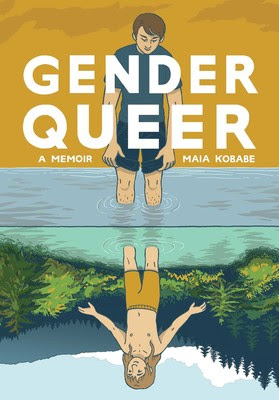
There's a call to arms on a social media from a few people who think the memoir in graphic novel form, Gender Queer by Maia Kobabe (e/em/eir pronouns), should be removed from shelves in school libraries for being pornographic. For the uninitiated, "graphic novel" means it's a cartoon, not that it's graphic in its content. My former school was named as one of the offenders who dares to carry such smut, so of course the post had the ironic effect of making me curious enough to go out and buy a copy of the book to see what all the fuss is about. 

Content Warning: Kobabe's drawing of a sex act is further down. Don't scroll down if you think you might be offended.

The original social media poster suggested parents call Family and Children's Services with their concerns about this bit of pornography in our schools, which is a horrible idea that would put undue stress on a service that has much more important needs to tend to than mediating quibbles around which ideas and images teenagers should be privy to. She doesn't seem to understand the scope of the organization. She also doesn't seem to understand what pornography is or what might actually harm teenagers today. 

My only criticism with the book is that, while it shows the main character, Maia, incrementally more courageous as e finds eir voice, illustrating specifically noteworthy events in eir life, the telling doesn't have a strong story arc. A graphic novel memoir that does this brilliantly, for comparison, is Persepolis, which is also a series of true events, but Satrapi crafts scenes together with a trajectory and more elements of storytelling, making good use of foreshadowing for instance. Gender Queer didn't end as much as it just stopped when e got to the present. But that's besides the point here.  

Wednesday, May 12, 2021

Michael Mann's New Climate War

It's not all that new. There are tons of books on this topic now, so it would be hard to find a completely new angle. But the public still needs to learn the basics, and Mann does a good enough job of explaining it all in a very conversational writing style that's approachable for casual readers of science. His big argument, however, is with most of those other books and anyone who errs on the side of worst case predictions of the future because the doomers might provoke us to give up the fight, and this war has just barely started. 

I still know some people who think e-cars are evil because they use cobalt, and fast fashion is the main cause of climate change and are against any carbon tax because it will harm poor people (despite my explanation of the rebate system). They're convinced that vegetarianism is more important than decreasing fossil fuels use, but also that persuading others towards vegetarianism is elitist and privileged because it's cheaper to eat beef, despite my attempts to show them, with grocery store prices, that it's cheaper to buy bulk beans and lentils and cook from scratch; it's only more expensive if you buy 'near-meat' products. Although it takes more time than going through a drive-through, it doesn't have to if you cook a pot full of rice and lentils once/week. I used to live well below the poverty line, and dried beans kept me and my kids afloat. But somehow beef is the road to equity?? 

When I ask for sources, it's all Tiktok videos, so that's where climate scientists and activists have to head next! It's clearly still necessary to explain all this over and over in short soundbites with intense visuals that people will take away with them and share endlessly. These types of books need to be promoted by influencers

Mann has written a different type of climate change book in that it feels sort of personal, and he names lots of names of individuals, corporations, and countries. He seems a little snarky at times, which can be fun, but it's definitely different that the usual dry facts and data. He comes down hard on some of the people and ideas I've supported in the past, which has given me pause, but I don't fully support his take-downs. He wants to mend the rift between various factions of environmental movements, but he's doing so by arguing that they're all wrong. That might not be the best way to build bridges.

The gist: denial isn't the biggest problem anymore; now it's "other breeds of deceivers and dissemblers, namely downpayers, deflectors, dividers, delayers, and doomers" (45). We have to do both individual actions and corporate /political actions, and ignore any fight about which is better or faster. We have to do ALL THE THINGS! (I argued the same last year.) "At the center of the acrimonious debate over individual action versus systemic change is a false dilemma. Both are important and necessary" (68). 

"The solution is already here. We just need to deploy it rapidly and at a massive scale. It all comes down to political will and economic incentives. . . . A renewable energy transition would create millions of new jobs, stabilize energy prices in the absence of fuel costs, reduce power disruption, and increase access to energy by decentralizing power generation" (143-4). 

Saturday, January 2, 2021

Gertz's Nihilism

A year after coming out with Nihilism and Technology, Dr. Nolen Gertz wrote just plain Nihilism, an "examination of the meaning of meaninglessness: why it matters that nothing matters." It's a really short book, but it took a while to wade through it all. Here it all is even more briefly assembled with my own understanding here and there.

We typically think of nihilism as very simply meaning, "we believe in nothing" (4), but he counters that from the start with the polar opposite definition of Russian nihilism via Wendell Phillips in 1881: "the righteous and honorable resistance of a people crushed under an iron rule . . . the last weapon of victims choked and manacled beyond all other resistance" (2),  and then takes us through Western philosophy to get to a view that, "Nihilism is about evading reality rather than confronting it, about believing in other worlds rather than accepting this one, and about trying to make ourselves feel powerful rather than admitting our own weaknesses" (73).


SOME HISTORY

I didn't love this epistemology section, but the book picks up speed afterwards. 

First, on Socrates, Descartes, and Hume and nihilism via our inability to know stuff: Anti-nihilists "inspire others to question and ultimately reject the foundations of their beliefs" (21). Socrates (a social reformer) provoked people to question everything. Then Descartes (a self-reformer) warned that can lead to "inextricable darkness" (21). "For Descartes we embrace illusions because our reach exceeds our grasp, because our desire to know (the will) exceeds our power to know (the intellect)" (22). Then he gets to Hume's fork: For Hume, we can only know things we experience directly and things that are true by definition, and, Hume famously said, all else must be committed to the flames, so  "supporting an idea may not be so different from supporting a sports team" (25). Gertz's conclusion so far: "From a Socratic perspective, nihilism can be overcome by enlightenment. From a Cartesian perspective, nihilism can be overcome by self-restraint. But from a Humean perspective, nihilism cannot be overcome. It is simply a product of human psychology" (28). 

Monday, July 27, 2020

On a Radical Vision of Future Earth

I grabbed this book, by meteorologist Eric Holthaus, as soon as it went on sale, excited to check out the new vision of how we can all better live together. There's lots of information for the uninitiated, and then it becomes sort of a fictional narrative. There are no characters or plot to speak of, instead it's a description of what needs to happen but written entirely in the past tense, as if it already happened. He seems to think this is how we'll better imagine what it all looks like when we solve this crisis. And it all really doesn't work (as a book and as a concept to save us), which I find a bit heartbreaking to tell you the truth. But good job trying something original, I guess.

It's being billed by the publisher as "the first hopeful book about climate change," which ignores so many many hopeful books out there: most recently Michael Mann's Madhouse Effect and George Monbiot's Out of the Wreckageand, going way back, Chris Turner's The Geography of Hope, which was a fantastic read about people actually getting shit done. I checked the publisher's page because the book has a self-published feel to it from the get go: cliché phrases and incorrect comma use, and a weird organization - part 1 is about a third of the book without any chapters, and part 2 has just three chapters, all followed by a very lengthy epilogue. But, nope. It's Harper-Collins. Curious.

Monday, August 26, 2019

Nathaniel Rich's Losing Earth

This is a quick read outlining the history of the efforts to do something to slow down fossil fuel use. Everything we know now about climate change, pretty much, we knew with great certainty forty years ago, in 1979. "The climate scientist James Hansen has called a 2-degree warming 'a prescription for long-term disaster. Long-term disaster is now the best-case scenario. A 3-degree warming, on the other hand, is a prescription for short-term disaster" (4). 5 degrees will bring the fall of human civilization. "The Red Cross estimates that already more refugees flee environmental crises than violent conflict" (4). We had a great chance to fix it all between 1979 and 1989, but we didn't take it.

WHY NOT?

"The common explanation today concerns the depredations of the fossil fuel industry, which in recent decades has committed to playing the role of villain which comic-book bravado" (6). But the fossil fuel industry was actually on board for a time. There are a whole lot of names and dates to keep straight below (I bolded the important ones), and the book, curiously, has NO index or footnotes! Rich wrote it as a compelling story, but I digest it better chronologically:

Sunday, August 25, 2019

The Plague of Climate Change

I just finished Camus's compelling read, The Plague. It's a parable provoked by the Nazi Occupation, but also about general occupation, oppression, and isolation. It's about resistance to incomprehensible evil and what it looks like to be a good person. But, it's striking how well what much of he says fits with climate change, so I'm going to summarize it here by exchanging the words "the plague" with "climate change," "scientist" for "doctor," and "temperature" for "death-rate." I'm also changing "man" to "person" just to equity it up a bit. Consider "pestilence" as "troubles," but I'll leave that as is. Let's see how this goes and if there are lessons to be learned!

The gist: The story follows a doctor, Bernard Rieux, who's an atheist and our narrator. His wife was sent away to recover from an illness before the plague hit. He misses her (a bit), but spends 20 hours a day helping the town. We meet all his varied associates and patients as a walled-off town copes with the sudden spreading of disease that seems as if it will never end. This is an extremely abridged version of a book 272 pages long (Stuart Gilbert translation). Some important characters, all remarkably benevolent seen from Camus's perspective, include a criminal who benefits from the chaos caused by the troubles, a priest trying to guide the masses, and a lover who's desperate to find a way to travel to see his girlfriend despite the new laws forbidding it. There's also a writer unable to find any words and a dear friend that are integral to the story but less vital to this bastardization of it:

Wednesday, July 17, 2019

Odell's How to Do Nothing: Resisting the Attention Economy


Or maybe we'd recognize Nietzsche's last man as ourselves:
"Once blasphemy against God was the greatest blasphemy; but God died, and therewith also those blasphemers. To blaspheme the earth is now the dreadfulest sin, and to rate the heart of the unknowable higher than the meaning of the earth! . . . The earth hath then become small, and on it there hoppeth the last man who maketh everything small. His species is ineradicable like that of the ground-flea; the last man liveth longest. 'We have discovered happiness'—say the last men, and blink thereby. . . . With the creators, the reapers, and the rejoicers will I associate: the rainbow will I show them, and all the stairs to the Superman. . . . What is great in man is that he is a bridge and not a goal."
Nietzsche's last men are contemptible because they aren't really alive. They have their basic needs met, but there's no spark in them, no spirit. They're merely content to exist with conveniences they had no part in creating. They need to be awakened from this sleepwalking! 

That's a nutshell version of what I heard from Jenny Odell's lovely and compelling read, How to Do Nothing (but with a lot less Nietzsche in it).

Sunday, July 7, 2019

Eleanor Oliphant? Not So Fine

I rarely read fiction, so maybe just ignore this rant. I know little about this kind of thing, but it might get me writing again after a dry spell, and it's at least a distraction from the world at large. Tra la la.

I was recommended this book, and it's being optioned by Reese Witherspoon. I loved Wild, so I thought this might be worth the Kindle edition at least. I was horribly mistaken.

Many spoilers below in my top six reasons why I really hate this book: 

Sunday, April 21, 2019

Life After Warming

David Wallace-Wells's book The Uninhabitable Earth starts out with a repetition of facts that won't be news to anyone paying attention, but he has a lovely way with words.

Four of the last five extinctions were from greenhouse gases, and now we're adding carbon to the atmosphere 100 times faster than at any other time, and "guilt saturates the planet's air as much as carbon, though we choose to believe we do not breathe it" (5). In the last 40 years, more than half the worlds' vertebrate animals have died and the flying insect population declined by three-quarters (26). His focus is largely on humanity, but we'll be taking most other life forms with us when we go. Our continued actions are at the level of a genocide, and the "Kyoto Protocol achieved, practically, nothing; in the twenty years since, despite all of our climate advocacy and legislation and progress on green energy, we have produced more emissions than in the twenty years before" (9). Even if we stop short of the two degree mark, we'll still have a sea-level rise "to draw a new American coastline as far west as I-95" (13). "Our current emissions trajectory takes us over 4 degrees by 2100" (27). At 5 degrees, "Parts of the globe would be literally unsurvivable for humans"(39). And "heat death is among the cruelest punishments to a human body, just as painful and disorienting as hypothermia" (48).

Thursday, March 14, 2019

Seligman's Hope Circuit

Martin Seligman is famous for a learned helplessness study I wrote about a few years back:
In a famous experiment, dogs were put in a compartment and trained to jump a barrier when given an electric shock. After one or two tries, the dogs jumped the barrier immediately after being put in the compartment even when no shock was given. BUT some dogs were restrained the first time and not able to jump the barrier. They had to tolerate the shock without being able to escape. When they were unharnessed, they still didn't jump the barrier, but just stayed there, tolerating the pain.