Friday, March 31, 2023

Where We're At: It's Still Here!


Several people have been screaming into the void about how Covid works, how bad it is, and what we need to do to stop it now that we're dealing with another dominating variant: We're on to Arcturus now (XBB.1.16), guardian of the bear. I've collected three threads here explaining the current situation and desperately trying to correct ongoing misinformation.

Tl;dr version: Covid is a vascular disease that stays in the bloodstream potentially coming back to cause more harm later - we don't know longterm how it will affect people. (Chicken pox becomes shingles decades later.) It's getting worse and will continue to get worse the longer we ignore it and allow it to spread and mutate into more evasive variants that no longer respond to our current meds, and it can cause dangerous brain effects that go unnoticed. We need to wear masks until we have really clean air in every public building evidenced with CO2 monitors on display showing 700ppm or less. (Actually we need to wear masks until we have eradicated the virus, but that might never happen, so it's nice to have an endpoint to rally behind.) 

Here's @1goodtern explaining the big problem with the reality that this virus causes brain damage:
So one of my friends/colleagues tests before they go to see their elderly mother, which was the only reason they found out they had a new covid infection. They stayed at home and said they have actually felt great for the first ten days of their infection, except every single one of their messages has multiple typos and disjointed sentences, when they're normally very precise. And the messages themselves are full of inaccuracies and contradictions and misrememberings.

Hey ho. At least they feel great.

Just imagine if that was your pilot or surgeon, or a truck driver, radiologist, gas engineer, politician, cardiologist, air traffic controller, judge, paramedic, sewage handler, biochemist, nuclear plant engineer, rail engineer, pharmacist, armed response unit... 

Feeling great and not realising they aren't great is not a good scenario for restricting spread of the disease. 

Thursday, March 30, 2023

Step By Step: Engulfed by a Lack of Sensitivity

Marian Turski, Auschwitz survivor and Polish historian, made a ten minute speech in December 2021 that has become a more and more timely reminder to pay attention to how we think about harm to one another.

He explains the slow and slippery way a government can get us to accept evil in society. Here it is in full, and it just takes four minutes to read, but I've bolded some important bits:

Let's use our imagination and our thoughts to get to the early 1930s, to Berlin. We find ourselves in the Bavarian district. It's just three stops away from the tier garden, the zoo. There is a station of the metro there; there is park. And one day in those early 1930s, you can read an inscription on the benches: Jews must not sit on these benches. You could say it's unpleasant; it's not fair; it's not right, but after all there are so many benches around you can sit somewhere else. Of course you can. 

That district was inhabited by intellectuals, by the intelligentsia German of Jewish origin. Albert Einstein used to live there, Nelly Sachs the Nobel Prize winner, the politician and industrialist who was minister of foreign affairs. There was a swimming pool and over its door an inscription that read: Jews are forbidden to enter. You could say but there are so many places in Berlin where you can take a bath or swim, so many lakes, canals. It's nearly like Venice. At the same time, you can read somewhere else: Jews must not belong to German singing associations. So what. All right, they want to sing. They want to make music; let them just meet somewhere else. They will do their singing. all right.

What comes up later is an order, really, more of an order than of an inscription: Non-Aryan children must not play with Aryan children, with the German children. All right they'll play on their own. And then you read, we only sell bread and food to Jews after 5 p.m. Right. Less choice: this makes your life harder, but after all after 5 p.m you can still do your shopping. Now I warn you, I warn you, I'm getting used to that thought that someone may be excluded becomes mediated into our lives, the thought that somebody can be stigmatized, that someone may be alienated.

And that's how it is done: step by step, slowly. 

Sunday, March 26, 2023

Being Athletic as a Pre-existing Condition of Long Covid

Novelist Alisa Lynn Valdés connected the dots between her personal observation that athletes are getting Long Covid (LC) more often than sedentary people and capillarization. The number of small blood vessels a person has in their muscles (capillaries) can triple in elite athletes. I think she's on to something:

Long Covid is a disease of the capillaries. Most people I know with LC were athletes, like me. I was a fitness trainer, runner, dance teacher for decades. Turns out athletes have 200% more capillarization than sedentary folks. Maybe the truth is, LC is more common in fit people. People at higher altitudes also have greater capillary density. And...whaddaya know? People at higher altitudes are far more likely to develop Long Covid.

It's the capillaries. 

Long Covid is vasculitis. Infectious, inhaled, airborne vasculitis. In horses, coronavirus is literally called Equine Infectious Vasculitis. 

How many of us have hands that look like this now?

That's vasculitis

Long Covid also seems to be linked to an overly enthusiastic immune response rather than a weak one. People in medicine and science need to take a moment to recalibrate their minds to be open to new possibilities, with humility. 

After the truth began leaking out in 2021, the media quickly stopped covering it. This is a major problem in pro sports. 

The take home message here is not to sit on the couch more! It's to do all you can to prevent getting Covid and inadvertently giving it to someone elderly, immunocompromised, or in great shape! This virus is taking out our peak performers and destroying the brains of some of our brightest minds. 

Please wear a mask whenever you're inside a public building until we can clean the air and have CO2 monitors attached to the walls that consistently show under 700ppm.

Wednesday, March 15, 2023

International Long Covid Awareness Day

Now we have a delegated day, today, to remind the world of the number of people who have lost their lives or livelihoods to this ever-mutating virus. Worldwide, about 1 in 1,000 have died so far, and almost 1 in 100 are living with long Covid

That's not 1% of the people who got Covid, or 1% of people who got long Covid, but 1% of all people in the world, or 65 million people. There is NO cure, so we have to focus on preventing cases of Covid.

Last month, a Wall Street reporter warned, that for months Federal Reserve officers insisted that the dwindling supply of workers from Covid was elevating inflation levels, then they suddenly decided to stop tracking it. She reported,
"It's premature to say that Covid is no longer an economic issue when long Covid has such a significant effect on America's workforce, economists and health care officials say. . . . The bottom line is that long Covid is why the labor force participation rate has not recovered to pre-pandemic levels"

Monday, March 6, 2023

Where is My Mind? On Freud and Neuropsychology

Freud got some things right, and this isn't a post to slam him. But he understood the whole concept of the unconscious mind upside-down. It's a lot like Aristotle's science, with the cause and effect going in the wrong direction. It's still pretty impressive how far they got as they laid the foundations for entirely new fields of study. I assimilated most of what's below from neuropsychologist Mark Solms's 2019 Wallerstein Lecture. It's fascinating, but over three hours long, and he talks really fast! I'm just a novice in this field of affective neuroscience, and I don't know enough to be sure his confidence in this theory is warranted, but it's a really interesting way to understand ourselves.  

Here's the gist of it.  

Freud figured that the conscious part of our mind, the part that's aware of our world and ourselves, was something that could be located in the brain, but he placed it in the cerebral cortex, the outermost area that does all the thinking. That makes sense because it's how we connect to the outside world. However, according to Solms, the conscious part is actually way in the innermost region of our brain at the upper part of the brain stem. This has been backed up with studies on people with encephalitis that have found that it's not essential to have a cortex in order to have emotional responses and an awareness of the world and self. When neuroscientist Jaak Panksepp had his students guess which rats didn't have a cortex, they guessed incorrectly because the rats missing this intellectual part of their brain were friendlier, more lively and interactive; they didn't have a cerebral cortex inhibiting their movement toward total strangers much like happens with the subdued inhibitions of friendly drunkenness.  

Sunday, March 5, 2023

In the News...

A couple unnerving things happened recently that I'm just catching up with. First, the CDC quietly added an update for guidance around certifying death from Covid last February. The controversial bit is here:

And then the NACI announced that bivalents are waning in effectiveness, and people really need two doses, BUT the only people allowed a second one are the immunocompromised and over 65. The funny thing is that it doesn't appear to be because there aren't enough to go around, since so few people are getting the shots at all anymore. For those who actually want more protection, you might not be allowed to get it. Once the bulk of us are over five months from a vaccine, we're all basically back to pre-vaccine times. 

For the love of all that is good in this world, please wear a mask when you're in a public place!!

In other news, Ford raised $6 million in the biggest political fundraiser in Canadian history that was also one of the first to be completely closed to the media, so that's not sus at all. And the Antarctic sea ice is at the lowest levels ever recorded! 

Tra-la-la.

It's not just that we're facing enormous problems that's frustrating, but that we have the solutions, so many books and conferences and accords on how to prevent climate change and the Delphi Consensus telling us exactly what to do to prevent the spread of Covid, but we're just not going to do those things. 

It's a funny world. 


And I'm just doing the math trying to decide if I should take CPP at 60 or 65. For me the pivot point, when you get more money for waiting, is at age 72. So the big question is, what are the odds I can survive the next 15 years?? 

Thursday, March 2, 2023

Understanding Long Covid

A couple days ago, Martin Kulldorff, a Swedish biostatistician, was at a White House roundtable discussing Covid when he said, 

"We knew about [infection-acquired immunity] since 430 BC, since the Athenian plague until 2020. Then we didn't know about it for three years, and now we know again."

Many classicists online jumped all over that for two reasons: The first, that the Athenian plague virus was one and done, closer to Ebola than a Coronavirus. People didn't seem to get it twice, so getting it once was protective IFF you survived that one case. 

The second issue is that 25% of people died from it within three years, including Pericles, their leader.

(For context, Socrates was about 40 at the time, and Plato was born just after it had run its course. At the end of this post, I included Thucydide's record of the time for a terrifying comparison to our current situation.) 

On the same day as the roundtable, an episode of The Agenda discussed how we should understand Long Covid in order to best address this healthcare crisis, and nobody advised getting it in order to avoid getting it. Guests included Dr. Fahad Razak, the former scientific director of Ontario's Covid-19 Science Advisory Table, Internist at St. Michael's Hospital, and Associate Professor at the University of Toronto, Dr. Raywat Deonandan, Epidemiologist and Professor in the Faculty of Health Sciences at the University of Ottawa, and Dr. Jennifer Frontera, Professor of Neurology at NYU Grossman School of Medicine, and of the World Health Organization brain health neurology and Covid-19 forum. They were all more or less on the same page, so this brief summary of the video doesn't clarify who said what:

Saturday, February 25, 2023

The Whale and Love

I used to write about films a lot, and then I just stopped. But for the first time in a long time, I'm compelled to say something about a film, mainly because so many reviews I read or watched seemed to get it all wrong. I have to wait for Thomas Flight (brilliant take on The Banshees of Inisherin) or Just an Observation (check out how he explains Barry) to take a stab at it.

The Whale is about the intersection of five people's lives over five days: Charlie, an online college English teacher, Liz, his friend, Ellie, his daughter, Mary, his ex-wife, and Tom, a random missionary that happened to knock on the door as Charlie was having a heart attack. It's about religion in a way that's being missed by the reviews I've read so far. 

*** SPOILER ALERT ***

Thursday, February 23, 2023

Marooned in Anomie

Jon Mooallem wrote a poignant piece in the New York Times yesterday about a project that's been recording people's experience with the pandemic since March 2020 over individual Zoom calls.

His words, "raise the possibility that when we say the pandemic is over, we are actually seeking permission to act like it never happened--to let ourselves off the hook from having to make sense of it or take seriously its continuing effects." 

This is well-timed to butt up against the Cochrane Review, which said that wearing masks "probably makes little or no difference." It got slammed by many experts in the field explaining, once again, that random control trials aren't the end all and be all of scientific evidence (and here's a take-down of the lead author as well). Some Cochrane critics:

Thursday, February 9, 2023

World Health Network's Safe Schools Initiative

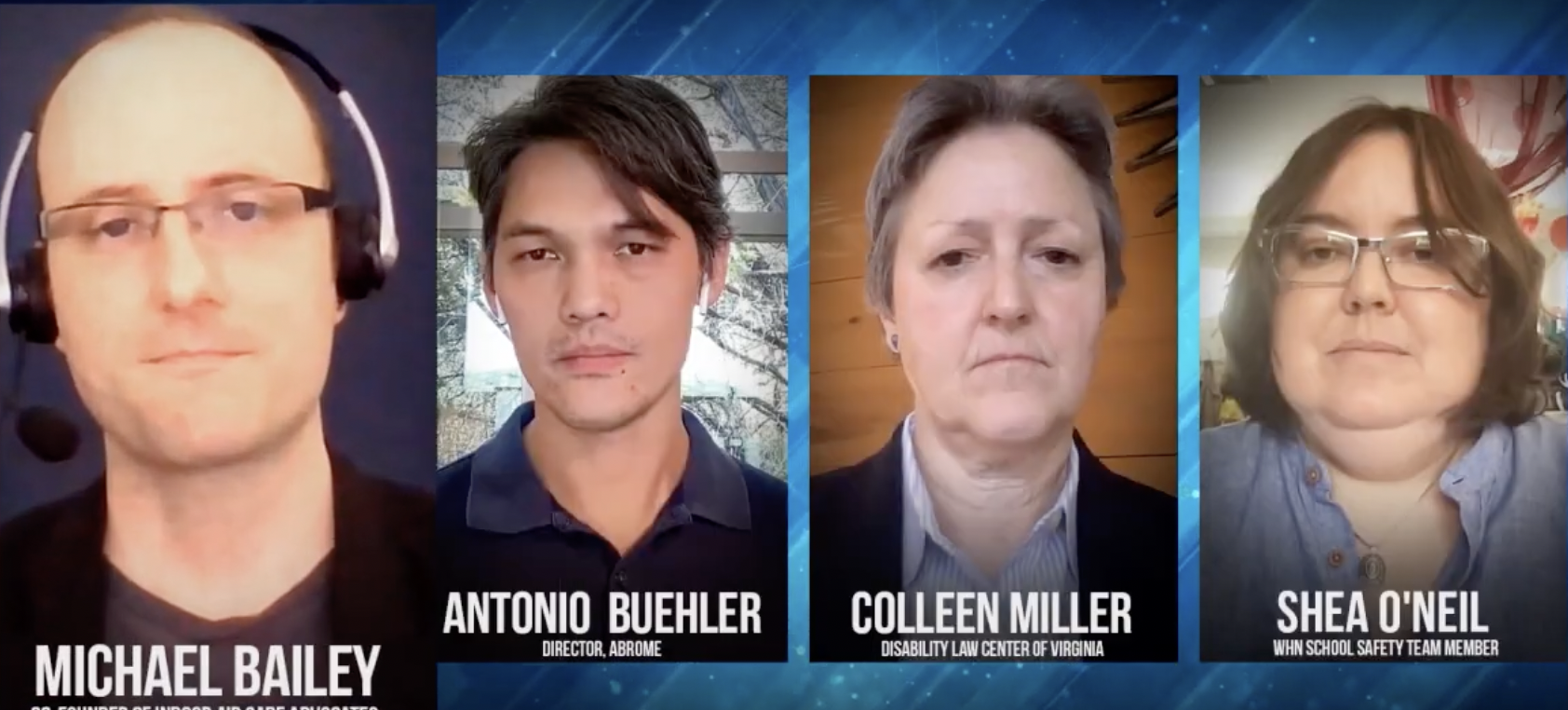
 The World Health Network has a 30 minute video out about Safe Schools with a small panel of people looking at how to make schools DavosSafe!

Michael Bailey, co-founder of Indoor Air Care Advocates, talked about ventilation and filtration. They published a parent advocacy guide to help parents advocate for clean air in schools. Their plan includes:

  • air quality plan that includes monitoring CO2
  • improving and quantifying ventilation (quantifying is most important)
  • portable HEPA or CR boxes to get 6-12 air changes per hour (ACH)
  • operating HVAC fans with Merv 13 or better
  • avoiding any tech that's not recommended, like ionization and foggers
If schools make promises, watch out for "to the extent possible" because that needs to be challenged. If we do all these things, then we can reduce exposure by 80% or better, so we still need N95s and testing. If parents get dubious responses from school, we can send CO2 monitors to classes with students to help characterize ventilation to refute outrageous claims. For example, one father was told the classroom has 10-12 ACH, but his kid's CO2 monitor showed closer to 4ACH, and then the open record request confirmed the lower air change rate. We have ways of getting solid information. 

Monday, February 6, 2023

Dating for Dogs

Lots of people discredit the Myers-Briggs as just a horoscope, but it's significantly different and can be useful in recognizing that we're all innately different kinds of people. This awareness can help us get along in this world and maybe even find love, or at least a better roommate.

Our Tendency to Notice Differences by Type

Dividing people into types based on intrinsic tendencies has been around for millennia, born of scrutinized observations of human nature. Ayurvedic Doshas were recorded about 3,000 years ago identifying people who are Vata (energetic but scattered), Pitta (systematic and ambitious, but dogmatic), or Kapha (methodical but slow moving). The four humours came around 500 years later with
Alcmaeon of Croton to differentiate those who tend to be sanguine (enthusiastic, active, social), phlegmatic (reserved, intellectual, solitary), choleric (ambitious, decisive, short-tempered), or melancholic (depressive, cold, dry). If you think of those categories long enough, you can easily find yourself playing a game of slotting your friends and family under each term.

Then Jung wrote Psychological Types in 1921, outlining opposing traits along three continuums: extraverted/introverted, sensing/intuitive, and thinking/feeling. (That last one might be better updated to task-oriented/people-oriented.) Although it produces only nine specific types, the continuum set-up provides infinite possibilities within each set of letters. It's similar to being mainly melancholic with a touch of sanguine, or having a primary and secondary dosha. Jung explains his stance on innate personality:

Sunday, February 5, 2023

The Times They are A-Changin'

Doing another degree has been eye opening to see how much university has changed over the past 20 years since my last Masters. TL;DR: It's a lot more like high school! I'm doing it at the same time as my youngest is in first year (at the same university even!), so I'm able to see the differences in undergrad programs as well. 

First of all - attendance counts!! In all the uni courses I took between 1986 and 1999, attendance was never taken. Now it's worth 10% of the grade in my courses and my daughter's. I hate this change for a few reasons. Pedagogically, a student's presence in the classroom isn't an accurate tool for assessment. I can show up every day and be stealthily listening to a podcast, or never come but do a thorough read of the textbook and understand the content perfectly. The professor is there to explain the concepts, and some courses require less explanation for some students. I like being able to assess my own needs to be in class. In first year psych, I went to the first class, then just showed up to the midterm and exam when I realized we're just following along with the text. What I absolutely loved about going to university was being given the freedom to make choices -- and make some mistakes. 

I took a history of feminism course once, got perfect on the midterm without effort, so stopped going to class or reading the text and, of course, totally bombed the final. I didn't know how much I didn't know! But I needed to learn that lesson on being too cocky for my own good! The more that people are saved from themselves, the fewer chances they have to learn how they learn. 

And... Covid. If attendance is worth 10%, then people show up when they're sick, and then other people get sick. That's just dumb.  

Monday, January 30, 2023

What Went Wrong? Hubris.

Mario Possamai, senior advisor for the SARS commission, was interviewed in an hour-long video from ISPR Respiratory Protection back in July 2022. Here's a summary of his talk with some of his slides:

He started comparing reactions to SARS. Back in 2003, a single patient with SARS walked in to Vancouver General Hospital about the same time as a patient walked into Toronto General. But the effects of this were dramatically different. One was fully contained, the other started a spread that led to dozens of deaths.

What was the difference? Vancouver General Hospital worked together better and listened to patients and front-line staff more.  

Saturday, January 28, 2023

It's a Social Problem, not a Medical Problem

Carol Dumaine wrote about the Davos safety measures, and how the rest of us are playing Covid roulette. It's a solid read, but I got totally sidetracked by one of the links she provides: "Infection of Society," by Antoine Danchin, published in EMBO Reports back in April 2003 - almost exactly 20 years ago. 

He talks about a common psychological occurrence: we are affected by huge sudden events far more significantly than by regular daily events. We care more about lives lost in a tsunami than in traffic, for instance, even though car collision fatalities number much higher. We begin to tolerate a certain level of vehicular carnage because we get used to it. But then he gets into how diseases have evolved to exploit ever growing weakness in our defences, most recently, 

"a societal shift such that we value the individual more than the community, which creates the new weaknesses that bacteria and viruses can exploit. In fact, there is a strong connection between diseases and society, and if we do not recognize this link, we will forever have new and increasingly virulent disease to face. Since antibiotics were discovered just over half a century ago, we have suddenly, in the course of only one generation, forgotten the terrible burden that infectious diseases present--at least those of us who are lucky enough to live in the developed world. But this sense of security is an illusion."

We have another avian flu sweeping the world right now, and Danchin explains that,

"the only effective prevention--establishing a controlled slaughtering system, and prohibiting the sale of live chickens at the markets in Hong King--cannot be implemented, simply because people traditionally like to eat freshly killed chicken. This shows vividly that it is impossible to separate infectious disease from our lifestyle or from the structure of our societies, and above all, from venal considerations. Our infections mirror our primary interests, and our way of life." 

He laments the number of parents no longer vaccinating their children 20 years ago, and warns,

"The threat of an epidemic of a disease that would certainly affect their unvaccinated children seem to be too far removed from these well-meaning parents to be taken seriously. The question of what is a tolerable level of infection, alas, is improperly asked. It is not a medical problem, but a social one, and thus asks for political intervention--in its noble meaning--as a consequence."

His solution:

"We have to teach our societies to reconsider our values--it is not the purse that is important, it is lives. We need to trap our societies with their own defects: nothing will happen without financial or economic pressure. . . . The Black Death stopped being a scourge when, after the implementation of sanitary cordons, soldiers had orders to fire on 'rich' people trying to cross the cordon. Using corruption, the rich were able to cross these lines and propagated the disease much more efficiently than rats ever did. We have not learned since. . . . The general consequence of the inertia created by venal interests and the existing strata in society is that rules are badly needed for the collective good. If we do not react fast enough, if we are not able to recreate the much needed sense of fraternity--and we are all equal when it comes to disease and death--then the microbes that we thought we had controlled will haunt us again. Unfortunately, a large number of deaths will probably be the price we have to pay to understand, finally, that true democracy is not representing the freedom of the individual, but that of the City."

Such incredibly prescient words. Such a shame we didn't listen.

Elsewhere today an actuary responded to the question, When will we stop studying the Covid pandemic? He said,

"I remember reading a few years ago a paper published in 2006, and and that paper was called, "Is the 1918-19 Flu Pandemic Finally Over," and essentially what was being recognized and acknowledged and the theory that the author was putting forward is that the generation of people who were young adults when the 1918-19 flu pandemic hit, tragically, had a decades-long elevated risk from cardiovascular causes which stayed with them for the rest of their lives. So it's only now, nearly 100 years later, that that generation are all no longer with us, and we can say that the flu pandemic's behind us. I'm expecting actuaries to be worrying about the long-term impacts of Covid for many decades."

So, only 97 years left, then! Maybe we'll have recognized the vital importance of the collective by then.

What Does Compassion in Education Look LIke?

Since the pandemic started, educators have been asked to use a "trauma-informed" approach to their teaching, i.e. pay attention to the psychological safety of their students. Some of the literature on this looks pretty good: build connections through empathy, be consistent and predictable in the classroom, be flexible to accommodate different needs, delight in students by finding the best in them, and co-regulate by sharing your calmness with others. But, in practice, it fell apart a bit.

In my own experience, I was made to be flexible at the expense of consistency and predictability in a way that overrode our guiding documents. And, I'd argue, in a way that wasn't compassionate. 

I practiced a trauma-informed approach long before it was called that, providing clear expectations but with many alternatives for people to choose. Before my classes start, I'd email a survey of questions to students asking if they'd have any concerns with general rules and deadlines, and where they'd prefer to sit in the room, what would make them most comfortable, what they like to be called, etc., so that when they walked into the room on the first day, they knew exactly what to expect and they had already had some say in what the room looked like. These are grade 12s, many over 18. With Covid, I added more questions about what would make them feel safe, and I asked if having windows open 1/2" would be okay to add some ventilation to the room. 

Then, once in the room, I again asked if people were comfortable where they were sitting and if it wasn't too cold. Everyone was fine. Except somebody wasn't, but they likely didn't want to be the odd one out in the class, so texted dad, who called admin, who marched down to my class immediately to tell me, "Kids can't learn if they're cold!" And the students learned a valuable lesson that day: Get dad to call admin, and you can make anything happen right before your eyes! 

We talked about what to do if you have a conflict with a person, that it's always best to start with to the offending person directly, and then go higher up if you feel like you're not being heard or not being treated fairly. "Resolving" a conflict doesn't always mean getting what you want, though. We have to measure out what we want, what others want, and if anyone needs something to happen differently to figure out what's fair. I asked them, What will you do in a few months, if you have a concern about a class in university? 

Get my dad to call the university. 

I shocked them by letting them know that university profs and administrators won't talk to their parents. 

Friday, January 27, 2023

OPSBA Conference in the Time of Covid

I'm missing my first trustee conference this weekend because there are no Covid mitigations in effect. I called to ask about it, and they're following the Ontario protocol, which is basically nothing. It's a full weekend at a hotel eating together, and I suspect that very few will be masked. Meeting people of a similar bent, being able to discuss the benefits and pitfalls of taking on this role, and being recharged by one another is something I normally relish. But it's not safe enough for me. They also decided not to livestream because it would be too costly, so I'll just hear about it second-hand. But Dr. Nili Kaplan-Myrth went and responded to a speaker with this concern about Covid. (I have no idea what the general topic was or what was said just prior to elicit this, and this is tidied up a bit from the recording at the link): 

Wednesday, January 25, 2023

On Argumentation and Straddling the Middle

At the school board meeting Monday night (video here, starting at 1:23:50 for over an hour), an open letter the board recently sent out was discussed. I said nothing because everything had already been said by everyone, and I didn't think it necessary to just be one more to add my thanks. The letter is well-written, clear, and well-supported with links to all necessary documentation. Last night, our director, associate director, and many trustees gave beautiful speeches about inclusivity, and I was happy that the board took such a strong and decisive stance on the issue. 

Thursday, January 19, 2023

Leading by Example or What's Good for the Goose...

This is about the Davos World Economic Forum, ending tomorrow. Social media is all atwitter with the incredible precautions they pulled off. Check out their rules here. It's three pages (!!!) of Covid rules and mitigations. Some highlights here:

"To create a safe environment at the Annual Meeting 2023, the Forum is working with the world's leading health experts and virologists. . . . The Forum strongly recommends that participants are vaccinated with the latest available vaccines and take a COVID-19 test before travelling to Davos. Participants are required to get tested in one of the Forum testing centres after arriving . . . with a PCR test. . . . If you fail to conduct a test, your badge will automatically be deactivated. . . . . Masks and disinfectants will be available throughout. . . . State-of-the-art ventilation systems have been installed"

And their masks are FFP2, similar to our N95s. They're not fooling around! On top of the PCR test, "Rapid antigen tests will be available free of charge . . . If you do not feel well, please take a self-tests."

Saturday, January 14, 2023

Unmasked People, Unmasked in Their Own Way

I think masks separate us like the families in Tolstoy's famous opening line of Anna Karenina. You know the one: "Happy families are all alike; every unhappy family is unhappy in its own way." Everyone I've met who wears a mask does it for more or less the same reasons: to protect themselves and others from a virus. But there appears to be a wide variety of reasons people won't wear a mask. 

NOTE: When I say masks, I mean NIOSH certified N95s or better - aka respirators. They do signficantly stop the spread of viruses.

I posted on twitter that I was starting to understand some concerns some people have raised about masks and that I think we need a new approach to get more people on board, and I was hit with an onslaught of comments along the line of, "They're playing you," and "I just can't bring myself to care at all about anti-maskers." I think this view is propagated because people against masks who are loudest on social media tend to be of a similar ilk: It's the pro-freedom, anti-everything group that bombards our posts, so they might colour the way mask advocates see anyone unmasked. But I've discovered there are others out there that don't fit the mold. And, if we want to get everyone in masks, then we have to care about anti-maskers enough to try to understand their position and bridge the divide. Instead, people got mad that I could have some compassion for them. 

It doesn't help anyone to lump them all together as sneaky and uncaring. I've argued before that anyone who is able to mask but won't is either misunderstanding the science and doesn't know they present a risk to others (which is totally on public health and our inept/corrupt premier), or they don't care they present a risk (sometimes, in part, because they don't know how serious the risk is, which is again on public health and our inept/corrupt premier). I still think those two different groups exist, but now, after getting tons of emails on masks as a trustee, I recognize there is huge diversity within each category. 

And I think I missed a category.

Thursday, January 5, 2023

We Need to Talk about Kraken (XBB.1.5)


I watched this livestream tonight:  an interview and Q&A with Dr. Eric Feigl-Ding (EFD), an U.S. epidemiologist who broke the news that the CDC knew XBB.1.5. was a variant of concern but didn't tell us and Dr. David Berger (DB), an emergency physician in Australia. Here are the main points as I heard them, a bit summarized to take out repetitive bits, and somewhere between quoted and loosely paraphrased. I bolded the bits I liked. Dr. Berger gives particularly good soundbites. You can watch the whole thing here
EFD: XBB is from Singapore, but XBB.1.5 is lightyears apart. It started in October in New England, Connecticut, New Jersey, Massachusetts, and New York. They are the same areas hit at the very beginning. This is a U.S. variant, from the northeast part of the U.S. I wasn't the first to track it, but posted and disclosed the unreported memo from the CDC. They are supposed to report if a new variant reaches over 1%. This blew up in October with BQ not being reported fast enough. XBB.1.5 was unreported until it hit 40%, so the CDC knew for weeks prior. This is unprecedented except for the original Omicron. There are lots of variants out there, but this one is highly immune evasive and and highly invasive in human cells. 

DB: XBB.1.5 has a high affinity for (likes to stick to) ACE2 receptors found on cells throughout the body. It's used to get into the cell, so it's easy to transmit it, and it may cause greater severity through dramatic growth in the cells. There could be very significant breakthroughs. Most important is that if we weren't discussing this one, we'd be discussing another in a few months the same way. We've encouraged unrestrained replication of this virus in a partially immune population - the ideal way to create mutants that will escape immunity, and here we are.