Monday, April 12, 2021

Michael Sandel's Tyranny of Merit: What's Become of the Common Good?

This excellent read, The Tyranny of Merit, by Harvard philosophy professor Michael Sandel, actually shifted some of my thinking, and I love a good lightbulb moment provoked by a book! I found the book sometimes a little outside my reach in places enough to need to read a few chapters numerous times, but I think I've got the gist of it all.  

In a nutshell, some of us hope that judging people based on their merit makes for a more fair and just system, and the education system can be used as a sorting machine. The promotion of merit and of the sorting tools we use to determine who deserves to rise to the top are seen as part of an open system of global thinking. Rejecting that position, then, it is believed, is clearly aligned with closed-minded thinking, BUT this is all a ruse brought to you by neoliberal politics. It's born of the illusion that we can create a level playing field of equal opportunity, which is a commonly touted argument. Less common, however, is Sandel's captivating argument around what it means to deserve anything and his claim that, even if we could have perfect equality of opportunity, a meritocracy brings with it some nasty side effects: "It would generate hubris and anxiety among the winners and humiliation and resentment among the losers--attitudes at odds with human flourishing and corrosive to the common good" (120). He ends with some plausible but difficult alternatives to our current way of thinking--in education, work, and through contributive justice--which require an entire overhaul of thinking reminiscent of Charles Taylor's notion of social imaginaries: we have to change our beliefs before we'll ever be able to change our behaviours.


MERITOCRACY CAN'T BE REALIZED 

We can't get a fully realized meritocracy. The term was first coined just in 1958 in a dystopian novel; it wasn't originally meant to be seen as a solution or a term of praise. Then in the 80s, Reagan created the belief that "market mechanisms are the primary instruments for achieving the public good" (21) and deregulated banks and businesses under the belief that, "Provided they operate within a fair system of equal opportunity, markets give people what they deserve" (62). Since, in theory, everyone can compete equally (the rhetoric of rising), government helped out by lowering taxes to remove barriers to success, which then provoked a dramatic rise in tuition fees. We tolerate inequalities because of the American Dream that suggests we can't win without some losers beneath us: Everything we do is fair and just provided people worthy have equal opportunities to access higher education; however, governing elites have the "responsibility for creating the conditions that have eroded the dignity of work and left many feeing disrespected and disempowered. . . . upheavals we are witnessing are a political response to a political failure of historic proportions" (19). We're starting to see the light. 

Monday, April 5, 2021

Interview with the Guelph Back-Grounder: On Teaching Critical Thinking

In early February, just before immersing myself into the current quad of online teaching, a friend of a friend interviewed me for a local independent journal. I thought it would be all about teaching during a pandemic, but together we meandering through a diverse chain of topics for about 90 minutes, which he cut into parts and posted in 5 segments, so far. I'm not sure if there are more. 

I haven't gone back to listen to any of the clips and won't have a chance soon (because I'm nearing the most hectic ending of this insane quad), but there were definitely times during that lengthy conversation that I felt like I completely contradicted something I had said 30 minutes earlier, so that's entirely a possibility! And, of course, other times that I forgot the names of things. I'm hoping I just remember more of the flubs than any potential nuggets of gold! 

Here are the five nine parts:

1. Can People be Taught to Think Critically?

2. Gullibility and the Velocity of Communications

3. Dialectics vs Debate and Ethical Reasoning

4. Conservative vs Liberal Bias

5. Competition in Schools

6. Groupwork Dynamics

7. Developing Community in the Digital Age 

8. Community Pushback

9. Sortition

Thanks to the Cloudwalking Owl for such a delightful chat! It's always nice to talk with someone when you each recognize otherwise obscure references being made. 

Saturday, April 3, 2021

World Autism Day

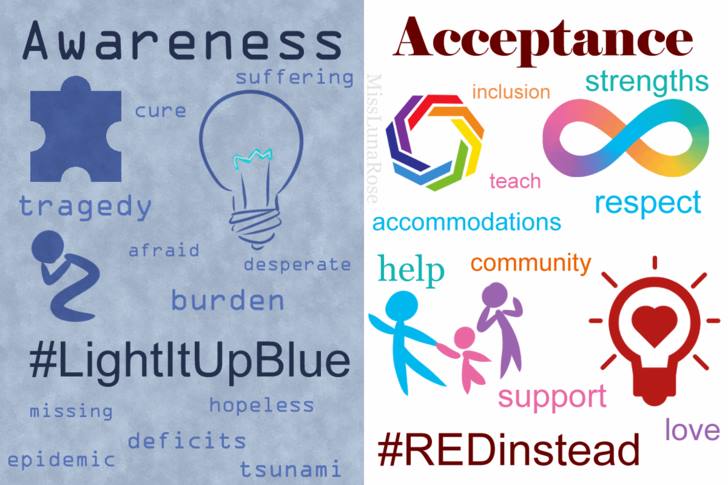
I've come up for air from this crazy year of teaching for World Autism Day - and I'm a day late. Many autistic people find April an awkward time because much of the messaging around autism comes from non-autistics. Miss Luna Rose made this great graphic to illustrate some of the concerns with the Autism Speaks organization's campaign to have everyone in blue for the month:

The #REDinstead goes back to 2015 with Alanna Rose Whitney's #WalkInRed alternative. It was Judy Singer who coined the term "neurodiversity" as well as creating the infinity loop way back in her sociology thesis paper in 1996. These are preferred by the autistic community, and that's what should matter.

Monday, January 25, 2021

Stop the Lucrative Cruelty in Yemen

There was an online rally with some impressive speeches about the war on Yemen today, what Yanis Varoufakis referred as a form of "lucrative cruelty." Here's the full video, and below are some of the words I found most impactful.

Biden was front and center when the US got involved in 2015 as the US war machine aided a unilateral attack on Yemen led by Saudi Arabia and UAE with American military support. Trump made it all much worse, but Biden is back with promises to stop it. (A good run-down of the beginning is here by Al-Adeimi.) "Biden needs to stop the logistical, intelligence, and military support to Saudis and lift the blockade so food and medical services can enter Yemen" (Ro Khanna). 

A third of bombing missions strike hit non-military targets, and 9.5 million children have no access to water, food, or basic sanitation (Finucane).

Ahmed Al-Babati, a soldier who was arrested for protesting the war, said we "must sacrifice our comfort for others' survival."

Cornel West gave an impassioned speech linking the police murders in the US with Wall Street crime and the Pentagon militarism. "It doesn't matter the color or gender of the President or Vice President. The poor, the workers, the hungry, must be the center of their focus."

Esa Mighty followed that with some spoken word that is worth hearing at 27 minutes in. 

Daniele Obono: "It's complicated, but not inevitable. These are the fruits of political choices. Don't complicate what is simple. 250,000 are dead. 80% are living in poverty. Two-thirds depend on aid."

Shireen Al-Adeimi: "In Canada, we need to stop arms manufacturing in London, Ontario [GM Defense]. In the U.S., Biden must lift the blockades. Every ten minutes a child under five is starved to death."

Jeremy Corbyn ended it: "$90 billion of arms have been sold to Saudi Arabia, and even more to neighbouring countries. We must act to stop the supply. In the U.S. Senate, Sanders helped passed the War Powers Resolution. In Britain, the government refused to act, but a lawsuit suspended sales temporarily. But the War Powers Act is not enough. It means that parliament can decide IF we go to war. Profits are being made from the killing of children. . . . We need a global movement with the confidence of a vision of a world without conflict. The U.S. can afford anything except levels of inequality that exist. . . . No child's life should be ended by bombs raining down on them from worldwide companies."

Thursday, January 14, 2021

Freedom at Any Cost

I believe it's not a coincidence that the UK, US, and much of Canada - the trio that promoted neoliberal free market politics - are not doing enough to restrict the spread of Covid. The rightwing in our countries (and some centre and left players) still act on the dogmatic ideology of freedom at ANY cost, so they're loathe to restrict hours of business. And God forbid they affect profits.

Reading George Monbiot's Guardian article today has strong parallels with a review of Timothy Snyder's latest book, Our Malady, about American healthcare system. And they could both be talking about Ford's treatment of Ontario.

Monbiot on Johnson:

"Here's the chilling, remarkable thing that should be inscribed on everyone's minds: there is no plan. . . . A government with any level of competence would have explained from the outset where we need to be before it lifts this lockdown. It might have stated what the R number should be. . . . It would have committed not to end the lockdown until such conditions have been met. . . . Without a plan, we are likely to remain trapped in a perpetual cycle of emergency followed by suppression. . . . From the outset, the government has tried to persuade us that there's a trade-off between protecting public health and protecting our social and economic lives. But there is no trade-off. . . . Every week brings a new scandal, as the government shows a generosity towards profit-seeking corporations that's not extended to the rest of the population. . . . But if you get the system right, you free the nation from both uncontrolled disease and lockdowns. This is the lesson from Taiwan. . . . The government could have used the first two lockdowns and the school holidays to carry out an emergency refurbishment programme in schools, fitting them with ventilation . . . Astonishingly, it did nothing."

Saturday, January 2, 2021

Painting for Community

 I did these fun little puzzle pieces as part of a local community initiative, "Belonging Together," with the aim of an ever-expanding mural from people across the region. I based all mine on photos from my neighbourhood. It's likely the last creative thing I'll do for fun before diving into online teaching. 

Gertz's Nihilism

A year after coming out with Nihilism and Technology, Dr. Nolen Gertz wrote just plain Nihilism, an "examination of the meaning of meaninglessness: why it matters that nothing matters." It's a really short book, but it took a while to wade through it all. Here it all is even more briefly assembled with my own understanding here and there.

We typically think of nihilism as very simply meaning, "we believe in nothing" (4), but he counters that from the start with the polar opposite definition of Russian nihilism via Wendell Phillips in 1881: "the righteous and honorable resistance of a people crushed under an iron rule . . . the last weapon of victims choked and manacled beyond all other resistance" (2),  and then takes us through Western philosophy to get to a view that, "Nihilism is about evading reality rather than confronting it, about believing in other worlds rather than accepting this one, and about trying to make ourselves feel powerful rather than admitting our own weaknesses" (73).


SOME HISTORY

I didn't love this epistemology section, but the book picks up speed afterwards. 

First, on Socrates, Descartes, and Hume and nihilism via our inability to know stuff: Anti-nihilists "inspire others to question and ultimately reject the foundations of their beliefs" (21). Socrates (a social reformer) provoked people to question everything. Then Descartes (a self-reformer) warned that can lead to "inextricable darkness" (21). "For Descartes we embrace illusions because our reach exceeds our grasp, because our desire to know (the will) exceeds our power to know (the intellect)" (22). Then he gets to Hume's fork: For Hume, we can only know things we experience directly and things that are true by definition, and, Hume famously said, all else must be committed to the flames, so  "supporting an idea may not be so different from supporting a sports team" (25). Gertz's conclusion so far: "From a Socratic perspective, nihilism can be overcome by enlightenment. From a Cartesian perspective, nihilism can be overcome by self-restraint. But from a Humean perspective, nihilism cannot be overcome. It is simply a product of human psychology" (28). 

Thursday, December 31, 2020

2020 Year in Review: Teaching Under the Banner of Covid

 Dr. Jennifer Kwan put out a call on Twitter for messages we wished to have sent ourselves a year ago. Then she added, 

Many wise people were prescient but unheard. And it's still happening. We have lots of excellent information to steer us in the right direction, but the powers that be keep ignoring it for their own benefit. I hope Ford is just an idiot and not actually genocidal, but the evidence so far could go either way. Apparently, in some places, vaccines are expiring before they could be administered. Nice. 

So here's what I screamed into the void this year: 

Hedges on American Psychosis

 Chris Hedges just put out a short video about American Psychosis, in which he explains,

We have blissfully checked out. Most people have no concept of how fragile their environment is. . . .  There's an emotional incapacity to understand collapse, even when it's facing you. I have covered, as a foreign correspondent, totalitarian cultures, so I know how totalitarian systems work. I know the dark emotions they evoke.  I know the mechanisms they use to shut down dissent. And, when I came back, it was utterly apparent that the country ha gone collectively insane in a very frightening way. . . . 

The critique will be that you're such a pessimist, that you're such a cynic, that you're not an optimist. Optimism becomes a kind of disease. It's what created the financial meltdown where you have this kind of cheerful optimism in the face of utter catastrophe, and you plow forward based on an optimism that is no longer rooted in reality. If hope becomes something you express through illusion, then it's not hope; it's fantasy

Wednesday, December 30, 2020

On Cuties, Euphoria, and Promising Young Woman

My social media feed is full of political scandals that I have no ability to affect, so I've immersed myself in movies and shows. Bechdel test for the win for this trio!

Film both reflects and affects society, like all forms of art but even more than most as it's a visual, auditory, and narrative medium. We sometimes see ourselves in the movies more clearly than in novels or paintings or songs. It's this reflection in the film Cuties, I suspect, that got thousands of people riled up enough to cancel their Netflix subscriptions and garner it an embarrassing 3.1/10 on IMDb. But beyond Netflix's many second rate sequels and unwatchable remakes, I'd argue that Cuties is one of the better films on the current marquee. 

Cuties is about an 11-year-old girl, Amy, who's new to town and trying to fit in with the cool kids. She's successful because she takes their competitive dance moves to the next level with sexy additions that she's seen online. Those dance scenes are what's driving the outrage, but it's the most realistic part of the film (which steps into the surreal from time to time). Kids are made to imitate what they see, and this is what's out there for real. 

Saturday, December 26, 2020

Ten Climate Change Items That Need Wider Reporting

Out of the frying pan, into the fire. A vaccine is here, hooray! But now let's actually take a good hard look at climate change mitigation.

This is from a thread of threads on Twitter by climate activist Ben See (9 min video from a year ago). We can't prevent a catastrophe because it's already started the tipping points. But we can slow some systems down IFF we can create a new global system that is focused on immediately getting GHGs down to zero. We're going to get some massive crop failures really soon otherwise. It's important to tell everyone, including children, the truth about the world. "One of the best ways to feel okay about this difficult moment in history is to actually take action and talk about it!"

See outlined a 10-point plan in need of reporting below. This is quoted entirely from his recent maze of posts, which is clearly cited throughout. In a nutshell, "Once the ice is gone, the Arctic Ocean will absorb more heat from the atmosphere, which will only make our climate predicament worse." . . .  Tropical Rainforests look increasingly unlikely to avoid collapse in the coming decades. . . . Food systems account for 37% of greenhouse-gas emissions. We must rethink destructive agriculture immediately. . . . Climate scientists expect 2.5- 3.5°C or even more by the 2090s (which would wipe out most species and likely put an end to organised human society. Over half of all species on the planet (which humans of course rely on for survival) will be wiped out by the 2060s without emergency action. . . . Tropics, subtropics and elsewhere will soon be hotter than the hottest heat waves of the past century, with many regions no longer able to support agriculture. . . . The world’s seed-bearing plants have been disappearing at a rate up to 500 times higher than would be expected as a result of natural forces alone. . . .  Deadly climate change heat waves will hit billions of people by the 2030s or 2040s (some literally unsurvivable without air conditioning) obliterating entire ecosystems and wiping out species. . . . This has been described as a death sentence for African countries. . . . Sea level rise is already causing havoc for some and will rapidly get worse.  

"Whatever else is happening in the world, is just chess pieces on a board compared to the effect of climate change."

Friday, December 25, 2020

Unforeseen Custody Issues: Who Could Have Predicted THIS?

I'm generally a worrier. If my kids don't text back after a few minutes, all sorts of images bombard my brain. Sometimes they don't text back for hours, and it always ends up being because they were sleeping or - back in the good old days - at a movie theatre with their phone actually off! So there's the voice that says, "They're dead in a ditch," but that's always being countered by the voice that says, "Don't be silly. This happens all the time, and it's always nothing!"  

But now Covid has ramped up that negative self-talk to 11.

I was finally able to relax a bit knowing that high schools are online only for three full weeks after the break. Just one week in the building, and then I expect to be teaching distance learning for the rest of the year! But then Christmas brought its own obstacles.

Saturday, December 19, 2020

Hannah Arendt in Lego

 @EthicsInBricks posted this lovely tribute to Hannah Arendt on Twitter last October, in honour of her date of birth, October 14, 1906, and I want to save it in the month of her death 45 years ago, so here's the thread all nicely cited and EIB's quotations in bold:


Sunday, December 13, 2020

How Is Hybrid Teaching Going?? It's Complicated.

We've recently been told that next semester, starting in February, will operate the same way as this semester did: running quadmester terms with in-school students attached to each school in a hybrid model with a rotation of half at home and half in the classroom, and online students being taught through the board office, completely unattached to any school. After calling each parent to update them on midterm student progress, a new task that took me about four hours to complete, it has become clear that the general public still doesn't understand what any of this means or the implications of it all. So let's break it down:

Hybrid System:

We teach students in the room as well as students at home, at the same time. I started with two laptops, one to teach from and one as a monitor to be able to read the chat happening as a backchannel during the lessons and discussions. Some would raise their hands in front of me, and others would raise their hand in on the meet, so I had to watch everything at once. I also wore a mic to be heard above my mask, and had the meet attached to speakers so kids in the room could hear people at home, but then I had to remember to turn off my volume whenever someone in the room spoke on the meet or it would reverb like crazy. I needed another half a brain to manage all the buttons. So, just last week, I started teaching only through the meet, without a mic or speakers or second laptop. Now I sit at my desk and just focus on the entire class over the meet regardless who is in the room. It honestly feels a bit ignorant to barely make eye contact with people in front of me, but I just can't do it the other way - it's too much for my brain to manage and be on my toes to answer questions about the curriculum. When I see how poorly others manage tech during meetings, I feel like I made the right call on that one!


Quadmester Schedule:

A quadmester schedule means two courses over 9 weeks with two full weeks of one class,  5 hours/day (basically one day = a former week of lessons), followed by two weeks of the other class, then the first class for 12 school days and then the second for 12 school days, which ensures we meet the provincial target of (22 days x 5 hours/day) 110 instructional hours/course. Got it? At the end of every day, I'm blown away by how exhausted I am. If I sit on the couch for a second, I'm out like a light.

Sunday, December 6, 2020

Mental Illness in Covid Times

For me to stop teaching in a physical classroom, because I don't feel safe in there, I need a note from my doctor indicating that I have a mental illness that prevents me from working and then take a sick leave. It can't just be a note that says I can't work in the building, that I have a situational anxiety that prevents me from working in an unsafe space; it has to be a note that says that my illness is so debilitating that I can't work at all. It was made clear to me that that's how anxiety works: Either you don't have it and you can work, or you do have it and you can't. Period.

Except that's not how anxiety works at all.  

Anxiety can get triggered by specific aspects of a situation. Someone might be unable to write a test in a room full of people but be completely fine to write it in a room alone with the teacher. Some people can't present in front of 30 people they don't know, but can really excel in front of a choice of three friends to bring along as their audience at lunch time. Teachers have been accommodating students with anxiety like this for years. Just IMAGINE if we told students with anxiety that if they really have it, then they have to take a leave from school, that it's impossible for them to do any work in any other way. 

Saturday, December 5, 2020

If It's Not One Thing, It's Another

I had a very sick kid here on the night before the last day of the last quadmester. My little one felt shaky and dizzy and came downstairs to get the pulse oximeter because they felt so faint. They promptly barfed in the kitchen sink. Of course it was full of dishes. After they slumped to the floor, I gave them a bowl to clutch and slid them away from the cupboards. Then I donned PPE and cleaned the sink and dishes and everything with bleach. 

Saturday, October 24, 2020

On Critical Race Theory

Conservative British MP, Kemi Badenoch, insisted that Critical Race Theory is somehow illegal, so I'm just going to save this rebuttal here: 

This is a Twitter thread from Kojo Koram - @KojoKoram - professor of law Birkbeck: 

"A thread on the new bogeyman of “critical race theory”: Kemi Badenoch. Watching dim-witted Tory junior ministers try to get their heads around the works of Derrick Bell, Patricia Williams and some of the most-decorated legal scholars of the last 50 years would be funny if this wasn’t so serious. Clearly, Google has told them that critical race theory is just people shouting about “white privilege” etc so here is an idiot’s guide to CRT to help: CRT emerged out of Harvard law in the 80’s in an attempt to explain the contradictions between the legal equality achieved through the civil rights struggle and the ongoing visible difference in the impact of the law across racial groups. This is the heart of CRT. Pretty simple isn’t it. There are certainly critiques that can be made of the tradition (I see it as having become too detached from political economy, for one) but to pretend it is a dangerous, illegitimate sphere of academic inquiry is just pathetic. 
CRT started with the material reality. Look at your cities. Look at your prisons. If law is blind, why does property law, criminal law etc seem to punish some groups more than others? You don’t care about this, fine, good for you. But you also want to stop others from caring? The same people who would defend the right of Charles Murray to talk about how Black people have lower IQ’s on the grounds of free speech are now cheering a government banning teachers trying to explain the difference between legal equality and material inequality. In the UK, Black people are stopped + searched nearly 10x white people. 40% of young people in custody are BME. If your explanation for this is anything other than ‘Blacks are just naturally/culturally more criminal’… then congratulations, you have just started doing CRT!"

Michael Sandel's Tyranny of Merit

I haven't yet read his newest book,(ETA - read it and discussed here) but Michael Sandel is everywhere these days promoting his new book. An excerpt from a Guardian interview:

Sandel charts the rise of what he sees as a corrosive leftwing individualism: “The solution to problems of globalisation and inequality – and we heard this on both sides of the Atlantic – was that those who work hard and play by the rules should be able to rise as far as their effort and talents will take them. This is what I call in the book the ‘rhetoric of rising’. It became an article of faith, a seemingly uncontroversial trope. We will make a truly level playing field, it was said by the centre-left, so that everyone has an equal chance. And if we do, and so far as we do, then those who rise by dint of effort, talent, hard work will deserve their place, will have earned it.” The recommended way to “rise” has been to get a higher education. . . . 
Sandel has two fundamental objections to this approach. First, and most obvious, the fabled “level playing field” remains a chimera. Although he says more and more of his own Harvard students are now convinced that their success is a result of their own effort, two-thirds of them come from the top fifth of the income scale. . . . "Americans born to poor parents tend to stay poor as adults.” . . . [Secondy,] even a perfect meritocracy would be a bad thing. “The book tries to show that there is a dark side, a demoralising side to that,” he says. “The implication is that those who do not rise will have no one to blame but themselves.” Centre-left elites abandoned old class loyalties and took on a new role as moralising life-coaches, dedicated to helping working-class individuals shape up to a world in which they were on their own. “On globalisation,” says Sandel, “these parties said the choice was no longer between left and right, but between ‘open’ and ‘closed’. Open meant free flow of capital, goods and people across borders.” Not only was this state of affairs seen as irreversible, it was also presented as laudable. “To object in any way to that was to be closed-minded, prejudiced and hostile to cosmopolitan identities.” . . . 

Friday, October 16, 2020

Imagine If Teachers Made the Decisions that Impact Teachers

So now the government has overruled regulation 274. I wrote about it ages ago, again firmly planted on the government side!! I'm really very, very pro-union, honestly, but some things just don't make sense to me. At the time, I was watching several LTO teachers in my building who knew the kids well, had developed strong relationships with students and staff, and had shown their excellence in spades, and they were passed over in favour of an unknown that happened to be in that top five in seniority. The LTOs passed over weren't brand new, as is often characterized, but had been supplying for years. It's not always that case that the longest serving are the most qualified or the best choice. And I haven't seen the regulation do anything to dampen nepotism. However, some people have seen the complete opposite effect. BUT that's not my focus here.

Some people think this entire issue is a distraction and are wary that the unions will go to town on it instead of focusing where we need them, on reducing class sizes by fighting to add more teachers or by allowing teachers to work from home. To what extent is all the reg. 274 talk a red herring to get us sidetracked? Lecce suggested that it will make hiring easier, but who's getting hired? Classes are being collapsed in this mess!

And then someone suggested to me that the entire reason we all have to teach online from inside the building isn't because of the board at all, but because of the union: it creates more supply teaching jobs. If teachers are allowed to teach from home, then they'll call in sick far less often, and there will be fewer opportunities for other teachers. I have NO idea if this is fact or fiction. It's pure conjecture at this point. But it does make sense that the union might support that (and therefore not fight it). And, while I completely understand that need for more job opportunities for OTs, having them show up to watch students log in while the teacher teaches from home, using up all their sick days, isn't necessarily giving them the best usable experience. A far better solution would be to split elementary school classes in half and have them "supply" using the teacher's lessons with the other half of the class and let the online teachers teach from home. But that's crazy talk, I know.  

However, my real focus is this: Wouldn't it be absolutely AMAZING if teachers had a say in all these decisions??

Maybe we could!

For the sake of my mental health, instead of marking this afternoon, I watched a talk from the Hannah Arendt Center: Revitalizing Democracy: Sortition, Citizen Power, and Spaces of Freedom. It was well worth it! I think it will show up here eventually (with suggested readings here). 

Monday, October 12, 2020

Does Teaching Effectively Under this System Legitimize Ford's Plan?

What Doug Ford's team is doing right now reminds me of Bojack Horseman, from the end of the first season on, when absolutely everybody just starts saying "Hollywoo" after the 'D' in the big sign goes missing. It becomes the accepted reality. So many are openly just accepting that kids and staff in schools will get sick, but it's not enough of them that we should actually act on the concern. According to their press conference on Friday, kids don't transmit the virus, and they only bring it in to the schools from elsewhere - they don't get it from the school. That was said shortly after the BBC's "Science in Action" reported on a study that concluded, "children more than any other group are transmitting the virus both to other children and adults" and another that pointed to rapid testing as a means to dramatically reduce transmission rates. But we'll just keep acting like it's not happening. 

Williams & Lecce from an early September bit of propaganda h/t @parentaction4ed

Anyway... 

For obvious reason, I'm hyper-focused on schools and the ridiculously ineffective plans being implemented. But, funny story, after a couple of boards suddenly shifted to a hybrid model of teaching (teaching both in class and at home at once) due to the number of parents pulling their kids from physical classes, I ended up on the other side of the argument. My attempts to commiserate and then offer support to affected teachers on Twitter failed dramatically, and I have incurred the wrath of several for, essentially, sleeping with the enemy.