Changing minds on big issues takes a long time and the work never ends.
Anti-drinking and driving groups appeared in the early 1980s, like MADD, typically made up of survivors or relatives of victims who saw first hand that something must be done to prevent so many disabilities and deaths. I was a teenager at the time, and my circle didn't think twice about driving hammered. I remember people saying things like these boring old ladies should get a life and stop telling us when we can and can't drive! We were all pretty sure we could drive just fine after a few. Who are they to tell us otherwise? Breathalizer legislation was on the books in the 60s, and RIDE programs were legal in the 70s, but it wasn't until MADD came about that we got flooded with school visits and PSAs and then really strict penalties were enacted for drunk driving including jail time! And they we all sobered up about it, realizing our inconvenience in staying the night or going back to get the car in the morning doesn't really warrant potentially taking a life.
Wheelchair ramps weren't an architectural requirement in public buildings until the 90s, but only after people with disabilities and allies fought for their rights to fully participate in society over decades, starting with Judy Heumann's winning lawsuit in 1970 against the NY Board of Ed that was preventing her equal access to the workplace because she uses a wheelchair. That was following by blocking traffic that got a weak bill passed, and then sit-ins that eventually forced politicians to listen and act. Check out Crip Camp, where activist Denise Jacobson said, "You can pass a law, but until you change society's attitude, that law won't mean much." And now we generally agree that everyone should have access to participate fully in society despite any form of disability. Right???
Early AIDS activists watched friends and loved ones die for years before they could get enough of an audience to have an effect on policy. "Sickness and death from HIV/AIDS was brought to a virtual standstill in the USA . . . by a vigorous public health campaign designed not around treating those who became infected, but by preventing infection in the first place." But it took years of activism, from 1979 to 1986, and many celebrities dying and children dying before public health started to issue PSAs, to actually teach the nation how to prevent the spread.
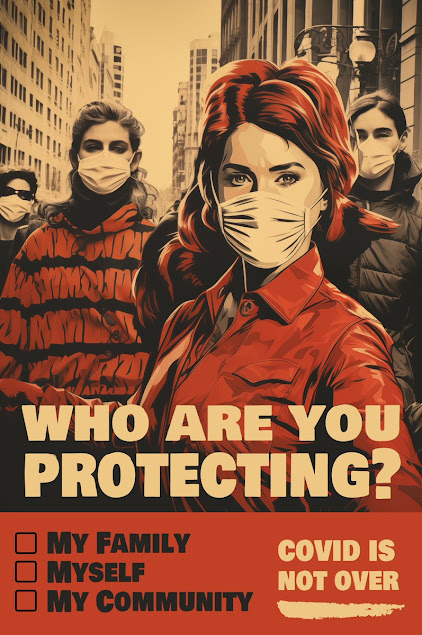
It takes a really long time to convince governments to impose safety measures that, in some way, affect people's freedom to do their own thing. It's not necessarily a bad thing on its own. to be careful about legislation, but it's very frustrating to be living during the activism phase watching so many children get sick. We've got children dying of Covid already. And lots of celebrities. But there's a huge coverup or spin or denial that has people claiming that, for instance, a fatal heart-attack at 13, 17, 27, and 44, all within a day of each other, is totally normal now. When my healthy friend succumbed to a heart attack in his early 60s, people were so fast to say that people die of heart attacks in their 60s all the time!! Instead of, you know, sorry for your loss. It's all ABC: Anything but Covid.


