I’m curious about the intersection of psychology, philosophy, and spirituality, and the more I read, the more closely they all appear to intertwine until they’re sometimes indistinguishable.
Buddhism overlaps with Stoicism, which influenced Albert Ellis’s REBT (then CBT and all its variations). They dig down to acknowledge and question mistaken core beliefs. Plato inspired some of Freud’s work, which mixed with Sartre and Camus to become the existential psychotherapy of Irvin Yalom and Otto Rank. They have a focus on the acceptance of death, which comes back around to the Buddhist prescription to meditate on our bones turning to dust. Yet, despite a general theme being repeated, it’s striking how hard it is to get out from the minutia of daily life to attend to it.
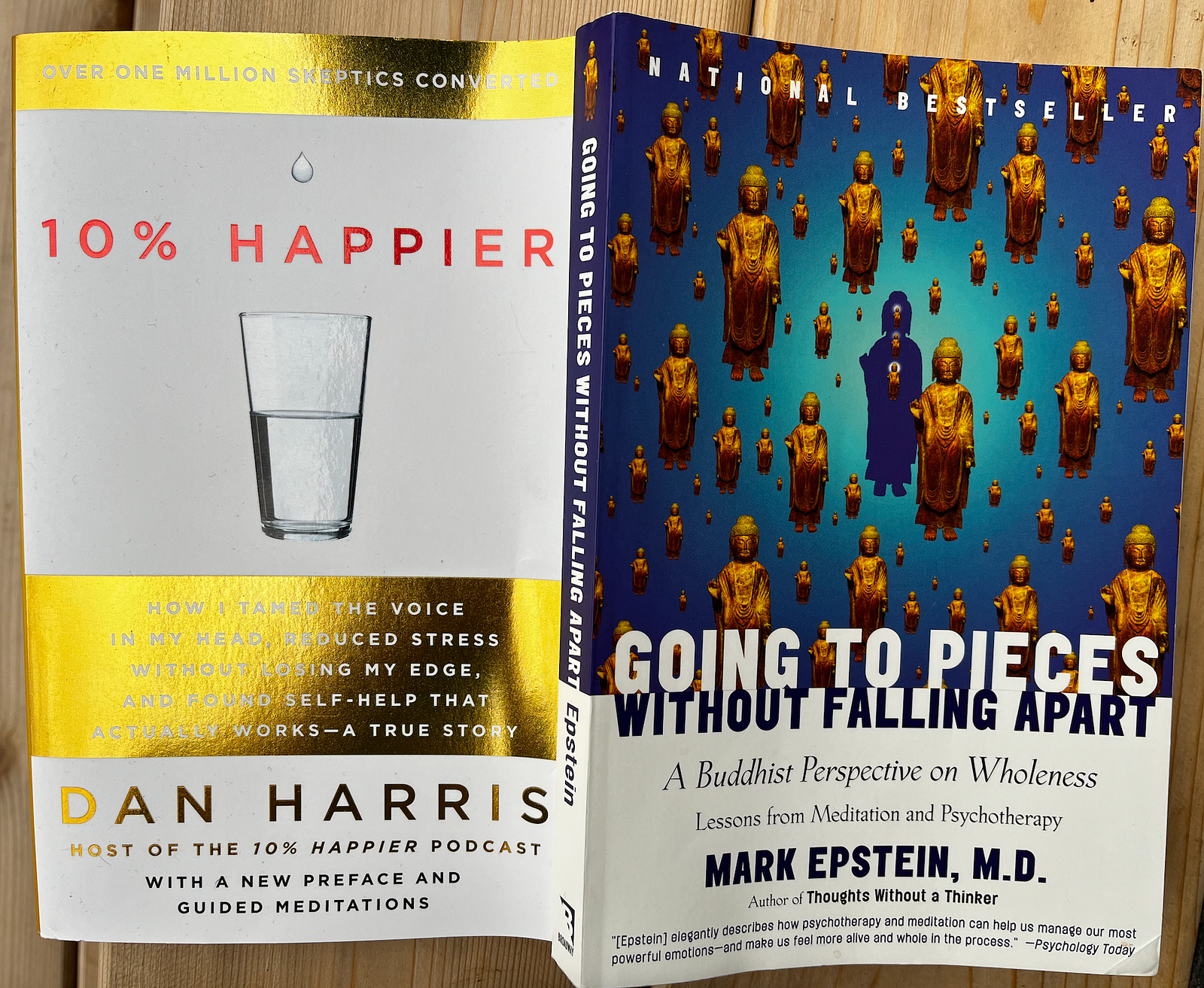
This mix can be found on Dan Harris’ channel, 10% Happier, which I stumbled on when he had comedian Bill Hader as a guest. Harris was a journalist who had a panic attack on air, then turned to meditation for help. I dove into his 2014 book, in which he chronicles his skeptical and very gradual buy-in to the whole idea in a very relatable way. He debunks a few well-known gurus over the course of the book, and then he ends up guided by a few contemporary Jewish Buddhists, including psychiatrist Dr. Mark Epstein (an unfortunate last name in these times). I went back to re-read his 1998 book, Going to Pieces without Falling Apart to flush out some concepts.
ACCEPTING CHANGE
”No man ever steps in the same river twice, for it’s not the same river and he’s not the same man.” ~ Heraclitus
These are both books that hope to show us a way to calm our mind enough to be able to think more clearly. Epstein calls the Buddha the original psychoanalyst who teaches us to take a step back from our monkey mind, or the “imperialistic tendency of mind” (prapañca) that can get us spiralling from one tiny error at work towards a vision of living in a cardboard box. We overthink all the time, but it’s possible not to do that. We don’t have to let the spiralling continue. Harris has a metaphor I like of our overwhelming thoughts and feelings bombarding us like a waterfall: we can take a step back to stand safely behind the waterfall to watch it all go by. Harris and Epstein agree that we need to practice this strategy of stepping back through meditation.